
Business owners in Hermosa Beach often face confusion when navigating corporate and commercial law requirements. These two legal areas serve different purposes but frequently overlap in daily business operations.
At Pierview Law, we help local businesses understand when each type of legal guidance applies. This guide breaks down the key differences between corporate and commercial law to help you make informed decisions for your Hermosa Beach business.
What Makes Corporate Law Essential for Hermosa Beach Businesses
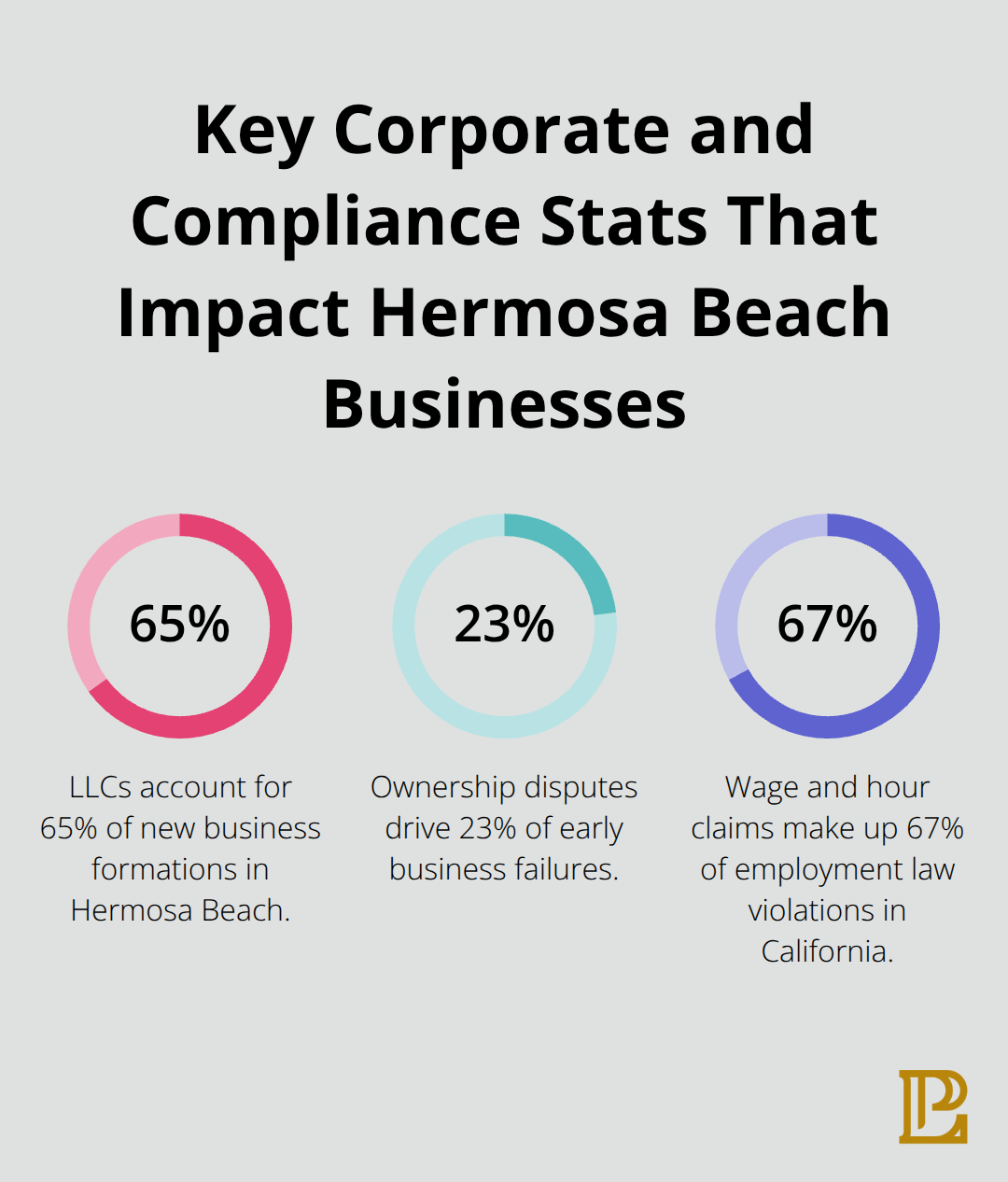
Corporate law governs how businesses structure themselves and operate internally. In Hermosa Beach, LLCs represent 65% of new business formations according to California Secretary of State data, which makes entity selection your most important initial decision. The choice between LLC, corporation, or partnership affects everything from personal liability protection to tax obligations.
S Corporations work best for businesses that plan rapid growth, as they allow up to 100 shareholders while they avoid double taxation. However, California courts require precise documentation for all business structures, and the California Secretary of State automatically suspends business privileges when companies miss filing deadlines.
Formation Requirements That Actually Matter
Hermosa Beach businesses must navigate over 40 regulatory agencies in California (each with different compliance requirements). Partnership agreements need specific dissolution procedures and deadlock resolution provisions since 23% of business failures stem from ownership disputes within the first three years. Employment contracts cannot contain non-compete clauses under California law, but comprehensive non-disclosure agreements protect trade secrets from employees who depart and cost California businesses $59 billion annually through intellectual property theft.
Governance Standards You Cannot Ignore
Corporate governance extends beyond basic formation documents. California Private Attorneys General Act allows employees to sue on behalf of the state, which turns individual violations into class-action lawsuits. Employment law violations cost California businesses $2.8 billion annually (with wage and hour claims that represent 67% of all violations). Businesses that misclassify employees as independent contractors face penalties that average $15,000 per worker, which makes proper classification procedures mandatory rather than optional.
Daily Operations and Compliance Challenges
Corporate law requirements affect daily business operations in ways many Hermosa Beach business owners don’t anticipate. The California Coastal Commission often requires specific environmental impact studies for commercial properties, which adds complexity to expansion plans. Beach Cities Health District enforces food service regulations that surpass state standards, which requires specific compliance from food-related businesses. These overlapping jurisdictions create compliance challenges that differ significantly from the transactional focus of commercial law.
How Commercial Law Affects Your Daily Business Operations
Commercial law governs the transactional side of business operations in Hermosa Beach and focuses on how companies interact with customers, vendors, and competitors. Contract drafts represent the foundation of commercial law practice, where California courts demand precise language that protects business interests. California Senate Bill 1103 requires specific tenant protection clauses in commercial leases, which means landlords and tenants must include qualified tenant provisions to avoid litigation. Sales transactions under the Uniform Commercial Code create obligations once goods are delivered, but California variations from the UCC require local legal knowledge to prevent disputes.
Contract Terms That Protect Your Business
The California Business and Professions Code defines unfair business practices broadly and covers deceptive advertisements, misrepresentation during negotiations, and contracts with unfair terms. Courts examine contract language carefully and hold businesses accountable for vague or misleading provisions. Trade secret misappropriation by former employees costs California businesses $59 billion annually, which makes comprehensive non-disclosure agreements mandatory for all employee contracts.
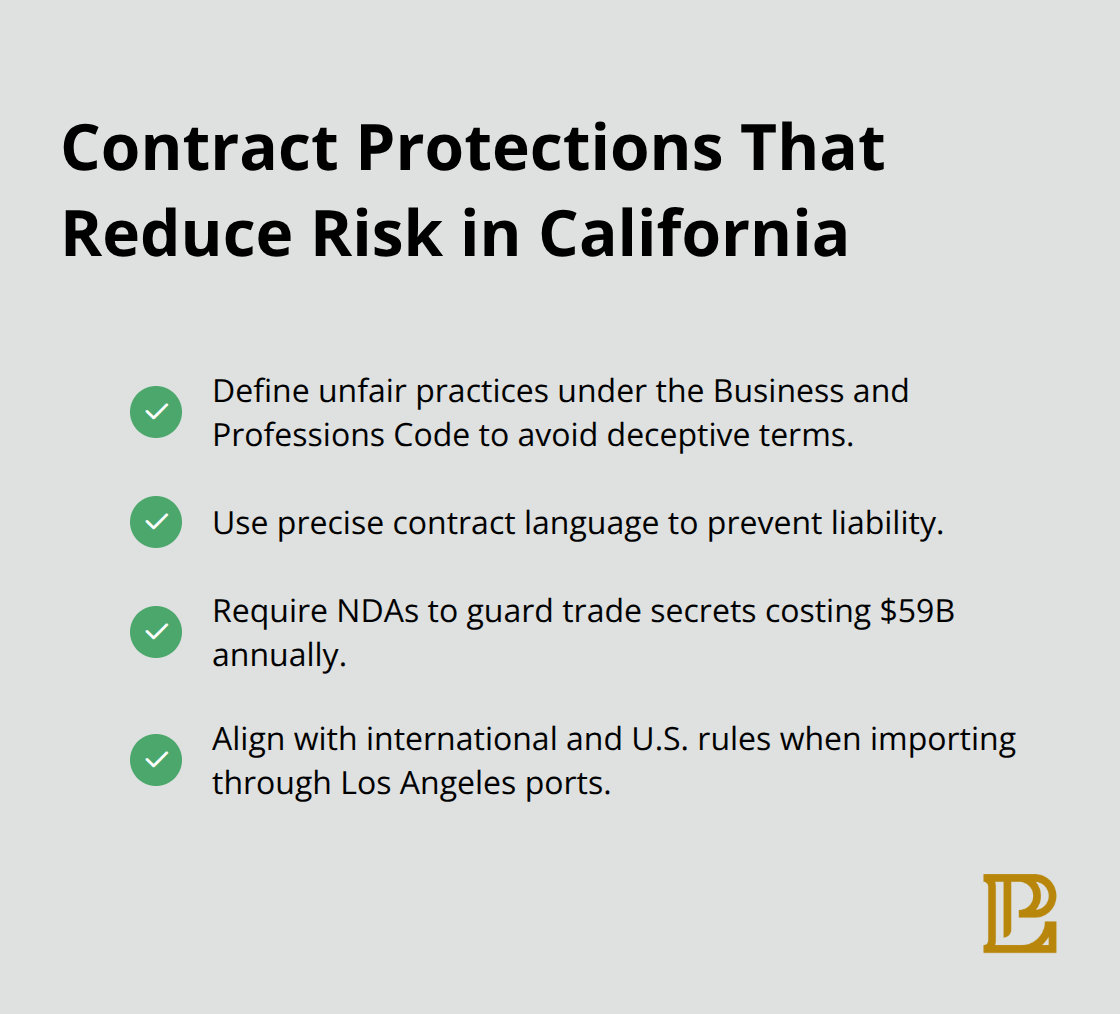
International trade matters require compliance with both domestic and international regulations (particularly for Hermosa Beach businesses that import goods through Los Angeles ports).
Dispute Resolution That Saves Money
Commercial disputes arise when contracts lack clear terms or when parties misunderstand their obligations. Wage and hour violations represent 67% of all employment law violations in California, with businesses that pay $2.8 billion annually in penalties. The California Private Attorneys General Act allows individual employee complaints to escalate into class-action lawsuits and turns minor violations into major financial liabilities. Businesses that address contract disputes early through mediation save an average of 60% compared to full litigation costs.
Compliance Requirements Beyond Basic Operations
Commercial law compliance extends far beyond contract management into operational requirements that affect daily business activities. The California Coastal Commission requires environmental impact studies for many commercial properties (which adds months to expansion timelines). Beach Cities Health District enforces food service regulations that exceed state standards and requires additional permits for restaurants and food vendors. E-commerce businesses must comply with California’s consumer protection laws, which impose stricter disclosure requirements than federal standards.
These operational complexities highlight the fundamental differences between commercial law’s transactional focus and corporate and commercial law‘s structural requirements.
What Separates Corporate Law From Commercial Law Practice
Corporate law attorneys focus on business structure, governance, and internal operations while commercial law attorneys handle transactions, contracts, and external business relationships. Corporate lawyers spend 70% of their time on entity formation, compliance filings, and governance issues according to California State Bar practice surveys. Commercial lawyers dedicate most hours to contract drafts, dispute resolution, and regulatory compliance for business operations.
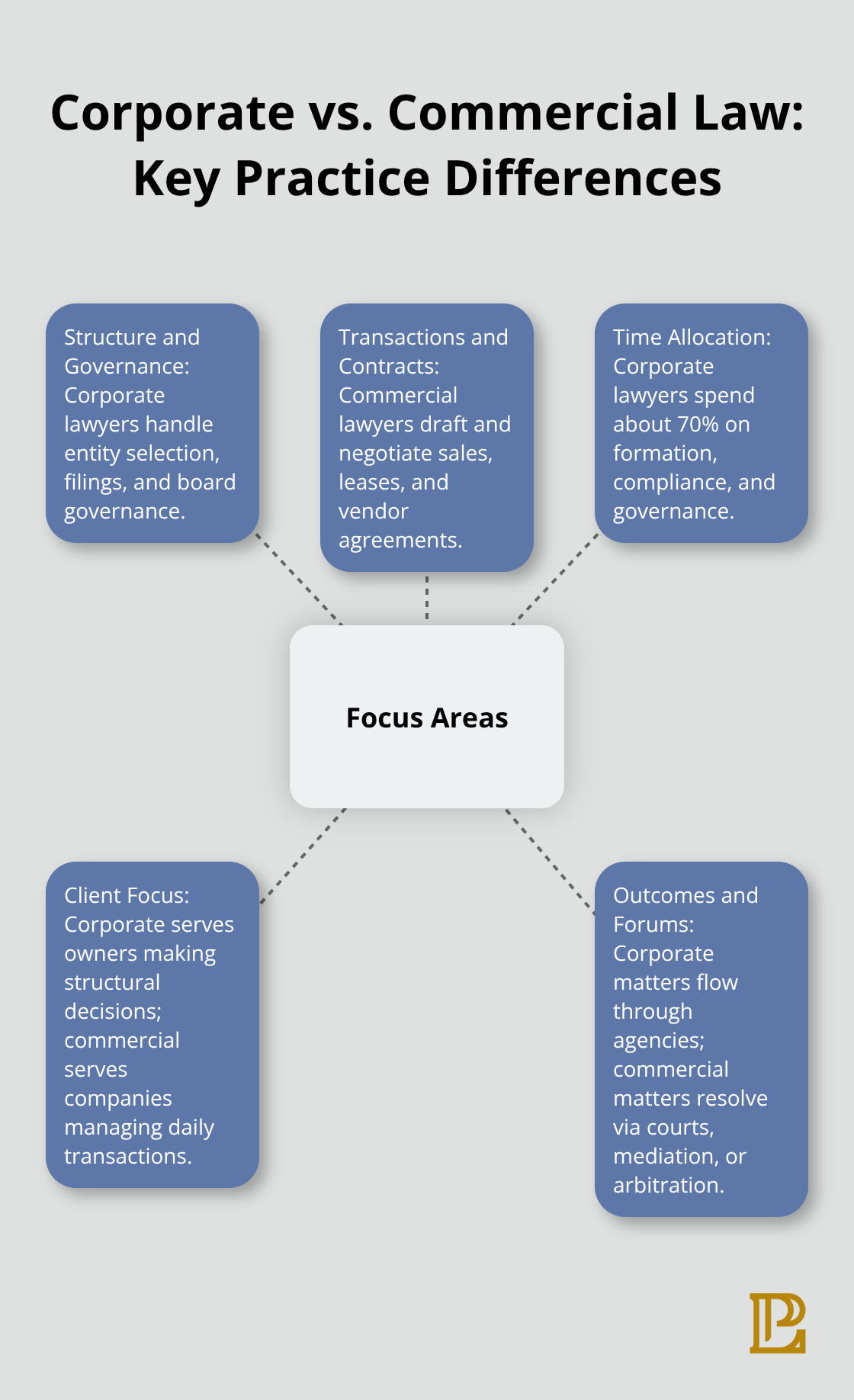
The client base differs significantly: corporate law serves business owners who make structural decisions, while commercial law assists companies that manage daily transactional activities with customers, vendors, and competitors.
Legal Procedures Follow Different Paths
Corporate law matters typically proceed through California Secretary of State filings, regulatory agency submissions, and administrative processes that rarely require courtroom appearances. Commercial law disputes often end up in California Superior Court or federal district courts (with 89% of commercial cases that settle before trial according to Judicial Council of California statistics). Corporate attorneys file articles of incorporation, draft bylaws, and handle merger documentation through administrative channels. Commercial attorneys prepare breach of contract complaints, negotiate settlement agreements, and represent clients in mediation or arbitration proceedings.
Court Systems Handle Cases Differently
Court procedures differ dramatically between these practice areas. Corporate compliance violations result in administrative penalties and suspension of business privileges, while commercial disputes lead to monetary damages, injunctive relief, and attorney fee awards. Corporate attorneys work primarily with regulatory agencies and administrative bodies that oversee business formation and compliance. Commercial attorneys navigate trial courts, arbitration panels, and mediation services that resolve transactional disputes between business parties.
Client Needs Determine Legal Strategy
Businesses that seek corporate legal help need structural guidance for entity selection, ownership agreements, and governance frameworks that protect personal assets and minimize tax obligations. Commercial law clients require contract protection, dispute resolution, and transactional support for sales, leases, and vendor relationships. Corporate law prevents problems through proper documentation and compliance systems, while commercial law solves existing disputes and manages business relationships. The timing differs: corporate legal work happens during business formation and major structural changes (while commercial legal needs arise continuously during normal business operations).
Final Thoughts
Hermosa Beach business owners need corporate legal help when they form entities, draft governance documents, or handle mergers and acquisitions. Commercial legal assistance becomes necessary for contract disputes, sales transactions, and regulatory compliance issues that arise during daily operations. The timing matters: corporate law work happens during business formation and structural changes, while commercial law needs emerge continuously through normal business activities.
We at Pierview Law handle both corporate and commercial law matters for Hermosa Beach businesses. Our attorneys cover entity formation and contract preparation, while our civil litigation team manages disputes through trial or alternative resolution forums. We provide legal solutions for individual and corporate clients throughout Los Angeles County (with personalized attention to each case).
Business owners should contact Pierview Law when they need guidance on entity selection, partnership agreements, or commercial contract protection. Our approach helps local businesses navigate California’s complex regulatory environment while we protect their interests in both corporate structure decisions and commercial transactions. We understand how corporate and commercial law intersect in daily business operations.