
Corporate law offers some of the highest-paying and most intellectually challenging opportunities in the legal profession. The median salary for corporate attorneys reaches $165,000 annually, with top-tier firms paying first-year associates over $215,000.
Building a career in corporate law requires strategic planning and deliberate skill development. At Pierview Law, we understand the competitive landscape that aspiring corporate attorneys face in today’s market.
What Academic Foundation Do You Need for Corporate Law?
Your law school choice directly impacts your corporate law prospects. Target schools ranked in the top 50 by U.S. News, as these institutions maintain strong relationships with major corporate law firms. Yale, Harvard, and Stanford lead placement rates at elite firms, but schools like Georgetown, Northwestern, and UCLA also provide solid pathways into corporate practice.
Maintain a GPA above 3.5 to qualify for competitive summer associate programs. Law Review membership opens doors that grades alone cannot – 68% of BigLaw associates held editorial positions on their school’s primary journal. These positions demonstrate your ability to analyze complex legal issues and meet demanding deadlines.
Corporate Law Coursework Strategy
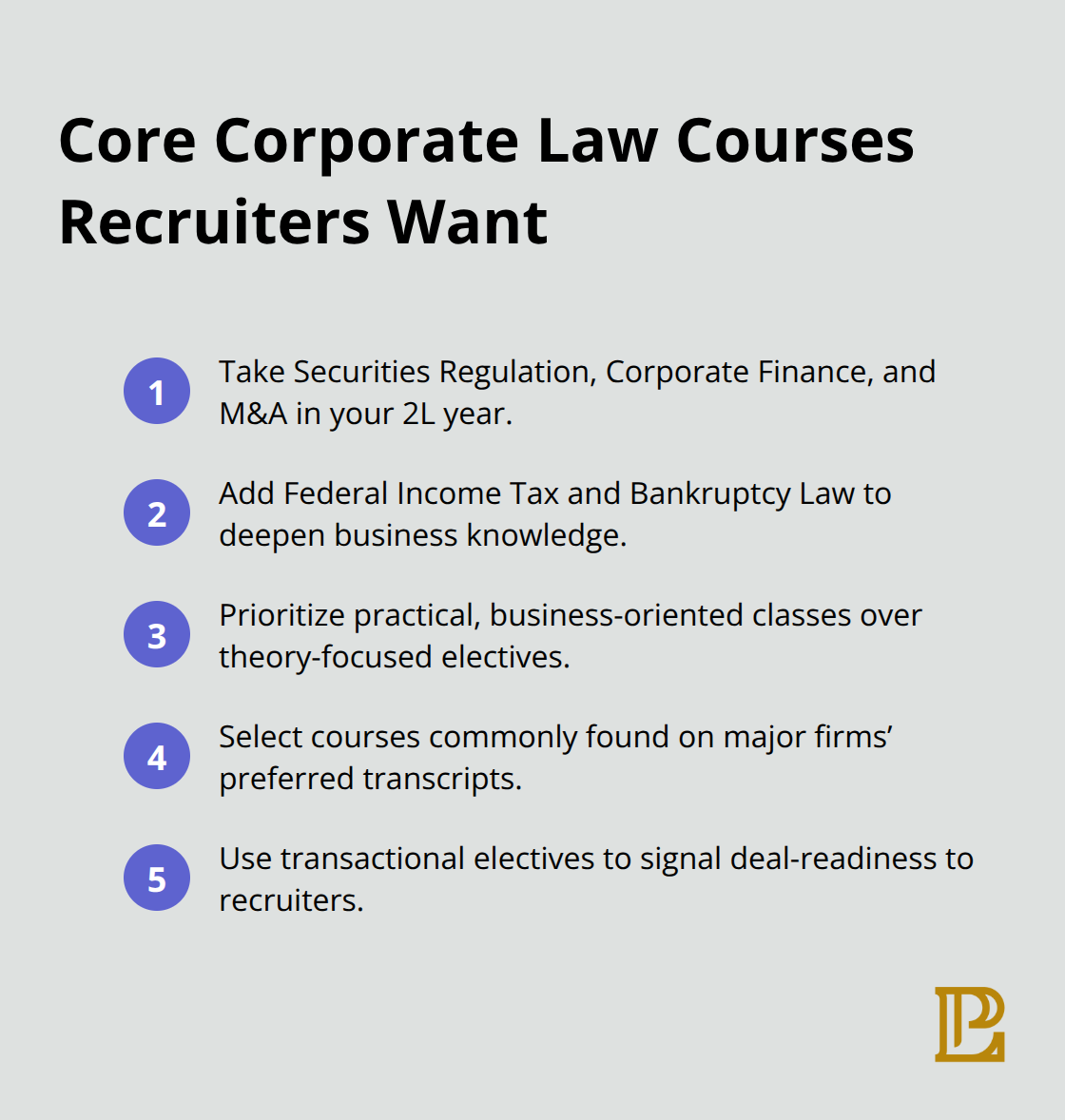
Take Securities Regulation, Corporate Finance, and Mergers & Acquisitions during your second year. These courses appear on every major firm’s preferred transcript. Add Federal Income Tax and Bankruptcy Law to build comprehensive business knowledge. Corporate recruiters value practical business-oriented classes over theoretical constitutional law courses.
Participate in transactional law clinics where available, as hands-on deal experience sets you apart from litigation-focused peers. These programs let you work on real transactions under faculty supervision (often involving actual corporate clients).
Bar Exam and State Licensing Requirements
Pass your state bar exam on the first attempt – corporate firms rarely wait for second-time test takers. California’s bar exam has a 25% first-time pass rate among all candidates, which makes preparation intensive and demanding.
Dedicate 400-500 hours to bar prep through programs like Barbri or Themis. Schedule your exam for the February administration if you graduate in December (this gives you extra preparation time). Corporate law firms begin recruitment in August, so July bar results create perfect timing for fall hiring cycles.
Academic Performance Benchmarks
Law firms track specific performance indicators beyond grades. Moot court participation demonstrates advocacy skills that translate to client presentations. Corporate law competitions like the National Transactional LawMeet provide direct exposure to deal structures and negotiation tactics.
Summer research positions with business law professors can lead to publication opportunities. These credentials show your commitment to corporate law before you even graduate, which helps distinguish your application from hundreds of other candidates seeking the same positions.
How Do You Gain Corporate Law Experience
Summer associate positions at major firms provide the clearest path into corporate law, but only 15% of applicants receive offers at top-tier firms. Apply to 20-30 firms during your 1L year and target both BigLaw and mid-size practices. Cravath, Sullivan & Cromwell, and Skadden lead compensation at $3,900 weekly for summer associates, while regional firms like Gibson Dunn offer comparable training with less competition.
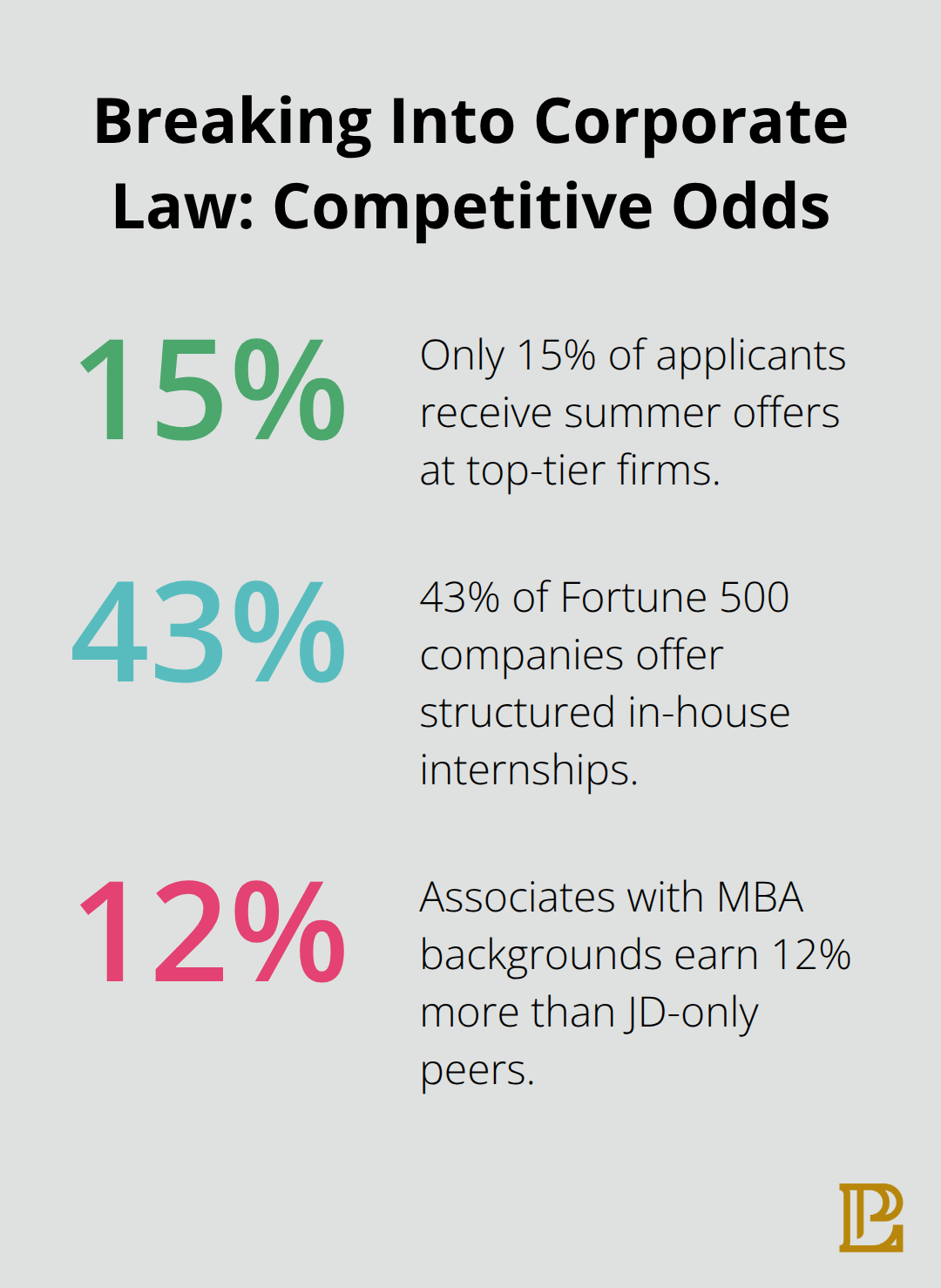
In-house legal departments increasingly hire law students for internships, with 43% of Fortune 500 companies now offering structured programs. Technology companies like Google and Microsoft provide the strongest business training, while financial institutions offer traditional corporate law exposure. These positions teach you how legal decisions impact business operations (knowledge that law firm associates often lack).
Build Business Knowledge Beyond Law School
Read the Wall Street Journal and Financial Times daily to understand market dynamics that drive corporate transactions. Subscribe to industry publications like The Deal and Mergers & Acquisitions Magazine to track current deal activity. Corporate lawyers who understand business fundamentals command higher salaries – associates with MBA backgrounds earn 12% more than their JD-only peers according to NALP data.
Take accounting and finance courses at your university’s business school during summers. Corporate law involves complex financial structures that require mathematical literacy beyond basic legal training. Understanding balance sheets, cash flow statements, and valuation methods makes you immediately more valuable to corporate clients who assume their lawyers grasp these concepts.
Strategic Professional Networking Approaches
Join the American Bar Association’s Business Law Section while still in law school – student membership costs $25 annually and provides access to substantive programming. Attend monthly CLE events where practicing attorneys discuss current deals and regulatory changes. These sessions offer direct contact with potential mentors and employers who remember engaged students.
Target alumni working at your preferred firms through LinkedIn and law school directories. Request 15-minute informational interviews rather than ask for jobs directly. Corporate attorneys receive fewer cold outreach attempts than litigators (making your approach more likely to succeed). Schedule these conversations during slow periods like January and August when deal activity typically decreases.
These foundational experiences prepare you to evaluate different career paths within corporate law, each offering distinct advantages and challenges.
Which Corporate Law Path Fits Your Goals
Law firm positions offer higher starting salaries but demand 80-hour work weeks and constant client availability. BigLaw firms like Cravath and Simpson Thacher pay first-year associates $215,000 plus bonuses that reach $100,000, but associate turnover hits 85% within five years according to American Lawyer data. Mid-size firms provide better work-life balance at $180,000 starting salaries while they maintain sophisticated deal work. Boutique corporate practices focus on niche areas like healthcare M&A or technology transactions and offer partnership tracks unavailable at mega-firms (where only 3% of associates make partner).

In-House Counsel Advantages
Corporate legal departments hire attorneys with 3-7 years of law firm experience and offer $200,000-$300,000 salaries with stock options and comprehensive benefits. Technology companies lead compensation with Google that pays senior corporate counsel $400,000 annually with equity included. In-house roles provide single-client focus and predictable schedules, but they limit exposure to diverse deal structures. Financial services companies like JPMorgan Chase and Goldman Sachs offer the most traditional corporate law preparation for in-house positions.
High-Demand Practice Areas
Securities law creates the highest rates at $800-$1,200 per hour for partners, which regulatory compliance needs and IPO activity drive. M&A work provides consistent deal flow with healthcare and technology sectors that lead transaction volume in 2024. ESG compliance creates new opportunities as 73% of Fortune 500 companies now require dedicated environmental and governance counsel according to Harvard Law School research.
Market Geography and Practice Focus
Data privacy law commands premium rates after GDPR implementation, with California’s CCPA that creates additional demand. Geographic markets matter significantly – New York leads M&A work, California dominates technology transactions, and Texas focuses on energy deals. Choose your location based on preferred practice areas rather than lifestyle preferences, as corporate law success requires proximity to major business centers where deals happen and clients operate their businesses.
Final Thoughts
Your career in corporate law begins with strategic academic choices and accelerates through targeted experience. Focus on top-tier law schools, maintain strong grades, and pursue business-oriented coursework. Summer associate programs and in-house internships provide the practical foundation that separates successful candidates from their peers.
Long-term success requires continuous adaptation to market demands. Securities law, M&A work, and ESG compliance represent the highest-growth areas through 2025. Geographic position matters – align your location with practice strengths rather than personal preferences (New York drives M&A activity while California leads technology transactions).
Professional development never stops in corporate law. Join the American Bar Association’s Business Law Section, attend CLE programs regularly, and maintain relationships with law school alumni. At Pierview Law, we support both individual and corporate clients with entity formation, contract drafts, and comprehensive business solutions across Los Angeles County.