
Licensing intellectual property is one of the smartest ways to generate revenue from what you’ve already created. Whether you own patents, trademarks, or proprietary processes, getting this right means the difference between a profitable deal and a costly mistake.
At Pierview Law, we’ve helped Hermosa Beach business owners navigate IP licensing agreements that protect their interests while opening new income streams. This guide walks you through the entire process, from understanding the basics to closing a deal you can actually live with.
What Can You Actually License and How Do You Structure It
Patents, trademarks, copyrights, and trade secrets form the foundation of IP licensing, but not all of them work the same way in a licensing agreement. Patents cover inventions-devices, software, manufacturing processes, business methods-and require USPTO registration before you can license them effectively. Trademarks protect brand names, logos, and symbols; they’re ideal for merchandising and brand extension deals because they’re typically easier to license than patents. Copyrights apply automatically upon creation for creative works like software code, written content, music, and photography, making them straightforward to license without registration, though registration strengthens your position if disputes arise. Trade secrets-your proprietary processes, customer lists, or formulas-can be licensed too, but they demand ironclad confidentiality agreements and controlled access. Patents and trademarks dominate licensing deals because they’re registrable, enforceable, and generate predictable revenue streams. If you own a combination of these assets, prioritize licensing the registered ones first; they command higher royalty rates and attract serious licensees.
Exclusivity Changes Everything
The choice between exclusive and non-exclusive licensing fundamentally changes your revenue potential and the licensee’s willingness to invest. An exclusive license means only one licensee can use your IP in a defined territory or market segment-this justifies higher upfront fees and royalty rates because the licensee invests heavily in development and marketing knowing competitors can’t access the same IP. Non-exclusive licenses let you license the same IP to multiple parties, spreading risk but reducing per-licensee payments. Most Hermosa Beach business owners start with non-exclusive licenses because they’re faster to negotiate and generate immediate cash flow, then move toward exclusive arrangements as they understand market demand.
Payment Structures That Align Your Interests
Payment structures matter enormously: lump-sum payments give you immediate capital but leave money on the table if the product succeeds; running royalties (typically 2-8% of net sales, depending on the industry) align your interests with the licensee’s success and generate ongoing income. The International Association for the Management of Intellectual Property reports that 85% of audited licensees underreport royalties, meaning you’ll need audit rights built into your agreement. Milestone payments-cash tied to specific achievements like first commercial sale or reaching a revenue threshold-balance both approaches and reduce your risk if the licensee fails to commercialize the IP. The strongest agreements combine a reasonable upfront fee with running royalties and clear audit rights.
Scope, Territory, and Field-of-Use Restrictions
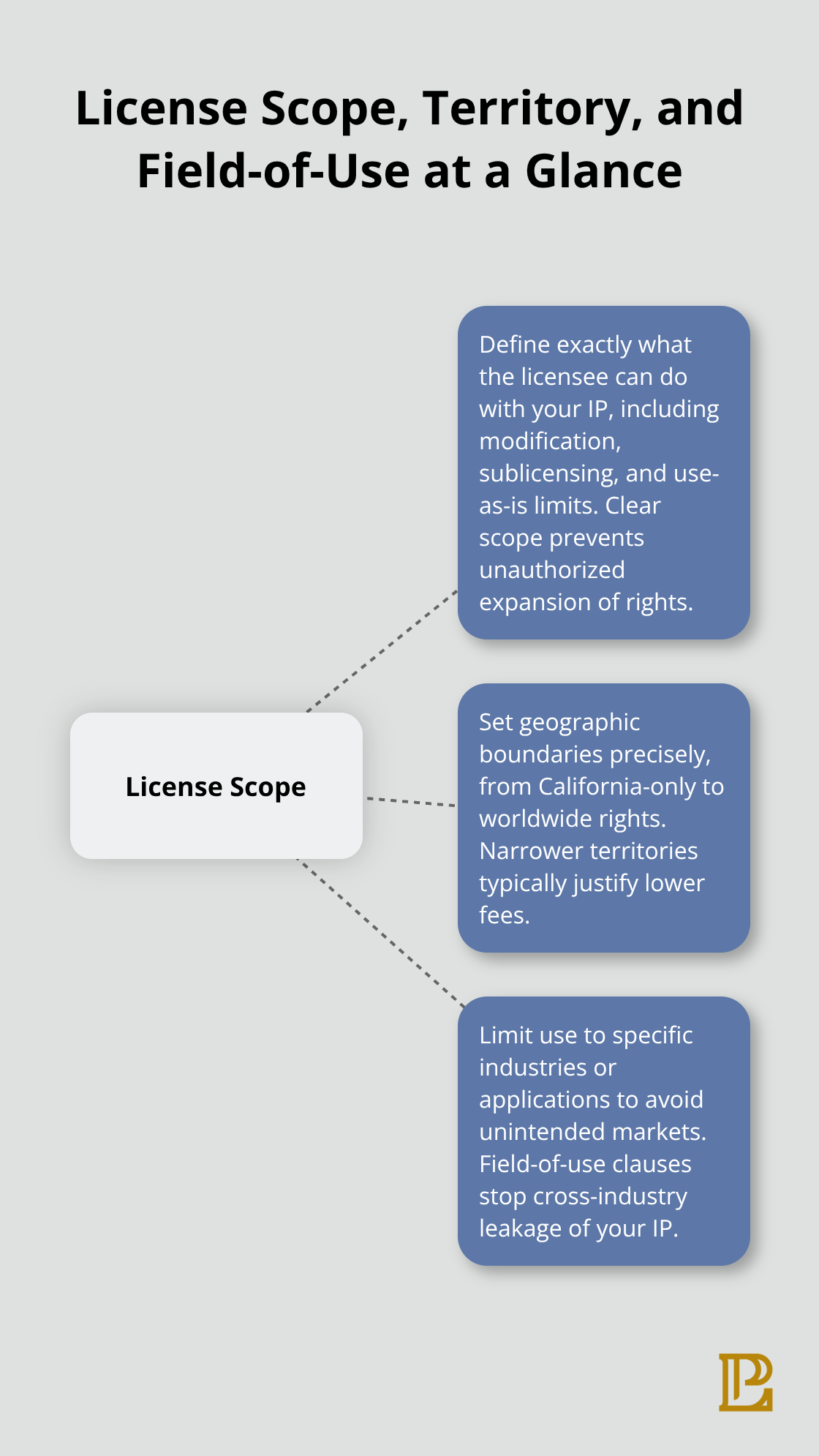
Every licensing agreement must define scope, territory, and termination conditions with surgical precision or disputes will haunt you for years. Scope means specifying exactly what the licensee can do with your IP-can they modify it, sublicense it to others, or only use it as-is? Territory determines geographic boundaries; a California-only license costs less to grant than worldwide rights. Field-of-use restrictions limit the licensee to specific industries or applications; this prevents a software patent licensed for healthcare from being used in financial services.
Termination, Quality Control, and Liability Protection
Termination provisions should address what happens if the licensee breaches the agreement, stops paying royalties, or simply wants out; most agreements include 30-90 day termination rights for cause and automatic expiration after a set period. Quality control clauses protect your brand by giving you approval rights over how the licensee uses your IP-critical for trademark licenses especially. Indemnification language allocates liability if the licensed IP infringes someone else’s rights; you typically indemnify the licensee for IP infringement claims related to your IP, while the licensee indemnifies you for how they use it. Confidentiality agreements protect trade secrets and sensitive business information shared during licensing discussions. Without these terms clearly written, you’ll spend thousands in legal fees resolving disputes that a well-drafted agreement would have prevented. Getting these details right upfront sets the stage for the negotiation process itself-where you’ll translate these structural choices into actual deal terms.
Preparing Your IP for Licensing
Before you license anything, you need to know exactly what you own, what it’s worth, and whether it’s actually protectable. Most Hermosa Beach business owners skip this step and jump straight to licensing negotiations-then discover mid-deal that they lack clean ownership, that their IP overlaps with someone else’s rights, or that they never registered the patents or trademarks they thought protected their assets. An IP audit forces you to confront these problems before they cost you money.
Inventory Your Assets and Confirm Ownership
Start by listing every asset you’ve created: patents filed with the USPTO, registered trademarks, copyrights (automatic upon creation but often unregistered), trade secrets, and proprietary processes. For each item, document the creation date, who created it, whether your company owns it in writing, and its current registration status. If employees or contractors built the IP, pull their employment agreements and work-for-hire contracts to confirm your company actually owns the rights-many business owners discover they don’t own what they thought they did. This inventory becomes your baseline for valuation and licensing strategy.
Assess Your IP’s Real Market Value
Valuation requires honest assessment: a patent covering broad, commercially viable technology commands higher royalty rates than a narrow design patent. The International Trademark Association recommends benchmarking your IP against comparable licenses in your industry to set realistic royalty expectations; if you’re licensing software, look at what similar software patents generate (typically 2-5% of net sales), and adjust based on exclusivity and market demand. Provisional patents, unregistered copyrights, and abandoned trademark applications have minimal licensing value-they signal weakness to potential licensees and limit your negotiating power.
Register Your IP Before Licensing Discussions Begin
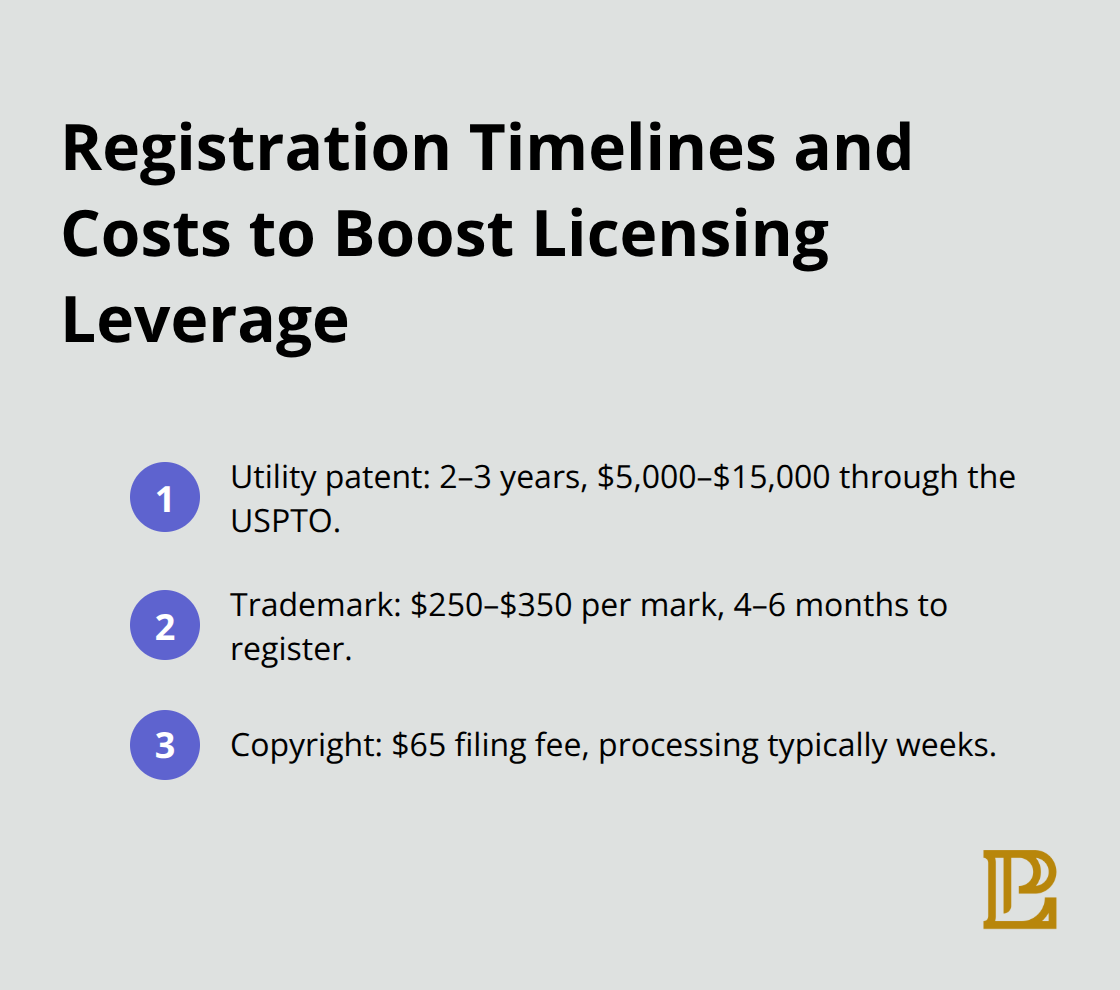
If you haven’t registered your key IP assets, do it now before licensing conversations start. USPTO patent prosecution takes 2-3 years and costs $5,000-$15,000 for a basic utility patent, but that investment pays dividends through higher royalty rates and stronger enforcement rights. Trademark registration costs $250-$350 per mark through the USPTO and takes 4-6 months; copyright registration costs $65 and takes weeks.
These registrations aren’t optional-they’re the foundation of credible licensing.
Protect Trade Secrets and Control Information Flow
Once registered, protect your trade secrets with confidentiality agreements, restricted access, and clear labeling of proprietary information. When a potential licensee wants to explore your IP during due diligence, require a non-disclosure agreement before sharing technical details or financial projections. This prevents them from stealing your ideas or using your information to develop competing technology independently. With your IP audit complete, ownership confirmed, and registrations filed, you’re ready to move into the negotiation phase-where you’ll translate these structural choices into actual deal terms that protect your interests and generate real revenue.
Negotiating and Structuring License Agreements
Set Royalty Rates Based on Industry Standards
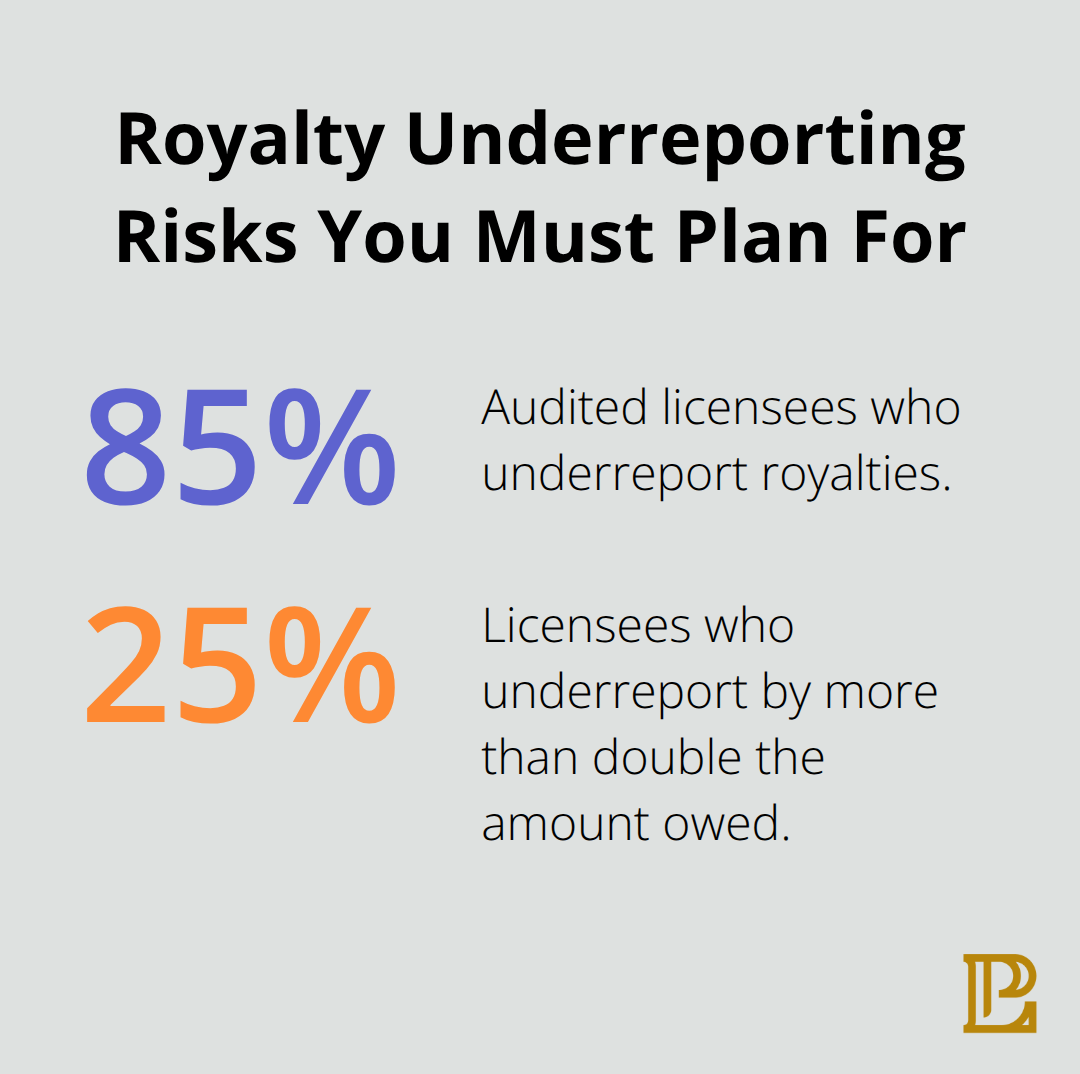
Royalty rates must reflect what licensees actually pay in your industry, not what you hope to collect. The International Association for the Management of Intellectual Property reports that 85% of audited licensees underreport royalties, with 25% underreporting by more than double the actual amount owed. This pattern reveals a systematic problem: licensees treat royalty obligations as negotiable after signing.
Start with 3-5% of net sales for non-exclusive licenses in most industries, then increase the rate for exclusive arrangements or patents covering broad, commercially proven technology. Software patents typically command 2-5%, while trademark licenses for merchandising can reach 5-10% depending on brand strength. Never accept vague language like “percentage of gross revenue”-specify net sales, define what deductions the licensee can claim, and require quarterly reporting within 30 days of quarter-end.
Combine running royalties with an upfront fee (typically 10-20% of your first-year royalty projection) and milestone payments tied to commercialization events like first sale or reaching a revenue threshold. This three-tier structure protects you if the licensee abandons the product while rewarding them for actual success. Milestone payments prevent licensees from sitting on your IP without generating revenue; if they miss agreed milestones, you can renegotiate or terminate the license.
Build Audit Rights and Termination Triggers Into Every Agreement
Audit rights determine whether you can verify what the licensee actually owes you. Include language allowing you to inspect their books and records at least annually, with the licensee covering audit costs if they underreport by more than 5%. Many licensees resist audit clauses, but they’re non-negotiable-without them, you rely entirely on self-reporting from a party with financial incentive to minimize payments.
Termination for cause should activate if they miss royalty payments by 30 days, fail to maintain quality standards, or breach confidentiality agreements, with immediate effect rather than notice periods that allow continued operation. For exclusive licenses, add termination rights if they fail to commercialize within 18-24 months or if sales drop below agreed minimums for two consecutive quarters. Non-exclusive licenses should include automatic expiration after 5-7 years unless both parties agree to renew, forcing periodic renegotiation as technology and markets shift.
Protect Your Brand and Reputation Through Quality Control
Quality control clauses protect your reputation by requiring licensee approval for packaging, marketing materials, and product modifications-especially critical for trademark licenses where poor quality damages your brand. Specify your approval timeline (typically 10-15 business days) and what happens if they proceed without approval (automatic breach, immediate termination rights). This prevents a licensee from manufacturing inferior products under your brand name or misrepresenting your IP in ways that harm your market position.
Allocate Liability and Require Insurance Protection
Indemnification language allocates liability between you and the licensee. You typically indemnify them against claims that your IP infringes someone else’s rights, while they indemnify you against claims arising from how they use the IP or their own conduct. Include insurance requirements-typically $1-2 million in general liability-with your company named as additional insured. This protects you financially if their use of your IP creates liability exposure.
Confidentiality agreements restrict their use of your trade secrets and technical information to the licensed purpose only, surviving termination for 3-5 years. These provisions sound legalistic, but they’re your only recourse when a licensee ignores royalty obligations, manufactures inferior products, or steals your proprietary information. Without clear enforcement mechanisms and liability protections, you’ll discover too late that your licensing agreement lacks teeth.
Final Thoughts
Licensing intellectual property successfully requires three non-negotiable steps: conducting a thorough IP audit to confirm ownership and registration status, setting royalty rates grounded in industry benchmarks rather than wishful thinking, and drafting agreements with teeth-audit rights, termination triggers, quality control provisions, and clear liability allocation. Skip any of these and you’ll either leave money on the table or discover mid-deal that you lack clean ownership or enforceable rights. The most common pitfall is underestimating the importance of audit clauses, since 85% of audited licensees underreport royalties, which means your agreement must include explicit inspection rights and consequences for underreporting.
Another frequent mistake involves vague payment language-“percentage of revenue” without defining net sales or allowable deductions invites disputes that consume time and legal fees. Many Hermosa Beach business owners also fail to register their IP before licensing discussions begin, which weakens their negotiating position and reduces royalty rates significantly. Exclusive licenses demand higher upfront investment in quality control and enforcement because you’re betting your revenue on a single licensee’s success, while non-exclusive arrangements require different risk management focused on monitoring multiple parties.
Termination provisions that lack teeth-allowing licensees to continue operating after breaching payment obligations-turn your licensing agreement into an unenforceable wish list. If you own patents, trademarks, or proprietary processes worth licensing, contact a business attorney who understands licensing mechanics and can review your IP portfolio. We at Pierview Law help Hermosa Beach business owners structure licensing agreements that generate real revenue while protecting their interests through every stage of the relationship.