
Valuing commercial real estate properties requires more than a gut feeling or a quick market glance. The difference between an accurate valuation and a flawed one can cost you thousands of dollars in a transaction or investment decision.
We at Pierview Law work with business owners and real estate investors in Hermosa Beach who need reliable property valuations. This guide walks you through three proven methods that professionals use to determine what a commercial property is actually worth.
Income Approach to Valuation
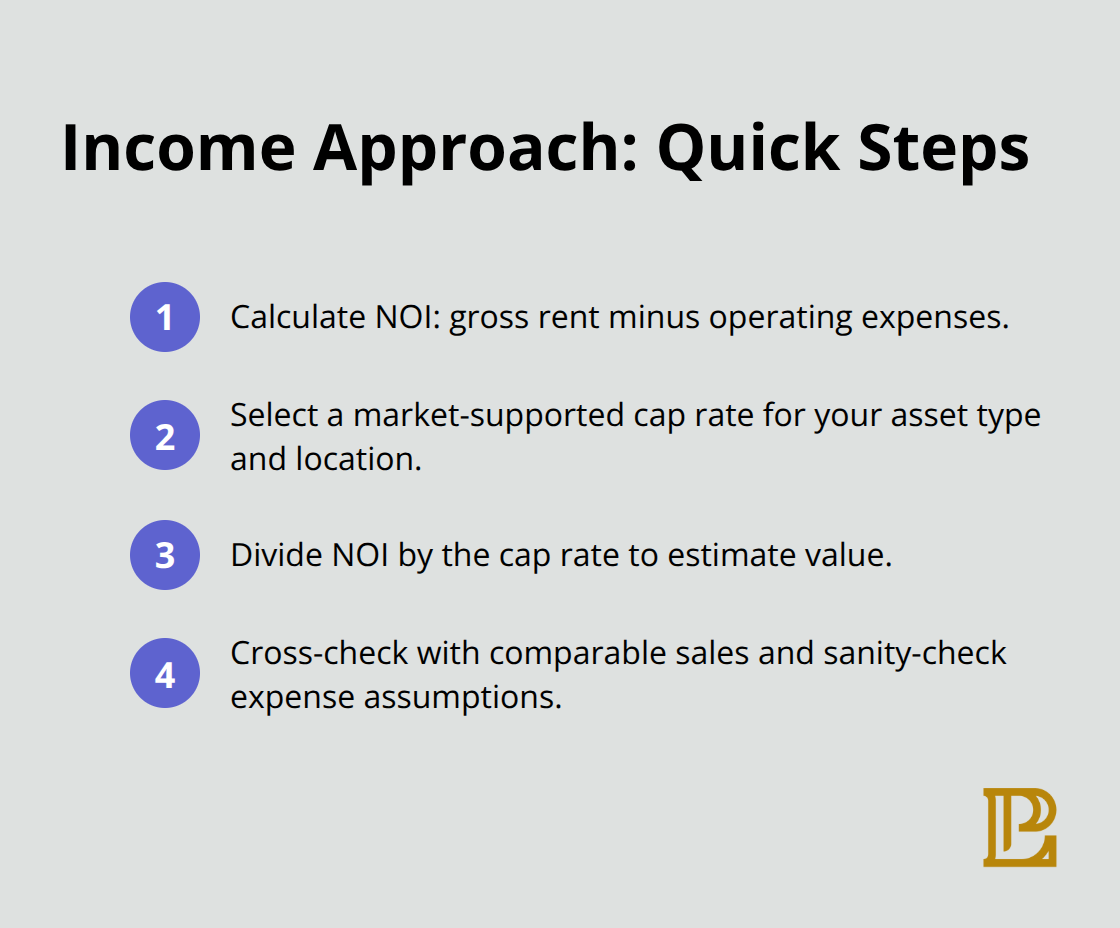
Net Operating Income Calculation
The income approach values a property based on the money it generates, not on what similar properties sold for or what it costs to build. This method works especially well for office, retail, and multifamily assets in Hermosa Beach because income-producing properties attract investors focused on cash flow.
Start with Net Operating Income, which represents the property’s gross rental income minus all operating expenses like property taxes, insurance, maintenance, and utilities. If a Hermosa Beach retail property generates $500,000 in annual gross rent and has $150,000 in operating expenses, the NOI is $350,000. This number drives everything else in the income approach, so accuracy matters. Many investors underestimate operating costs and overstate NOI, which inflates valuations dangerously.
Capitalization Rate Analysis
The capitalization rate, or cap rate, translates NOI into property value by dividing NOI by the cap rate. In Hermosa Beach, commercial properties typically see cap rates between 4.5% for premium office near The Strand and 7.5% for older retail further inland, with most properties clustering between 5.5% and 6.5%. Using the earlier example, a $350,000 NOI divided by a 6% cap rate equals approximately $5.83 million in value.
Cap rates reflect market risk and conditions, so higher uncertainty pushes rates up and values down. Hermosa Beach properties near The Strand and major transportation hubs command lower cap rates because location premiums reduce perceived risk. A property 15–20% closer to transportation infrastructure or the coastline can justify cap rates 0.5–1% lower than comparable inland properties.
Discounted Cash Flow Method
The discounted cash flow method extends this logic over multiple years, projecting NOI growth or decline and accounting for the time value of money. This approach works best when you expect significant changes in income or expenses over a holding period, but it requires realistic assumptions about rent growth, tenant turnover, and capital expenditures.
Most Hermosa Beach investors find that cap rates provide sufficient accuracy for standard income-producing properties without needing complex DCF models, especially when comparable sales data is available to validate the cap rate assumption. Understanding how the market values similar properties sets the stage for comparing your property against real transactions in your area.
Market Approach to Valuation
The market approach values your property based on what similar properties actually sold for in Hermosa Beach. This method cuts through speculation because it anchors to real transactions, not projections or construction estimates. The approach works best when comparable properties exist in your area, which is the case for most commercial real estate in Hermosa Beach. Unlike the income approach, which relies on cap rate assumptions that can vary widely, the market approach shows you exactly what buyers paid for similar assets recently.
Identifying Comparable Sales
Start by identifying three to five properties that sold within the last 12 to 18 months in Hermosa Beach or nearby submarkets like Manhattan Beach or Redondo Beach. The properties should match your subject property in age, size, location, and type. A 2005 office building with 15,000 square feet near The Strand is your best comparable, not a 1970s warehouse in an industrial park 2 miles away. According to market data, Los Angeles office properties average around $588 per square foot with typical deals near 20,063 square feet, but Hermosa Beach properties near The Strand command significant premiums over inland locations. Properties within 15 to 20 percent closer to major transportation hubs or the coastline outperform comparable inland properties by that same margin. This proximity premium reflects actual buyer behavior in Hermosa Beach’s coastal market.
Once you identify your comparables, note the sale price per square foot and the total sale price for each property. If a similar office building sold for $5.2 million and contains 10,000 rentable square feet, that equals $520 per square foot. This metric lets you quickly estimate your property’s value by multiplying your square footage by the per-square-foot rate from comparables.
Making Adjustments for Property Differences
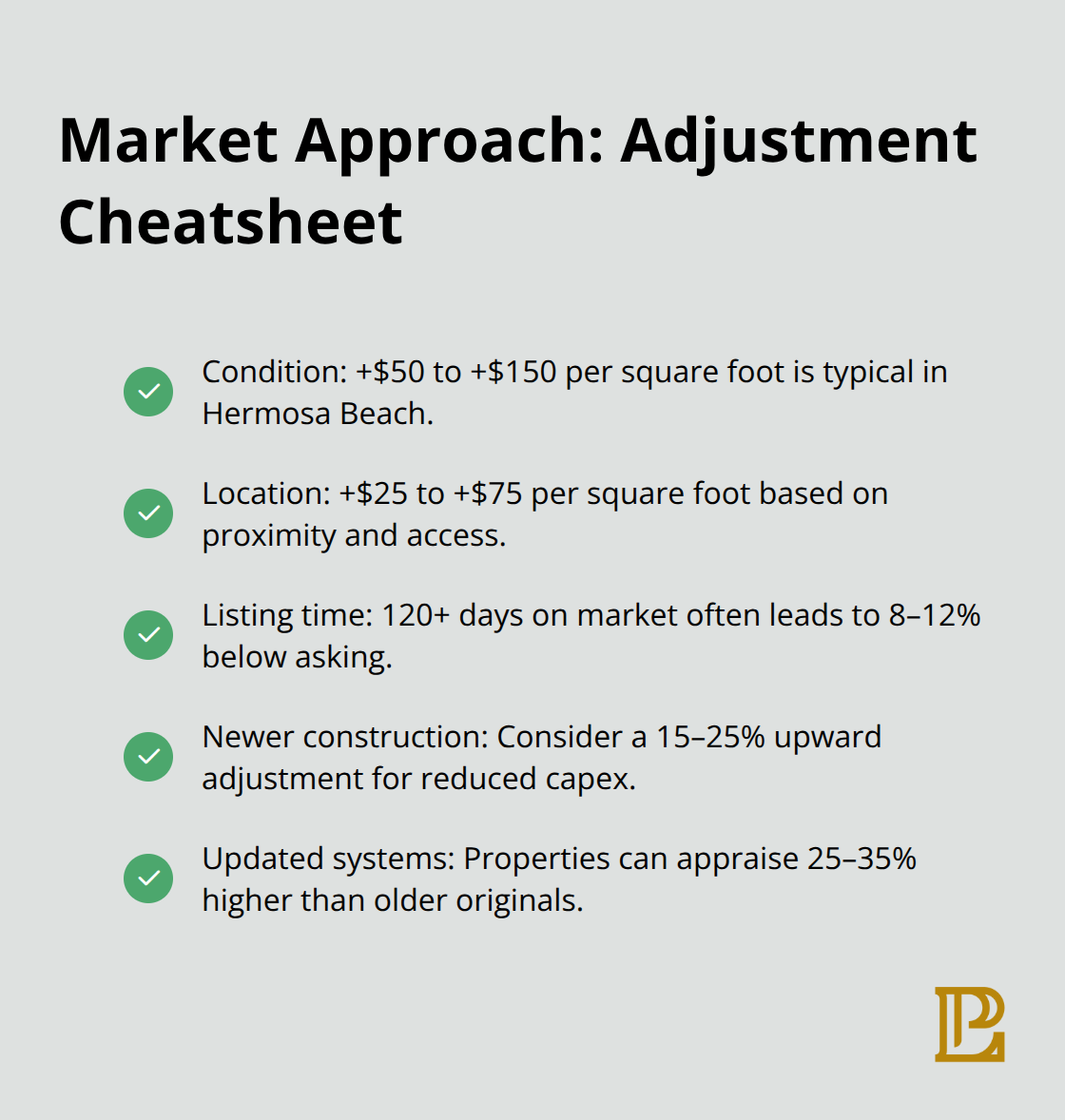
No two properties are identical, so you must adjust comparable prices for meaningful differences. A building constructed after 1990 typically requires about 30 percent fewer capital improvements over five years compared with older structures, which justifies a 15 to 25 percent upward adjustment if your subject property is newer. Conversely, a 20-year-old office building with updated HVAC and modern electrical systems can appraise 25 to 35 percent higher than a comparable older property with original systems.
Typical adjustments in Hermosa Beach range from $50 to $150 per square foot for condition differences and $25 to $75 per square foot for location variations. If a comparable sold at $550 per square foot but had deferred maintenance that your property lacks, add $75 per square foot to arrive at a fair adjusted price. If your property sits one block further from The Strand than the comparable, subtract $50 per square foot to account for the location difference. The key is making adjustments based on what the market actually paid for those differences, not guessing.
Accounting for Market Timing
Properties on the market longer than 120 days historically sell 8 to 12 percent below asking, so if a comparable was listed for 120+ days before sale, reduce your valuation estimate by that margin. This adjustment captures real market conditions and prevents you from overstating your property’s value based on a weak comparable sale.
After adjusting all comparables, average the adjusted prices to arrive at a market-supported value range. This approach grounds your valuation in actual Hermosa Beach transactions rather than cap rate assumptions or replacement costs. The market approach provides a reality check against the income method, and when both methods align, you gain confidence in your valuation. When they diverge significantly, the cost approach offers a third perspective that can help explain the difference.
Cost Approach to Valuation
Land Value Assessment
The cost approach values a property by calculating what it would cost to rebuild it today from the ground up, then subtracting depreciation. This method works best when comparable sales are scarce or when a property has unique features that don’t fit standard market comparisons. For Hermosa Beach investors, the cost approach serves as a reality check against income and market valuations, especially when those methods produce wildly different results.
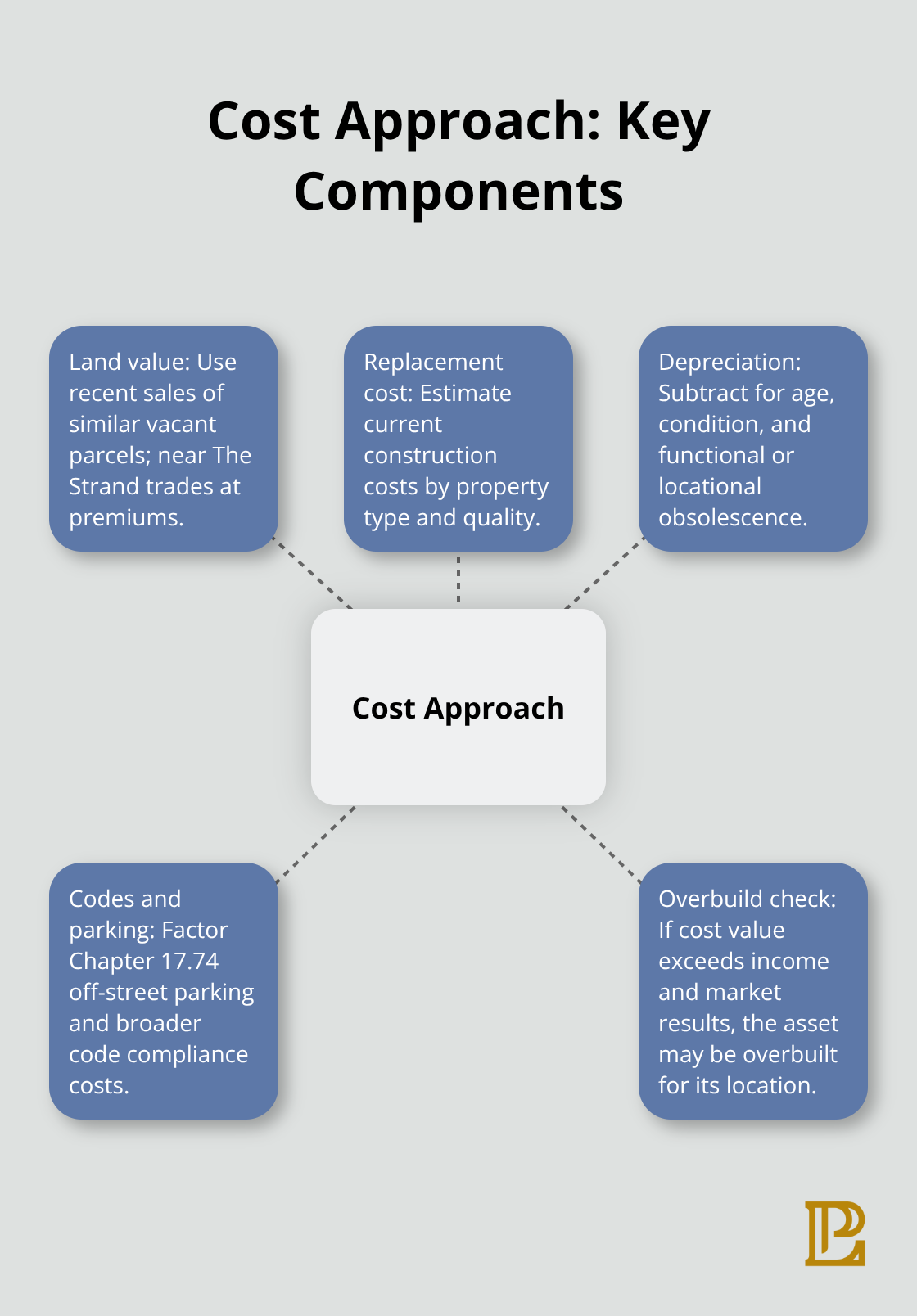
Start by valuing the land separately using recent sales of similar vacant parcels in Hermosa Beach. Land near The Strand commands premium prices, while inland locations cost considerably less. Current Hermosa Beach land values range from roughly $350 to $500 per square foot for commercial parcels, though beachfront and near-beach locations exceed these figures substantially.
Building Replacement Costs
Once you establish land value, add the replacement cost of the building as if it were new construction. Office space typically runs $350 to $500 per square foot to build, while retail space averages $250 to $350 per square foot depending on finishes and systems. A 10,000 square foot office building in Hermosa Beach would cost approximately $3.5 to $5 million to construct today, plus land value.
Most investors make critical mistakes here: they fail to account for the actual cost of modern building systems, parking requirements, and compliance with current Hermosa Beach zoning codes. Chapter 17.74 of the Hermosa Beach Municipal Code specifies off-street parking requirements that significantly increase development costs and ongoing operating expenses. A property that meets 1970s parking standards may require costly retrofitting or variance approvals to meet today’s requirements, which directly reduces value.
Depreciation and Obsolescence Factors
Next, subtract depreciation, which reflects the building’s physical condition, age, and obsolescence. A well-maintained 20-year-old office building with updated HVAC and electrical systems appraises 25 to 35 percent higher than a comparable property with original systems from 1990 or earlier. Conversely, deferred maintenance creates immediate valuation penalties-a building that needs roof replacement, foundation repair, or system upgrades loses 10 to 20 percent of its replacement cost value until those items are addressed.
Buildings constructed after 1990 typically require about 30 percent fewer capital improvements over five years compared with older structures, which the market recognizes in pricing. The cost approach rarely produces the highest valuation because it ignores income potential and market sentiment, but it provides a floor value below which the property should not sell unless distressed. If your cost approach valuation significantly exceeds both the income and market approaches, the property likely overbuilt for its market or location, signaling poor investment potential.
Final Thoughts
Valuing commercial real estate in Hermosa Beach requires choosing the right method for your situation. The income approach works best when you have reliable rental data and want to focus on cash flow potential. The market approach grounds your valuation in actual sales transactions, which proves especially valuable in Hermosa Beach’s competitive coastal market where comparable sales data is readily available. The cost approach provides a floor value and helps explain discrepancies between the other two methods.
Most investors and property owners benefit from using all three approaches together rather than relying on a single method. When the income, market, and cost approaches converge within a reasonable range, you gain confidence in your valuation. When they diverge significantly, the differences signal something worth investigating-perhaps the property is overbuilt for its market, or the income assumptions are unrealistic compared to what similar properties actually generate. Hermosa Beach’s unique characteristics (proximity to The Strand, parking requirements under Chapter 17.74 of the Municipal Code, and zoning restrictions) demand careful attention during valuation.
We at Pierview Law help business owners and investors navigate the financial and legal complexities of commercial real estate transactions. Contact us to discuss your property valuation needs and transaction strategy, and let our team guide you through the process of valuing commercial real estate with both market reality and legal considerations in mind.