
Most startups fail because founders skip the structural foundation. Getting your startup corporate structuring right from day one protects your personal assets, minimizes taxes, and makes scaling possible.
At Pierview Law, we’ve seen how the wrong entity choice costs business owners thousands in unnecessary taxes and legal exposure. This guide walks you through selecting the right structure, handling compliance, and building governance that grows with your business.
Which Entity Structure Fits Your Startup
LLC, C Corporation, or S Corporation: What Sets Them Apart
Picking between an LLC, C Corporation, and S Corporation determines everything from how much you’ll owe in taxes to whether your personal savings stay protected if something goes wrong. The wrong choice locks you into years of unnecessary expenses and legal exposure. LLCs offer the simplest path for most Hermosa Beach startups because they separate your personal assets from business liability while avoiding the double taxation that C Corporations impose. A C Corporation makes sense only if you’re raising venture capital or planning to reinvest all profits back into the business, since C Corporations pay corporate tax on profits and then shareholders pay tax again on dividends-effectively a 40 to 50 percent combined tax hit depending on your income level.
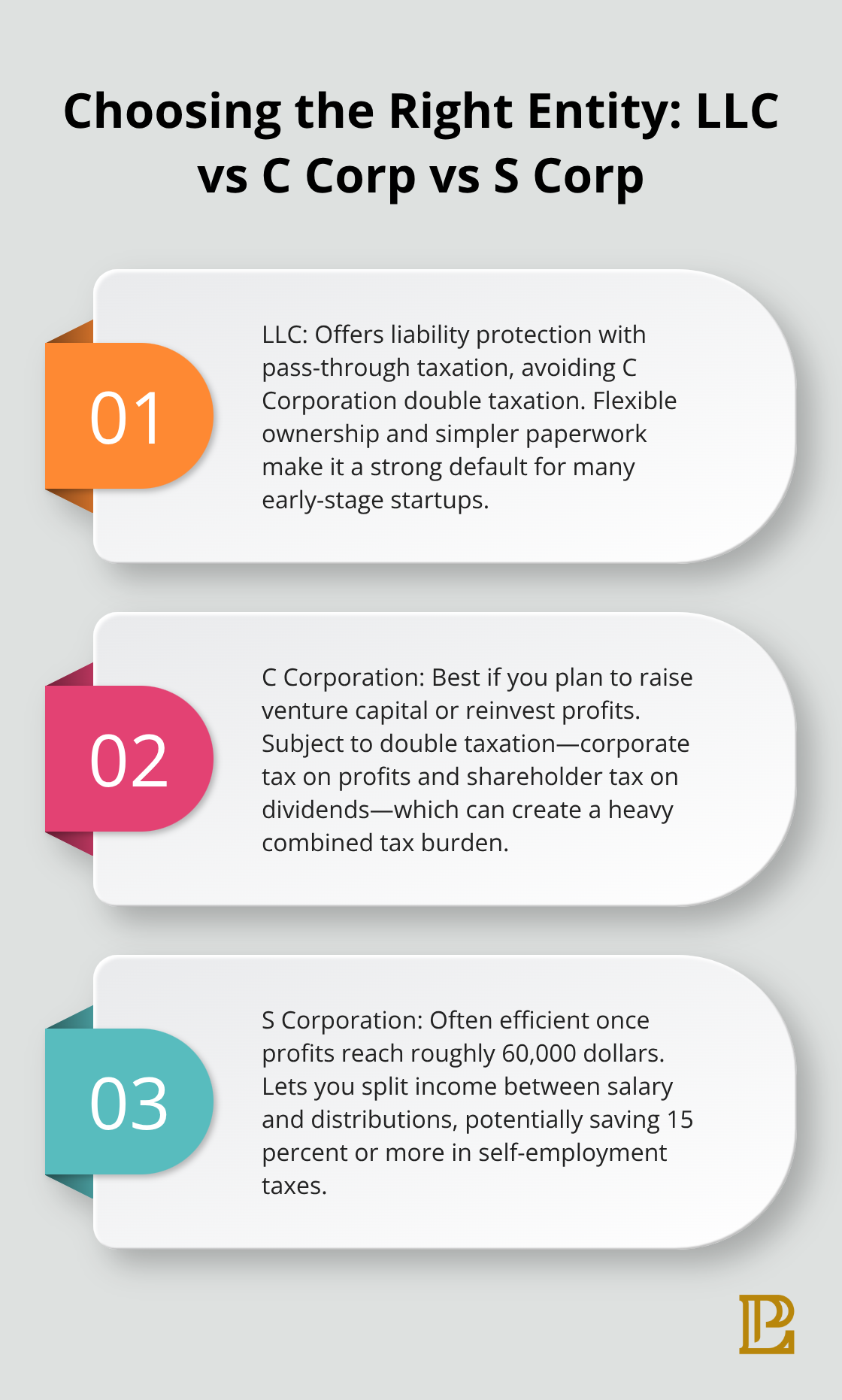
S Corporations work well once your business reaches roughly 60,000 dollars in annual profits, because they let you split income between salary and distributions, potentially saving 15 percent or more in self-employment taxes. California imposes an 800 dollar annual franchise tax on both LLCs and Corporations regardless of profit, so factor that into your decision if you’re just starting out. Most founders in your position choose an LLC first because the liability protection matches a Corporation, the paperwork stays lighter, and you avoid the franchise tax burden until you’re actually generating significant revenue.
Protecting Your Personal Assets Through Proper Structure
The liability shield only works if you maintain separation between your personal finances and the business. Courts will pierce the corporate veil and hold you personally responsible if you mix personal and business money, fail to file annual documents on time, or ignore required meetings and record-keeping. Ownership flexibility matters too-an LLC gives you complete freedom to split ownership however you want and change those splits later, while Corporations lock you into share structures that become complicated when investors enter the picture. If you’re planning to bring in outside investors or cofounders with different contribution levels, an LLC operating agreement lets you allocate profits, losses, and control independently of ownership percentages. A Corporation forces those three elements to move together.
Staying Compliant With California Requirements
The California Secretary of State requires you to file a Statement of Information every two years for both LLCs and Corporations, costing around 20 dollars each time, and missing this deadline can suspend your good standing status and expose you to personal liability. Start with the structure that matches your current reality, not some imagined future five years out-you can convert later if circumstances change. The foundational documents you file at formation set the tone for how your business operates, which is why getting them right matters before you bring in cofounders, investors, or employees.
Foundational Documents and Compliance Requirements
Operating Agreements and Articles of Incorporation Set Your Rules
Your operating agreement or articles of incorporation form the contract that governs how your business runs and who controls what when disagreements happen. Most founders skip this step or use a generic template, then face costly conflicts later when a cofounder interprets ownership differently or an investor demands control rights that weren’t documented. Startups that rush through formation documents often spend $5,000 to $15,000 in legal fees to fix ambiguities and disputes that cost nothing to prevent upfront.
An LLC operating agreement should spell out exactly how profits get distributed, who makes decisions, what happens if a member wants to leave, and how new members can join. For Corporations, bylaws serve the same function but also define board authority, shareholder voting rights, and stock issuance procedures. If you bring in cofounders or investors, a shareholder agreement for Corporations or a member agreement for LLCs protects everyone by documenting vesting schedules, buyout terms, and what happens if someone dies or becomes unable to work.
California law doesn’t require these documents to exist, but courts will fill in the blanks with default rules that rarely match what you actually intended-and those defaults favor whoever has the best lawyer when conflict arrives.
Filing Your Formation Documents With the California Secretary of State
The California Secretary of State filing takes 15 minutes online through their portal, costs $70 to $100 for an LLC or Corporation, and generates your official formation documents within 2 to 3 business days. Once formed, you need an Employer Identification Number from the IRS, which is free and takes 10 minutes to apply for online.
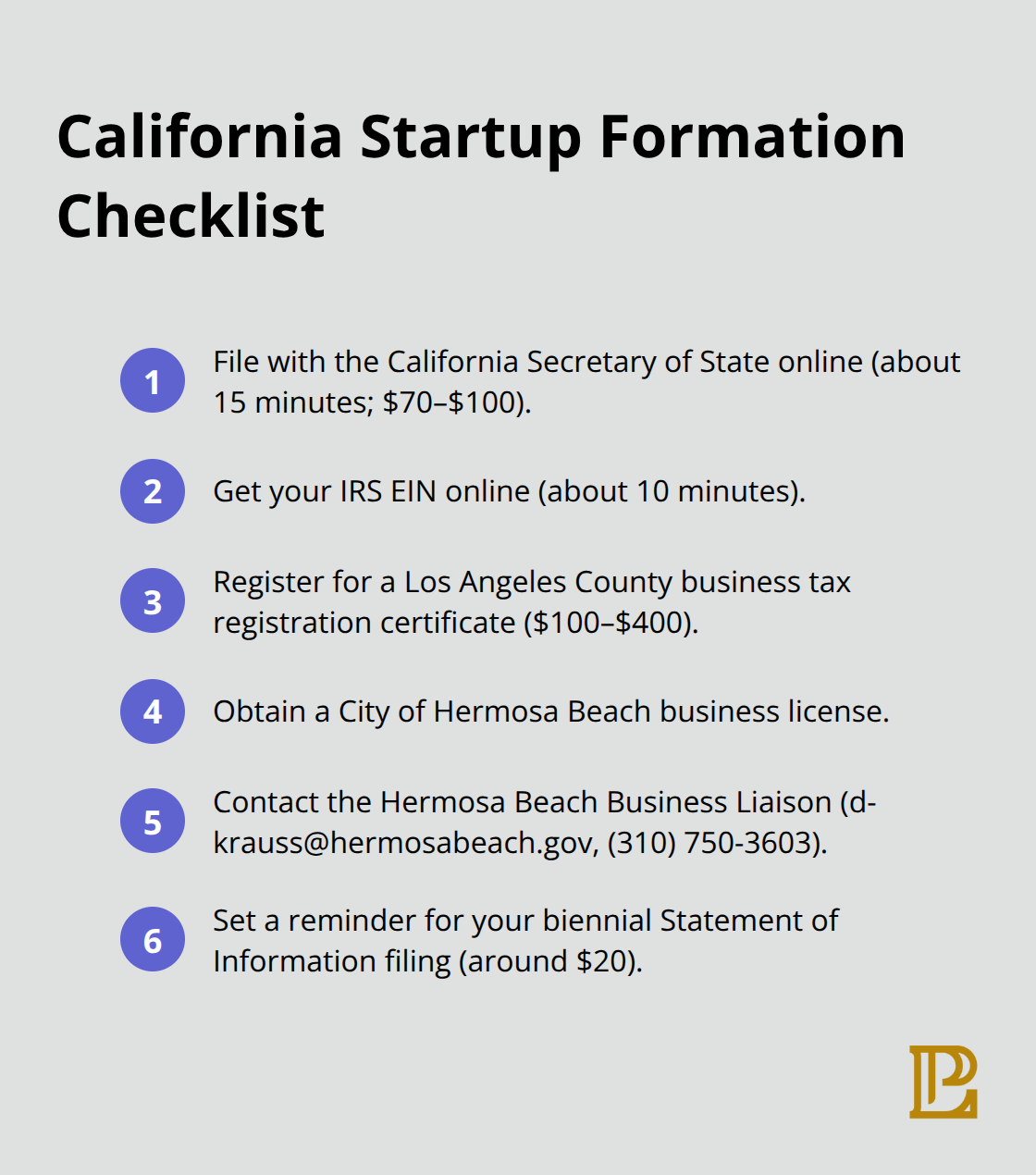
Don’t skip this even if you’re a sole proprietor, because it separates your personal tax records from your business and becomes required the moment you hire anyone.
Los Angeles County and Hermosa Beach add their own layer: most service businesses need a business tax registration certificate from the county assessor, which costs roughly $100 to $400 depending on your industry and gross revenue. You’ll also need a local business license from the City of Hermosa Beach. Contact Doug Krauss, the Hermosa Beach Business Liaison, at dkrauss@hermosabeach.gov or call (310) 750-3603 to confirm exactly which permits and licenses your specific business type requires-this saves you from discovering six months later that you’re operating illegally.
Staying Current With Ongoing Compliance Filings
The California Secretary of State requires you to file a Statement of Information every two years for both LLCs and Corporations, costing around $20 each time. Missing this deadline suspends your good standing status and personally exposes you to liability, so set a calendar reminder now rather than discovering this when a lawsuit arrives. If your business involves retail, food service, or any regulated industry, expect additional compliance requirements from the health department or labor board.
The liability shield only works if you maintain separation between your personal finances and the business. Courts will pierce the corporate veil and hold you personally responsible if you mix personal and business money, fail to file annual documents on time, or ignore required meetings and record-keeping. These foundational documents and compliance steps create the legal framework that protects your personal assets-but only if you treat them as living requirements rather than one-time tasks.
As your startup grows and you bring on cofounders, employees, and investors, your governance structure must evolve beyond the basic formation documents to handle more complex decision-making and oversight.
Scaling Your Governance as You Grow
The 50-to-100 Employee Inflection Point
Most startups hit a wall around 50 to 100 employees where the founder-led approach stops working. Research published in California Management Review analyzed 78 California startups and found that those adopting structured management systems in their early years grew three times faster than unstructured peers, with lower CEO turnover during rapid scale phases. The transition point isn’t arbitrary-it’s when decision-making becomes too complex for one person to handle without creating bottlenecks that slow hiring, product development, and customer onboarding. Waiting until you’re forced to formalize governance usually means you’ve already lost momentum and talented employees to companies with clearer decision rights.
Building Process-Driven Leadership Now
Start with simple, repeatable processes that prevent the stall later. Document your core workflows, assign clear accountability for each function like product, marketing, and finance, and implement dashboards showing KPIs that matter to your business. This shift from personality-driven leadership to process-driven governance sounds rigid, but founders who resist it confuse structure with creativity-the real barrier to scaling is ambiguity about who decides what. Founders should plan for a staged transition from founder-led to process-led governance as the company expands.
Using an Advisory Board as a Bridge
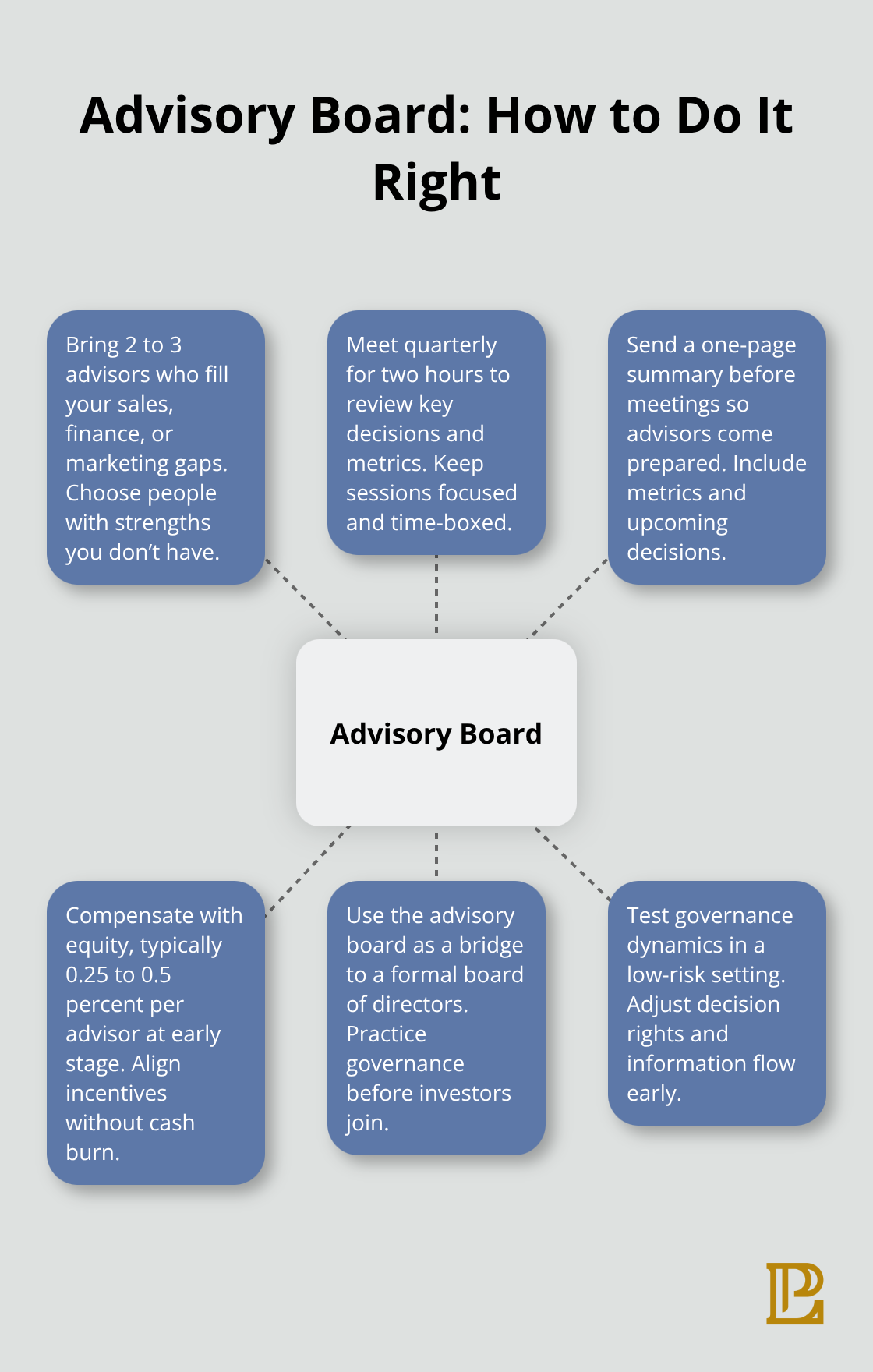
An advisory board bridges the gap between solo leadership and a formal board of directors. Start with two to three advisors who bring skills you lack-someone with sales experience if you’re product-focused, a finance person if you’re technical, a marketer if you’re operations-heavy. Meet quarterly for two hours, send them a one-page summary of metrics and decisions beforehand, and compensate them with equity (typically 0.25 to 0.5 percent per advisor for early-stage companies). This structure tests governance dynamics before you form a formal board.
Transitioning to a Formal Board Structure
As you approach Series A funding or hit $1 million in revenue, transition to a formal board with a typical structure of five members: two founders, two investors, and one independent director. That independent seat matters because it adds unbiased oversight without diluting founder control. Set explicit expectations upfront about decision rights, meeting frequency, and what information the board receives each month. Formal board meetings should happen monthly or quarterly with two hours of preparation per hour of meeting time-this rigor forces you to think clearly about strategy instead of reacting to daily crises.
Protecting Your Company Through Documentation
Keep detailed minutes documenting decisions and who voted which way, because these records protect you if disputes arise later and demonstrate to future investors that governance happens seriously at your company. Implement a simple system now: assign someone to track board resolutions in a spreadsheet, maintain a corporate records book with bylaws and meeting minutes, and establish a calendar for annual filings and governance reviews. This foundation prevents the costly legal battles that occur when founders and investors disagree about who had authority to make which decisions.
Final Thoughts
Your startup corporate structuring decisions made today determine whether your business survives the first five years or collapses under legal and tax complications. A founder who chooses an LLC, files proper operating agreements, and stays current with California filings avoids the $5,000 to $15,000 legal bills that come from fixing ambiguities later. Clean governance attracts investors, protects your personal assets, and gives you the foundation to scale without constant firefighting.
Follow a simple timeline to stay on track. File your formation documents with the California Secretary of State within the first month, obtain your EIN from the IRS immediately, and contact the Hermosa Beach Business Liaison to confirm local licensing requirements. Set calendar reminders for your biennial Statement of Information filing-missing this deadline costs nothing to prevent but everything if it suspends your good standing. Once you hit 50 employees or approach Series A funding, formalize your governance with an advisory board or board of directors, document your decision-making processes, and maintain detailed meeting minutes.
We at Pierview Law help Hermosa Beach founders navigate entity formation, draft operating agreements that prevent disputes, and establish governance systems that support growth. Reach out to discuss your specific situation and get the structural foundation right.