
Cross-border deals present real complexity that most business owners underestimate. The stakes are higher, the rules change by country, and one misstep can cost millions.
At Pierview Law, we’ve guided companies through dozens of international transactions. We know where deals break down and how to prevent it.
What Makes Cross-Border M&A Different From Domestic Deals
Cross-border transactions operate under a completely different rulebook than domestic deals. A company acquiring a business in California faces one set of regulations. That same company acquiring a business in Germany or Singapore faces entirely different foreign investment laws, tax treaties, currency controls, and approval processes. The complexity multiplies when multiple jurisdictions are involved.
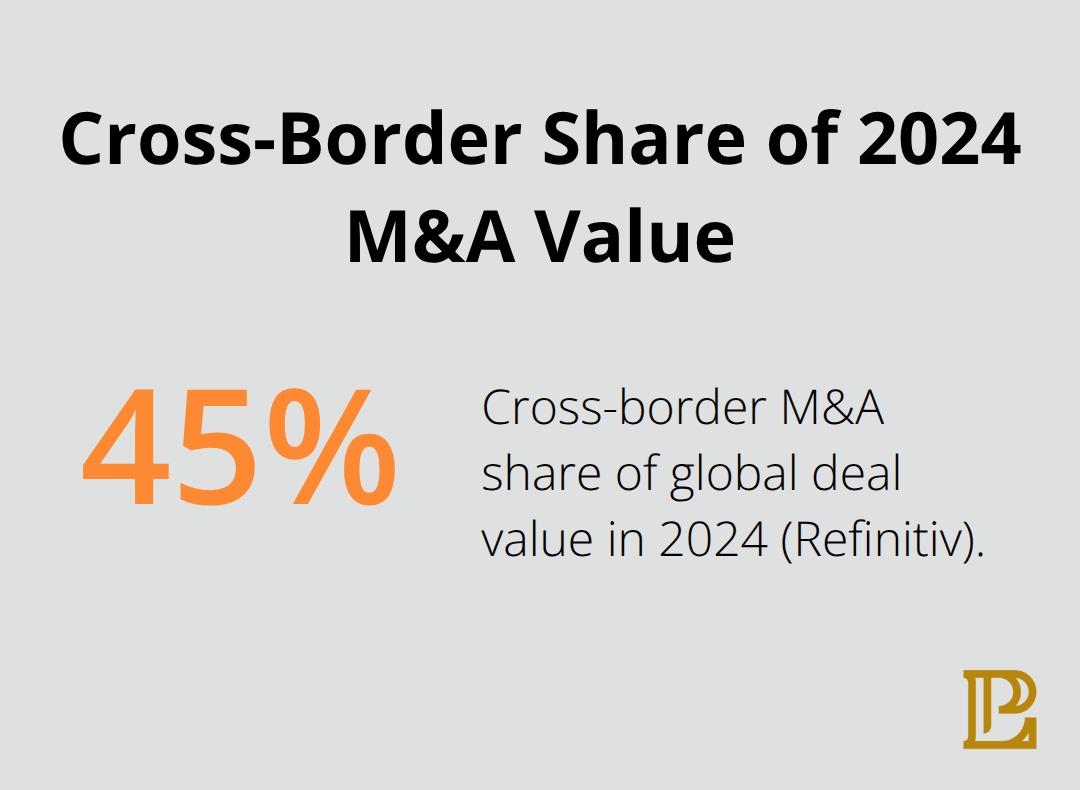
According to Refinitiv, cross-border M&A deals in 2024 represented 45% of global M&A activity by value, yet these transactions take significantly longer to close and encounter more regulatory obstacles than purely domestic transactions. The average cross-border deal requires navigation through 8 to 12 different regulatory bodies, compared to 2 to 4 for domestic acquisitions.
Market Growth and Deal Activity
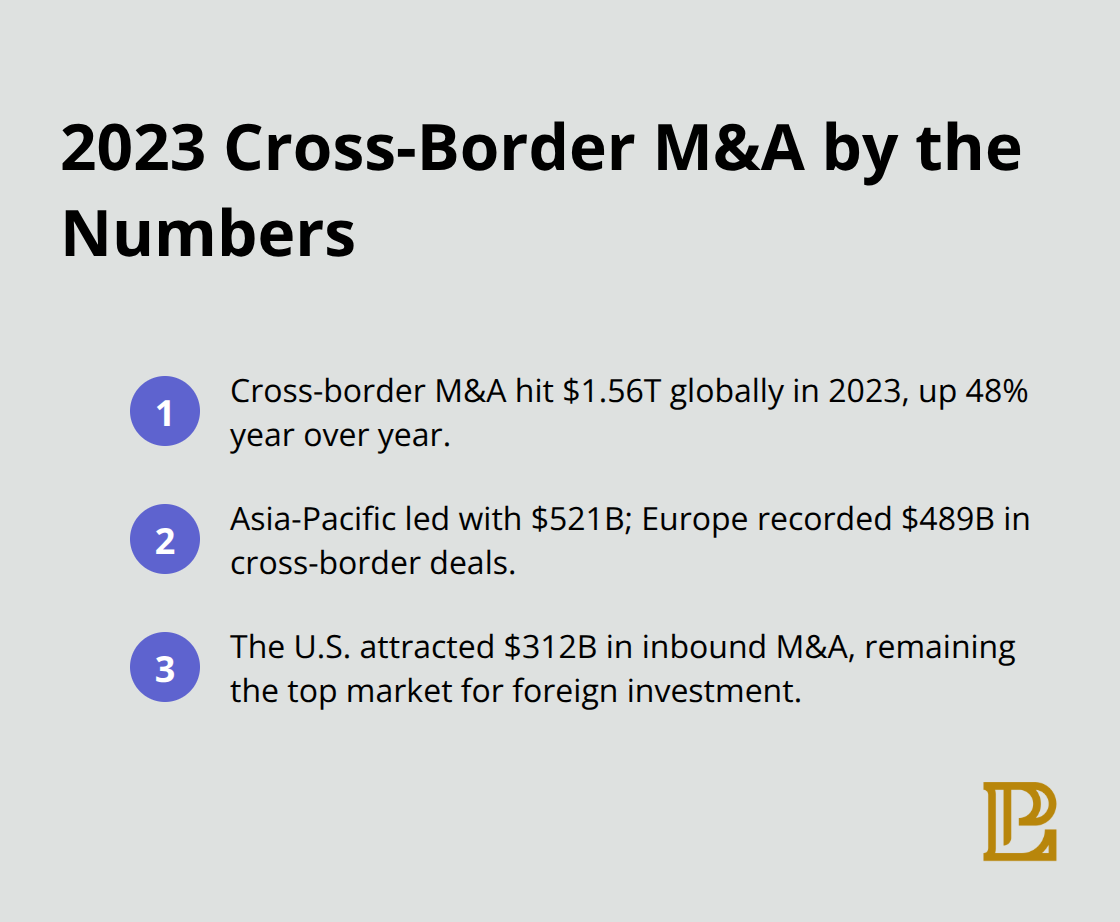
International M&A activity has surged over the past five years. In 2023, cross-border M&A reached $1.56 trillion globally, up 48% from 2022, according to UNCTAD data. The Asia-Pacific region led with $521 billion in cross-border deals, while Europe recorded $489 billion. The United States remained the dominant market for foreign investment, attracting $312 billion in inbound M&A.
Technology and healthcare sectors drive most cross-border activity, with software and biotech companies accounting for roughly 35% of all international deals. Real estate-focused cross-border transactions have also grown, particularly in commercial property acquisitions where foreign investors seek stable markets like the United States. These numbers show that cross-border M&A is no longer niche activity-it’s mainstream business strategy, and the competition for deals is fierce.
Why Speed and Jurisdiction Matter
The jurisdiction where you acquire assets directly impacts deal structure, timeline, and cost. A business acquisition in the UK requires Foreign Direct Investment screening under the National Security and Investment Act, which can delay closing by 30 to 90 days. The same acquisition in Canada triggers Investment Canada Act review. Australia imposes a Foreign Investment Review Board assessment for acquisitions exceeding AUD 1.235 billion.
China maintains strict foreign ownership restrictions in most sectors, making acquisitions nearly impossible without a state-approved partner. These regulatory barriers aren’t theoretical-they directly affect whether your deal closes and how much you’ll spend on compliance. Understanding which markets have open investment policies versus restrictive ones determines whether you pursue a deal at all.
Countries like Singapore, the Netherlands, and the United States maintain relatively open foreign investment regimes, while others require government approval before you can even begin negotiations. This reality shapes your entire deal strategy from day one. The regulatory environment you face will determine whether you move forward, restructure your approach, or walk away entirely-which is exactly why the next section on legal and regulatory hurdles demands your full attention.
Legal and Regulatory Hurdles in Cross-Border Deals
Foreign Investment Restrictions That Block Transactions
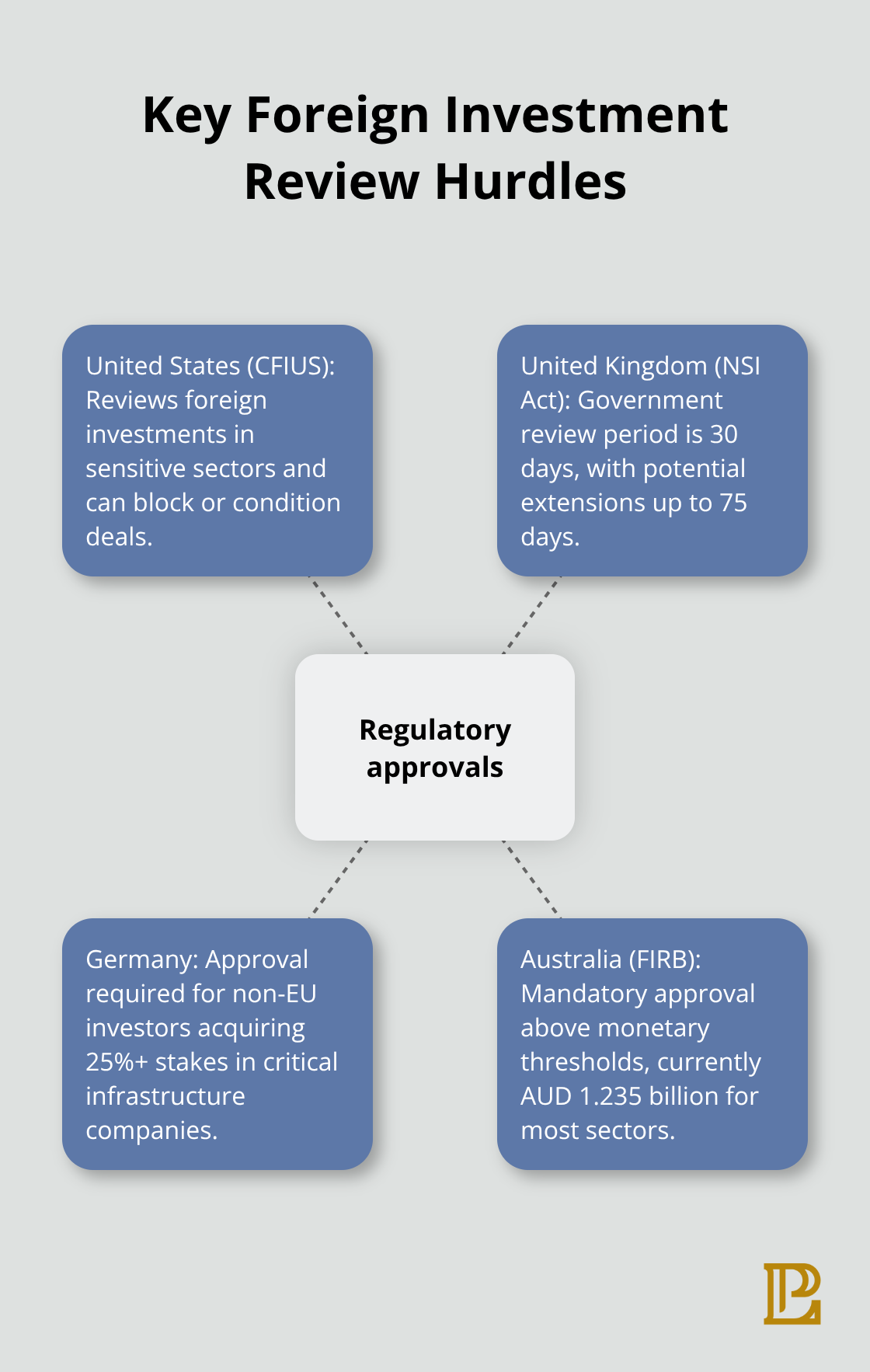
Foreign investment restrictions vary wildly by country, and ignoring them costs time and money. Some nations openly welcome foreign buyers while others demand government approval before negotiations even begin. The United States has the Committee on Foreign Investment in the United States (CFIUS), which reviews deals involving foreign investors in sensitive sectors like defense, technology, and infrastructure. CFIUS can block transactions entirely or impose conditions that reshape your deal structure.
The UK’s National Security and Investment Act gives the government 30 days to review acquisitions in sensitive sectors, with potential extensions to 75 days. Germany requires approval for non-EU investors acquiring stakes above 25% in companies operating critical infrastructure. Australia’s Foreign Investment Review Board sets monetary thresholds that trigger mandatory approval, currently AUD 1.235 billion for most sectors. These aren’t bureaucratic niceties you can rush through-they’re hard stops that determine whether your deal happens at all.
Identify your target’s jurisdiction first, then immediately research that specific country’s foreign investment rules before you spend resources on due diligence. This sequence prevents wasted effort on deals that regulators will never approve.
Tax Treaties and Structuring Opportunities
Tax treaties between countries create massive opportunities for savings but require precise structuring to capture them. The United States maintains over 60 income tax treaties that reduce withholding taxes on dividends, interest, and royalties. A subsidiary in the Netherlands, for example, can access favorable treaty rates with numerous countries, which is why many multinational structures route investments through Dutch entities.
However, misunderstanding treaty provisions costs real money. Treaty shopping rules now prevent abusive structures, and the OECD’s Base Erosion and Profit Shifting initiative tightens loopholes yearly. Proper structuring requires understanding both the source country’s rules and the residence country’s rules-a mistake in either direction eliminates your tax savings and creates unexpected liabilities.
Antitrust Enforcement in Multiple Jurisdictions
Antitrust enforcement in cross-border deals has intensified significantly. The European Commission blocked the proposed $44 billion Broadcom-Qualcomm merger in 2018 over competition concerns, and the UK Competition and Markets Authority regularly scrutinizes foreign acquisitions in telecommunications and digital markets. China’s State Administration for Market Regulation now reviews deals involving data collection and AI technology.
The threshold for triggering antitrust review varies by jurisdiction-some countries examine any deal above a certain revenue level, while others focus on market share concentration. Filing for antitrust clearance in multiple jurisdictions simultaneously stretches timelines to 12-18 months in complex cases. Getting this wrong means your deal collapses after months of negotiation, so antitrust assessment must happen early and inform your entire deal strategy from the beginning.
These regulatory obstacles demand attention before you move forward with due diligence. The next section shows you how to conduct the financial and legal assessments that identify hidden problems and structure your deal to survive regulatory scrutiny.
What Financial and Legal Assessments Actually Reveal
Due diligence in cross-border deals requires investigation far beyond what domestic transactions demand. You’re not just reviewing financial statements and contracts-you’re uncovering hidden liabilities buried in unfamiliar legal systems, tax exposure created by treaty mismatches, and compliance violations that regulators in multiple countries will scrutinize.
Financial Assessment Across Different Accounting Standards
Start with financial assessment by engaging accountants familiar with the target’s jurisdiction, not just your home country accountants. They need to restate financial statements under your accounting standards because GAAP, IFRS, and local accounting rules produce different pictures of profitability and debt. A company showing strong earnings under Chinese accounting standards might reveal significant losses when restated under US GAAP.
Request five years of audited financials, tax returns, and bank statements to identify trends and anomalies. Look specifically for related-party transactions, which obscure true operational performance and create tax risks when regulators challenge pricing between connected entities. These transactions often hide inflated costs or artificially reduced revenues that distort the company’s actual value.
Legal Compliance Verification in Multiple Jurisdictions
Legal assessment means understanding the target’s regulatory compliance status in its home jurisdiction and every country where it operates. Verify licenses, permits, and certifications are current-a manufacturing facility missing environmental certifications in Germany creates massive liability you inherit. Review litigation history, labor disputes, and regulatory investigations thoroughly.
Contact the target’s tax authority to confirm no outstanding assessments exist. Examine employment contracts for severance obligations that multiply when restructuring occurs post-acquisition. In countries with strong labor protections like Germany and France, terminating employees costs substantially more than in the US, so factor these costs into your valuation.
Data Privacy and Sector-Specific Regulations
Assess data privacy compliance under GDPR if the target operates in Europe, or under China’s data localization rules if it operates there. Non-compliance with GDPR alone carries fines up to 20 million euros or 4% of global revenue. Have local counsel in the target’s jurisdiction conduct this assessment-they understand how regulators interpret rules and what hidden issues commonly emerge in your specific sector.
Structuring Purchase Agreements for Risk Allocation
Structure your purchase agreement to allocate risks appropriately: indemnification for undisclosed liabilities, escrow holdbacks for tax exposure, and representations regarding regulatory compliance that survive closing for 18 to 24 months. These protections give you recourse if problems surface after you own the company. Proper structuring transforms due diligence findings into contractual safeguards that protect your investment and limit your exposure to inherited problems.
Final Thoughts
Cross-border deals succeed when you treat regulatory compliance and legal structure as core strategy, not afterthoughts. The companies that close international transactions efficiently identify regulatory requirements before committing resources to due diligence, engage local counsel in the target jurisdiction early, and structure purchase agreements to allocate risk appropriately between buyer and seller. Most expensive mistakes happen when buyers skip steps or proceed without proper clearance in critical markets like the US, Europe, or the target’s home country.
Timeline expectations separate successful cross-border deals from failed ones. These transactions routinely take 12 to 18 months from initial offer to closing, yet many buyers plan for 6 to 9 months-regulatory review periods alone consume 30 to 90 days in most developed markets, and antitrust clearance in multiple jurisdictions stretches timelines further. Building realistic timelines into your deal strategy prevents frustration and keeps negotiations on track when unexpected delays occur.
Bring in attorneys before you sign a letter of intent, not after. We at Pierview Law recommend engaging counsel the moment you identify a potential target in another jurisdiction, as early involvement prevents costly restructuring later and identifies deal-breakers before you’ve invested significant time and money. Our business law team handles entity formation, contract drafting, and financing support across complex transactions, and we work with clients throughout Los Angeles County California to structure cross-border deals that survive regulatory scrutiny.