
The banking landscape in Hermosa Beach is changing rapidly, with mergers and acquisitions in the banking industry reshaping the local financial sector. These strategic moves are driven by various factors, from technological advancements to shifting customer expectations.
At Pierview Law, we’ve observed the significant impact these changes have on community banks, credit unions, and the broader financial ecosystem in our area. This blog post explores the current trends, challenges, and considerations for banks navigating M&A activities in Hermosa Beach’s unique market.
What’s Driving M&A in Hermosa Beach Banks?
Local Market Dynamics
The banking sector in Hermosa Beach faces a wave of consolidation, with several notable mergers and acquisitions reshaping the financial landscape. In 2023, KPMG LLP reported that M&A activity in the Los Angeles region hit a 10-year low (only 588 transactions recorded). However, this trend now reverses, particularly in the banking sector.
One of the primary drivers of M&A activity in Hermosa Beach’s banking sector is the need for scale. Smaller community banks find it increasingly difficult to compete with larger institutions that offer a wider range of services and more advanced digital banking solutions. This has led to a series of strategic mergers aimed at creating stronger, more competitive entities.
Hope Bancorp’s recent acquisition of Hawaii’s Territorial Bancorp in a $78.6 million all-stock deal marks a significant expansion beyond California. This move highlights the growing trend of local banks seeking to diversify their geographical presence and increase their market share.
Technology and Digital Banking
The rapid advancement of financial technology is another key factor driving M&A activity. Many smaller banks in Hermosa Beach lack the resources to develop cutting-edge digital banking platforms independently. Through mergers and acquisitions, these institutions can quickly gain access to advanced technologies, enhancing their ability to serve customers in an increasingly digital world.
Regulatory Pressures
Regulatory compliance becomes increasingly complex and costly, particularly for smaller banks. The Dodd-Frank Act and other regulations have significantly increased capital adequacy requirements and compliance burdens. As a result, many community banks in Hermosa Beach explore M&A opportunities as a way to spread these costs across a larger asset base.
Impact on Community Banks
The consolidation trend has a significant impact on community banks and credit unions in Hermosa Beach. While some view this as a threat to local banking, others see it as an opportunity for community-focused institutions to strengthen their position.
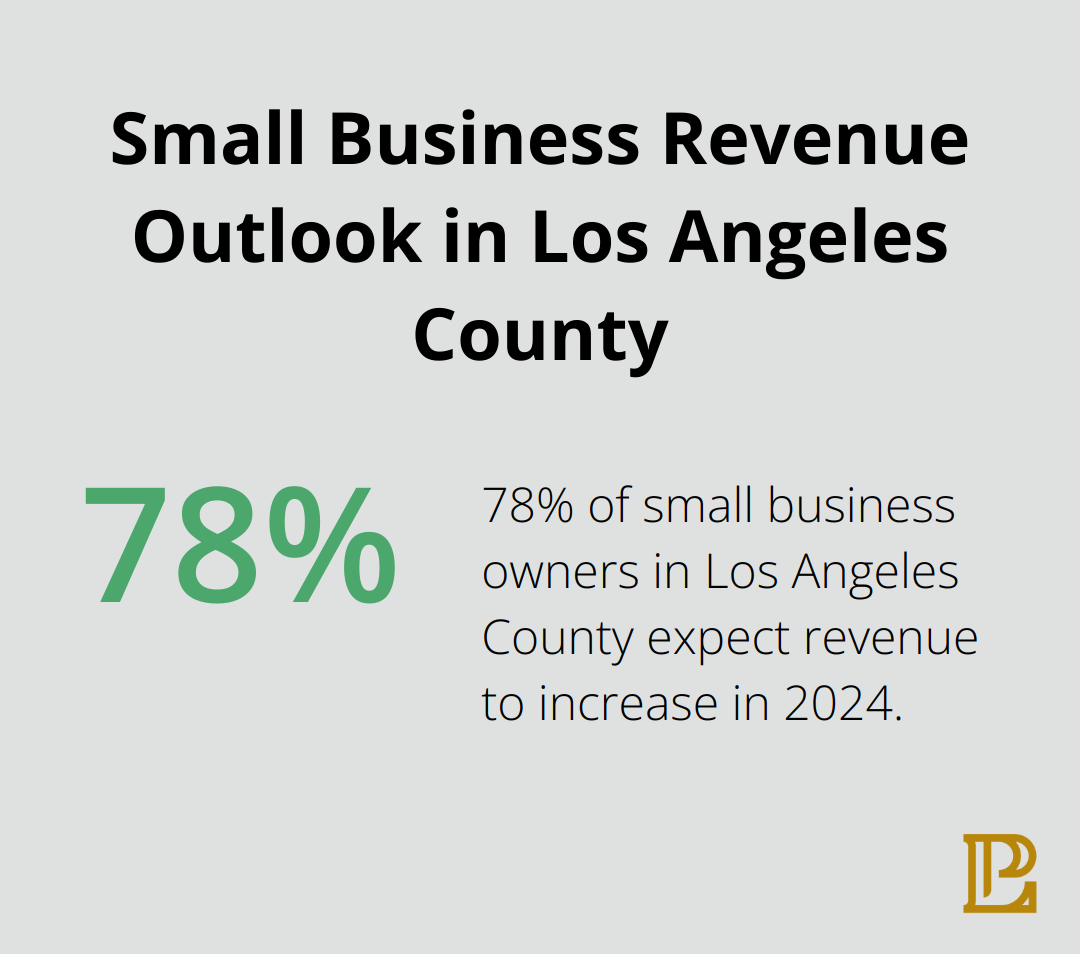
A survey by Bank of America found that 78% of small business owners in Los Angeles County expect revenue to increase in 2024, indicating a positive outlook for local businesses. This optimism could translate into increased demand for banking services, potentially benefiting well-positioned community banks that have strategically merged or acquired complementary institutions.
Successful M&A transactions in the local banking sector often hinge on careful legal planning and execution. Banks considering mergers or acquisitions should seek experienced legal counsel (such as Pierview Law) to navigate the complex regulatory landscape and ensure a smooth transition that preserves the community-focused values that many Hermosa Beach residents value in their local financial institutions.
As we move forward to examine the legal and regulatory challenges in banking M&A, it’s important to understand how these factors shape the decision-making process for financial institutions in Hermosa Beach.
Navigating Legal Hurdles in Banking M&A
State and Federal Compliance Maze
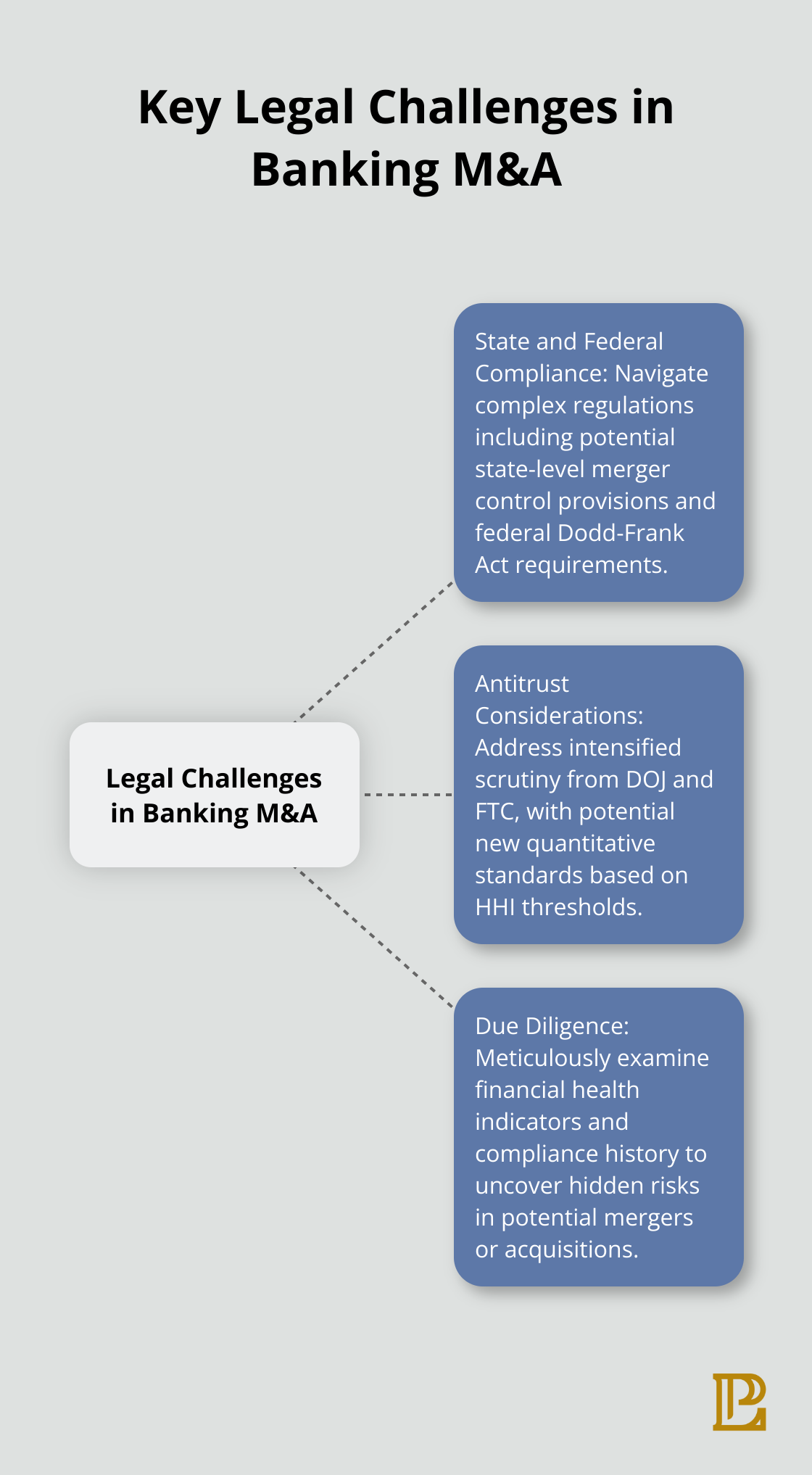
The legal landscape for banking mergers and acquisitions in Hermosa Beach presents a complex web of regulations. California’s Law Revision Commission (CLRC) now considers state-level merger control provisions in antitrust law. This potential shift could introduce lower burdens of proof and stricter scrutiny on mergers affecting California markets. Banks in Hermosa Beach must anticipate these developments to avoid costly missteps.
At the federal level, the Dodd-Frank Act continues to shape the regulatory environment. The act’s increased capital adequacy requirements have pushed many smaller banks towards consolidation. Manhattan Bancorp reported a total risk-adjusted capital ratio of 13.01% by December 31, 2012 (well above the “well-capitalized” status). This demonstrates the financial acrobatics required to meet regulatory standards.
Antitrust Considerations in a Changing Landscape
Antitrust scrutiny in Hermosa Beach continues to intensify. The U.S. Department of Justice and FTC’s 2023 Merger Guidelines significantly influence potential state merger assessments. A proposed quantitative standard based on the Herfindahl-Hirschman Index (HHI) could categorize mergers as presumptively illegal if HHI exceeds certain thresholds.
This heightened scrutiny affects not just traditional bank mergers but also acquisitions of fintech startups. Banks looking to enhance their digital capabilities through acquisitions may face additional regulatory hurdles. The proposed reforms emphasize protecting market competition, potentially allowing smaller firms more room to innovate before acquisition.
Due Diligence: Uncovering Hidden Risks
Due diligence in banking M&A requires meticulous attention to detail. The allowance for loan losses, a key indicator of a bank’s financial health, requires careful examination. Manhattan Bancorp’s allowance for loan losses was $2.4 million (or 0.87% of gross loans held for investment) as of December 31, 2012. This level of detail proves essential in assessing potential risks in a merger or acquisition.
Banks must also scrutinize the target’s compliance history. With SB 763 proposing to increase criminal penalties related to Cartwright Act violations (allowing for civil penalties of up to $1 million), the stakes for non-compliance have reached new heights.
Legal Expertise: A Critical Asset
Navigating these legal and regulatory challenges requires experienced legal counsel. While many firms offer M&A services, few possess the depth of knowledge in both banking regulations and local market dynamics that Pierview Law brings to the table. As the regulatory landscape continues to evolve, partnering with a firm that understands both the letter of the law and the nuances of Hermosa Beach’s banking sector proves invaluable for successful M&A transactions.
The legal complexities of banking M&A extend beyond regulatory compliance and antitrust considerations. Financial and operational aspects of these transactions present their own set of challenges, which we will explore in the next section.
The Financial Puzzle of Bank M&A
Valuation Challenges in Hermosa Beach
Valuing banks in Hermosa Beach for M&A purposes presents unique challenges. Traditional methods like price-to-book ratios often fail to capture the true value of local financial institutions. Manhattan Bancorp’s total stockholders’ equity increased to $57.1 million by December 31, 2012 (a growth of 75.6% from the previous year). This rapid growth complicates valuation, as historical metrics may not reflect current potential.
Hidden Assets and Local Market Dynamics
Intangible assets play a crucial role in bank valuations. Manhattan Bancorp’s mortgage servicing rights (MSRs) valued at $5.1 million significantly contributed to their non-interest income strategy. These off-balance-sheet items can substantially impact a bank’s worth, yet standard valuation models often overlook them.
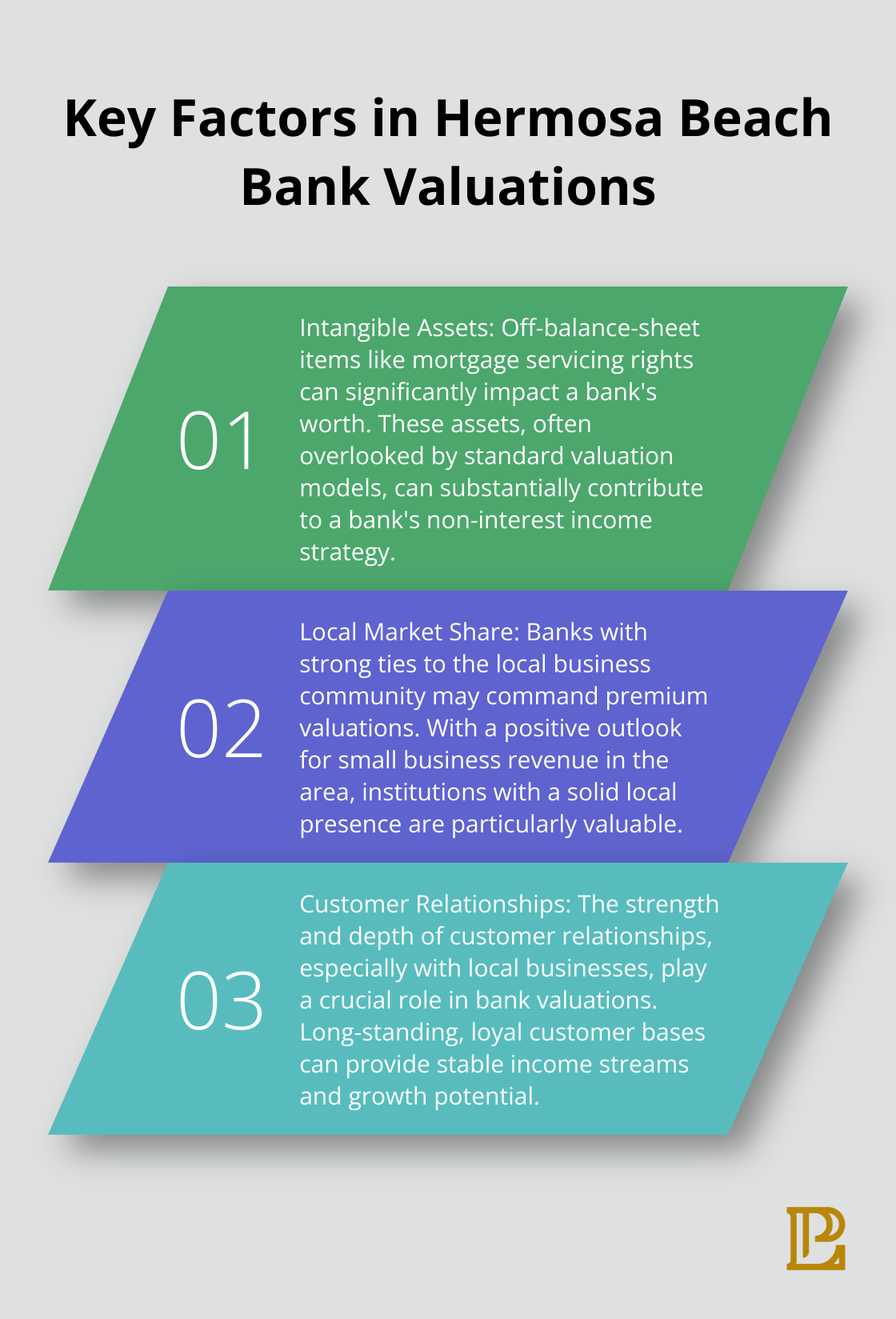
Local market share and customer relationships also factor heavily into valuations. With 78% of small business owners in Los Angeles County expecting revenue increases in 2024, banks with strong ties to the local business community may command premium valuations.
Operational Integration Complexities
Post-merger integration often proves more challenging and costly than anticipated. When Professional Business Bank merged with Manhattan Bancorp in 2012, it resulted in the acquisition of four additional branches. This expansion increased market presence but also introduced significant operational complexities.
Banks must carefully assess the compatibility of their core banking systems, customer relationship management tools, and regulatory reporting processes. Incompatible systems can lead to data inconsistencies, compliance issues, and customer dissatisfaction.
Cultural Alignment: A Critical Success Factor
Employee retention and cultural alignment often determine the success or failure of M&A deals. Manhattan Bancorp’s success in growing its mortgage division (which accounted for approximately 87% of non-interest income in 2012) hinged on retaining key talent and maintaining a sales-oriented culture.
Banks considering M&A should conduct thorough cultural due diligence. This includes assessment of management styles, decision-making processes, and customer service philosophies. Misaligned cultures can lead to employee turnover, productivity losses, and ultimately, deal failure.
Final Thoughts
Mergers and acquisitions in the banking industry continue to reshape Hermosa Beach’s financial landscape. Community banks and credit unions adapt to new market realities, driven by the need for scale, technological advancements, and regulatory pressures. We expect further consolidation in the local banking sector, with smaller institutions seeking partnerships and larger banks targeting acquisitions to expand their capabilities.
Successful banking M&A transactions require more than financial acumen. The complex web of regulations, antitrust considerations, and operational challenges demand expert legal guidance. Pierview Law understands the intricacies of banking M&A in Hermosa Beach and provides sophisticated legal support to navigate these transactions successfully.
The future of banking in Hermosa Beach will be shaped by those who effectively navigate M&A complexities. Banks can turn these challenges into opportunities for growth and innovation in our vibrant local market. With careful planning, strategic foresight, and expert legal guidance (such as that provided by Pierview Law), financial institutions can position themselves for success in this evolving environment.