
Corporate social responsibility and law are no longer optional considerations for business owners in Hermosa Beach. The regulations governing CSR practices have become increasingly complex, with federal mandates, state requirements, and industry-specific rules creating a challenging landscape.
At Pierview Law, we help business owners understand these obligations and build strategies that protect their companies while meeting legal requirements. This guide walks you through the key compliance areas and practical steps to strengthen your CSR framework.
What CSR Laws Actually Apply to Your Business
Federal and State Requirements Shape Your Obligations
Federal law sets the foundation, but California imposes stricter obligations that you cannot ignore. The Transparency in Supply Chains Act specifically requires companies with annual worldwide gross revenues exceeding $100 million to disclose efforts to eliminate slavery and human trafficking from supply chains. This is not optional-failure to comply exposes your business to reputational damage and potential legal action.
The EU Non-Financial Reporting Directive and the UK Modern Slavery Act have created a global standard that affects even small businesses in Hermosa Beach if you sell products or services across state lines or work with international suppliers. Environmental regulations continue to tighten with measurable penalties for non-compliance. If your business operates facilities, manages waste, or handles hazardous materials, California’s strict environmental codes apply directly to you.
Labor Laws and Fiduciary Duties Demand Action
Labor laws have expanded dramatically, covering wage standards, workplace safety, anti-discrimination protections, and explicit requirements around supply chain due diligence. Directors’ fiduciary duties increasingly align with CSR initiatives when pursued in good faith for long-term shareholder value. This means your board cannot ignore sustainability and social responsibility-it is now part of good governance, not separate from it.
Industry-Specific Rules Vary Significantly
Industry-specific requirements add another layer of complexity that varies dramatically by sector. Travel and tourism companies must address decarbonization across operations and supply chains. Real estate developers and property managers face housing compliance issues under fair housing laws and tenant protection statutes. Manufacturers and importers must screen suppliers for labor violations and document their due diligence thoroughly.
Documentation Creates Your Legal Defense
The documentation burden is substantial and non-negotiable. You must maintain records of all supplier audits, compliance assessments, remediation efforts, and stakeholder engagement activities. Regulators and courts will scrutinize these records if liability arises, so incomplete or missing documentation becomes evidence against you.
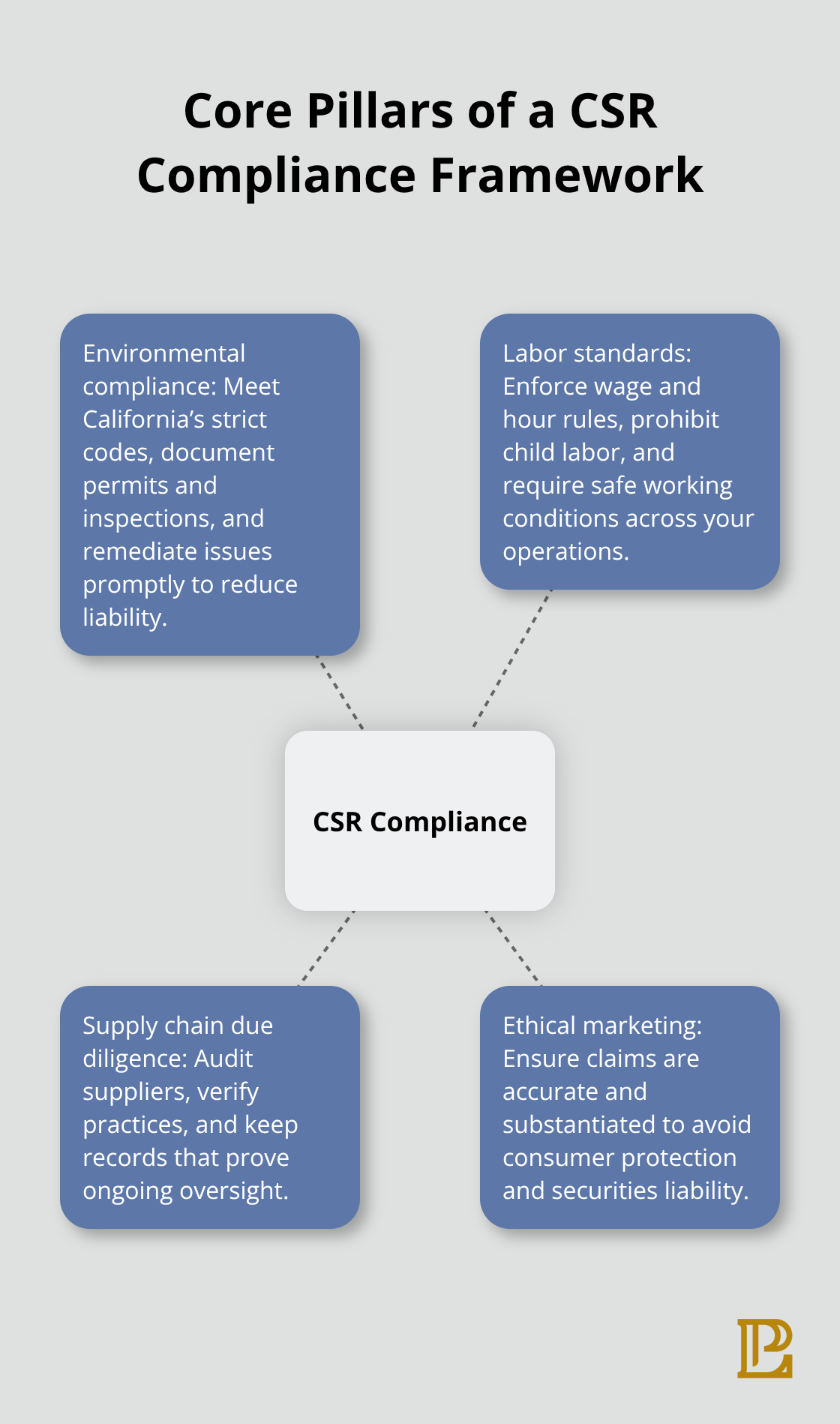
Many businesses treat CSR reporting as a marketing exercise rather than a legal obligation. Transparency requirements now carry teeth-misleading or overstated sustainability claims trigger liability under consumer protection and securities laws. Third-party verification of your CSR disclosures strengthens credibility and reduces legal exposure. A formal CSR compliance framework covering environmental compliance, labor standards, supply chain due diligence, and ethical marketing, backed by regular audits and thorough documentation, is no longer a competitive advantage-it is a legal necessity that protects your business from mounting regulatory scrutiny. Understanding these requirements is the first step, but translating them into actual policies and procedures requires a structured approach that addresses your specific operations and industry.
Common CSR Legal Challenges for Businesses
Environmental Liability Threatens Your Personal Assets
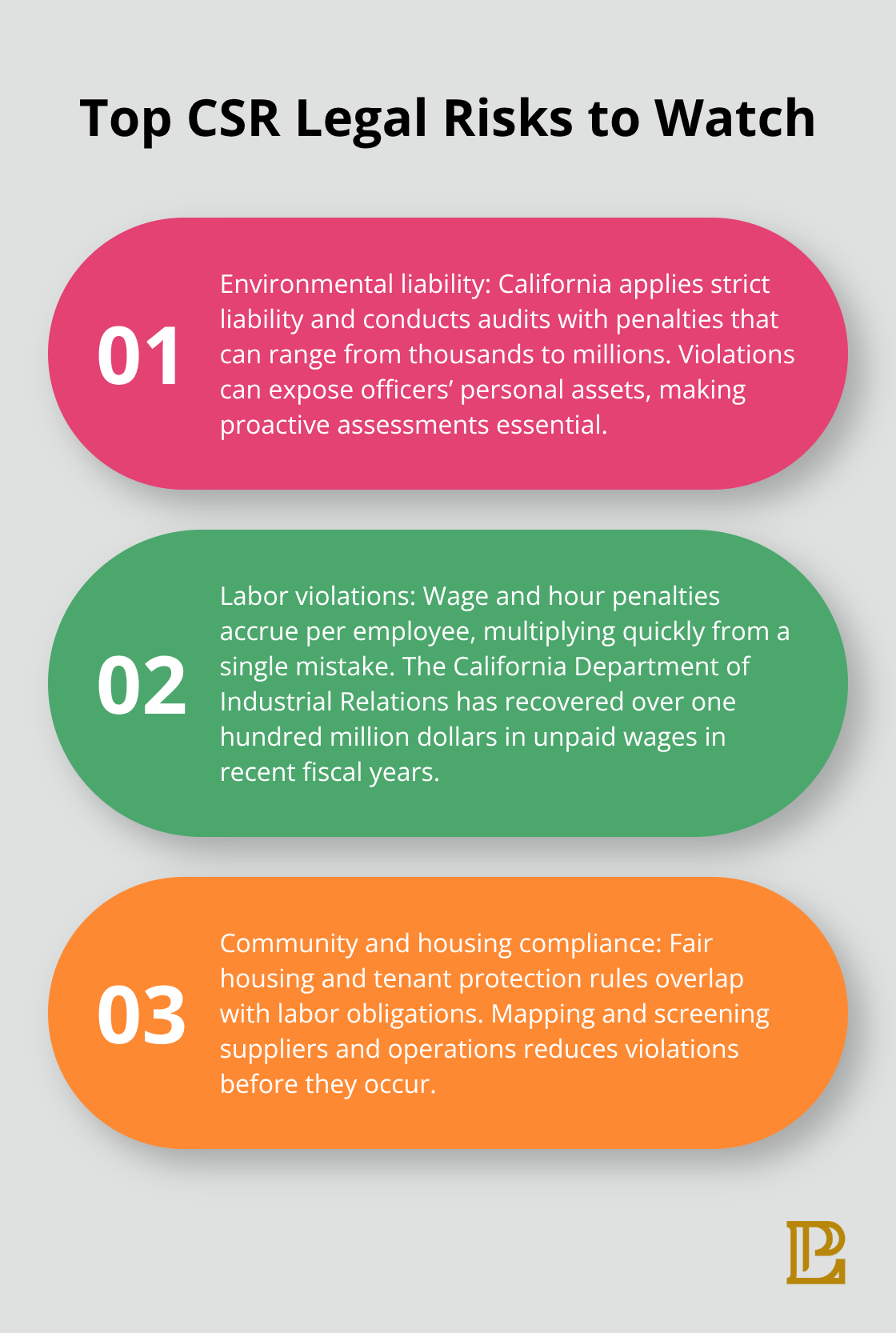
Environmental liability stands as the most concrete financial threat businesses in Hermosa Beach face today. California’s environmental regulations impose strict liability standards, meaning regulators hold you responsible for contamination even if you did not directly cause it. If your facility handles hazardous materials, stores waste, or operates near water sources, inspectors conduct audits with measurable penalties attached. Non-compliance fines range from thousands to millions depending on violation severity and duration.
More critically, environmental violations create personal liability for officers and directors under California law, not just corporate liability. Your personal assets become exposed when violations occur. The California Department of Toxic Substances Control maintains an active enforcement program and does not wait for complaints to investigate. Many businesses discover violations only after an audit or when selling property, at which point remediation costs skyrocket. Conduct an environmental assessment of your current operations now, document what you find, and create a remediation timeline. Third-party environmental consultants charge between five and fifteen thousand dollars for a basic audit, but this investment protects you against far larger liability exposure down the road.
Labor Violations Accumulate Quietly and Compound Rapidly
Labor and employment compliance failures create persistent legal exposure because violations accumulate quietly. California’s wage and hour laws impose penalties per violation per employee, so a single payroll mistake affecting ten employees generates ten separate violations. The California Department of Industrial Relations recovered over one hundred million dollars in unpaid wages in recent fiscal years, and they actively pursue cases.
Supply chain labor violations carry different weight entirely. If your suppliers employ undocumented workers or operate unsafe facilities, you bear responsibility under the Transparency in Supply Chains Act and California’s supply chain due diligence expectations. You cannot claim ignorance about supplier practices. Conduct supplier audits at minimum every two years, require written commitments to labor standards in all contracts, and document every interaction. This upfront work prevents expensive litigation and regulatory action later.
Community Impact and Housing Compliance Create Overlapping Obligations
Community impact obligations increasingly overlap with labor compliance because fair housing laws, tenant protection statutes, and community benefit agreements now carry teeth. Real estate developers and property managers in Hermosa Beach face specific exposure around habitability standards, rent control compliance, and displacement prevention. If your business operates in hospitality, retail, or service sectors, labor practices directly affect community stability and regulatory standing.
Start by mapping your entire supply chain and identifying which suppliers operate in high-risk jurisdictions or handle sensitive activities. Then implement a screening process that examines labor practices, environmental compliance, and community impact before engaging new suppliers. This systematic approach to supplier evaluation prevents costly violations before they occur. The next section addresses how to build a CSR compliance strategy that transforms these legal obligations into actionable policies and procedures tailored to your specific operations.
Building Your CSR Compliance Strategy
Conduct a Legal Audit of Your Current Operations
Start with a legal audit of your current operations before you create any new policies. This audit maps your existing practices against California’s Transparency in Supply Chains Act, environmental regulations, labor standards, and fair housing laws if applicable to your business. Many business owners in Hermosa Beach operate without knowing which CSR obligations actually apply to them, and that uncertainty becomes liability. Schedule time with your leadership team and document how you currently handle supplier relationships, environmental management, workplace safety, and community engagement. Write down what you do today, not what you wish you were doing. This baseline reveals gaps immediately. If you cannot produce supplier audit records from the past two years, that gap is a compliance vulnerability. If your contracts lack language requiring suppliers to meet labor standards, that is another vulnerability. If you handle environmental materials without documented procedures, that is a third. These gaps are not failures-they are starting points. The audit typically takes two to four weeks depending on your business size and complexity. Involve your finance team, operations manager, and HR department in this process because they understand your actual practices better than anyone else.
Develop Written Policies That Assign Clear Responsibility
After identifying gaps, develop written policies that address your specific vulnerabilities and assign ownership to actual people. Do not create generic sustainability statements that sound impressive but lack enforcement mechanisms. Instead, write policies that specify who is responsible for supplier screening, how often audits occur, what happens when violations are discovered, and how you document everything. For environmental compliance, assign responsibility to a specific person or department and require quarterly inspections with written records. For labor compliance, establish a supplier contract template that explicitly requires adherence to wage and hour laws, prohibits child labor, and permits your right to audit. For community impact obligations, document how you engage with local stakeholders and address complaints. Link executive compensation to CSR performance metrics-research from leading organizations shows this alignment significantly increases compliance outcomes because leadership takes these obligations seriously when their bonuses depend on it. Update your governance documents to explicitly include CSR goals alongside financial targets.
Monitor Policies Quarterly and Document Everything
Monitor these policies quarterly by reviewing audit results, supplier compliance records, and incident reports. Do not wait for annual reviews. Quarterly monitoring catches violations early when remediation costs less and legal exposure remains minimal. Create a simple spreadsheet tracking which suppliers you have audited, when the next audit is due, and any findings that require follow-up. This documentation becomes your legal defense if regulators investigate. When violations surface, document your remediation steps immediately and preserve all records. Many businesses fail to meet CSR obligations not because they lack good intentions but because they lack accountability systems that actually work. The discipline of regular monitoring transforms CSR from an aspirational goal into an operational reality that protects your business from regulatory exposure.
Final Thoughts
Corporate social responsibility and law are now inseparable for business owners in Hermosa Beach. The regulations you face directly affect your operations, your personal liability, and your bottom line. This framework moves you from uncertainty to action by identifying your specific obligations, revealing compliance gaps, and establishing systems that actually work.
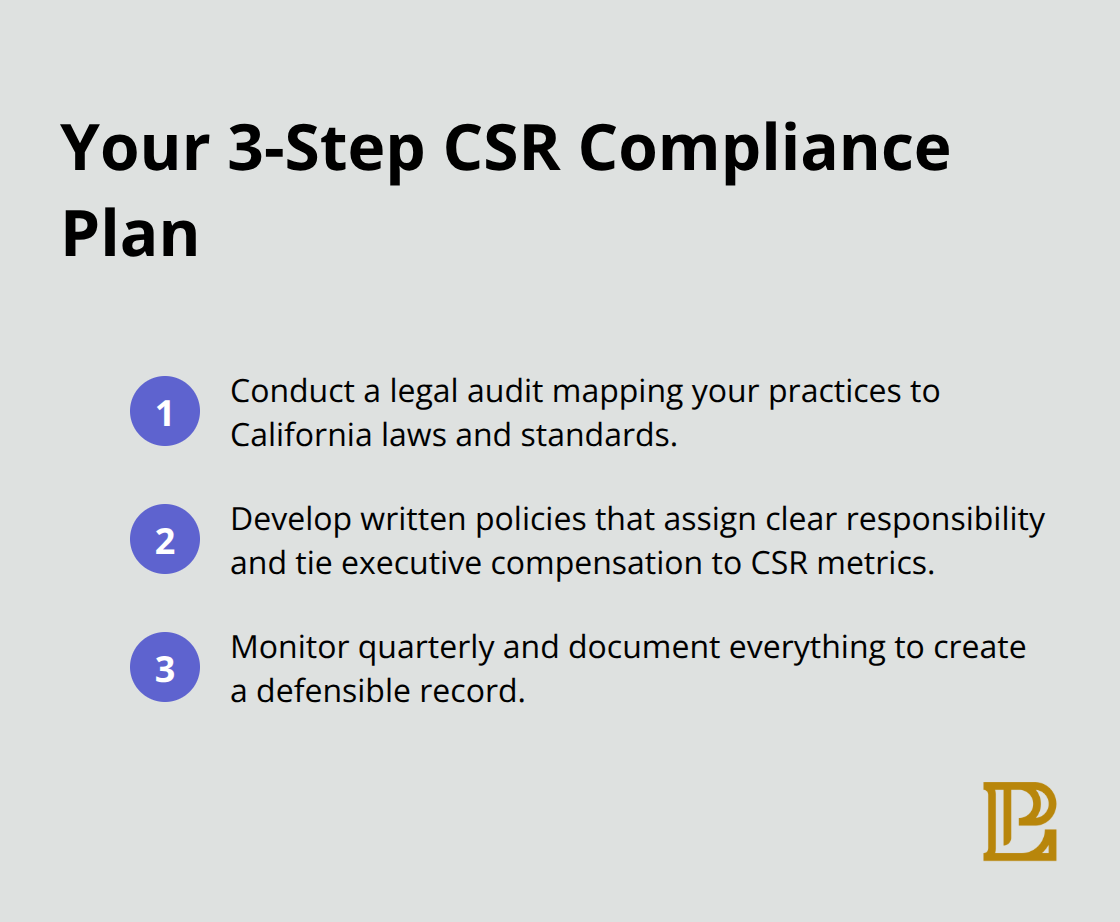
CSR compliance requires three concrete steps that transform responsibility into operational reality. First, conduct a legal audit that maps your current practices against California’s Transparency in Supply Chains Act, environmental codes, labor standards, and industry-specific rules. Second, develop written policies that assign clear responsibility to actual people and link executive compensation to CSR performance metrics. Third, monitor these policies quarterly with documented records that become your legal defense if regulators investigate.
Your next step is to schedule a consultation with legal counsel who understands both your industry and California’s evolving CSR landscape. Pierview Law provides business law services including entity formation, contract drafting, and outside general counsel support to help you build CSR frameworks tailored to your operations. Start your legal audit this month, identify your compliance gaps, and assign ownership to specific people.