
Your intellectual property is one of your most valuable business assets, yet many business owners in Hermosa Beach don’t realize how exposed they are to IP risks until it’s too late.
An IP risk assessment identifies vulnerabilities before they become expensive legal battles. At Pierview Law, we’ve seen firsthand how a proactive approach saves businesses thousands in potential damages and lost revenue.
Why IP Risk Assessment Matters
Most business owners in Hermosa Beach don’t conduct an IP risk assessment until after they’ve been sued or discovered a competitor selling knockoffs of their products. That’s a costly mistake. A proper assessment identifies vulnerabilities before they drain your bank account through litigation, damages, or lost market share. We’ve handled disputes where businesses lost tens of thousands in revenue because they never mapped out what IP they actually owned or failed to register it properly. The difference between a business that acts proactively and one that reacts to infringement is often the difference between staying competitive and folding.
Hidden vulnerabilities cost real money
Many business owners assume their brand name, logo, or product design is automatically protected. It isn’t. Trademark rights come from use and registration, not wishful thinking. If you haven’t filed a federal trademark application with the USPTO, your protection is limited to the specific geographic area where you actively use the mark. A competitor in another state can register the same or similar mark and legally operate there.
Copyright protects original creative works automatically, but registration with the US Copyright Office strengthens your position significantly. If you need to sue for infringement, registration allows you to recover statutory damages up to $150,000 per work and attorney’s fees. Unregistered works limit you to actual damages, which are often difficult and expensive to prove. Patents expire after 20 years, so waiting to file means losing years of exclusive protection. An assessment reveals these gaps before they become problems.
Competitor activity moves faster than most realize
Monitoring competitor behavior isn’t optional-it’s a survival tool. Set up Google Alerts for your brand name and product categories. Check marketplaces like Amazon and Etsy monthly for counterfeit or confusingly similar products. The International Trademark Association reports that counterfeit goods cost the global economy over $4.7 trillion annually, with small and medium businesses particularly vulnerable because they lack visibility into global supply chains.
When you find infringement, act quickly. A cease-and-desist letter often stops unauthorized sellers without litigation. DMCA takedown notices remove infringing content from platforms within days. Waiting weeks or months to respond gives infringers time to establish market presence and customer loyalty, making them harder to remove later.
Build your monitoring plan now
An IP risk assessment includes a formal monitoring plan that assigns responsibility for regular searches and defines your response protocol. This plan protects your brand before problems escalate into expensive disputes. The next section walks through how to conduct that assessment and identify what IP assets actually need protection.
The Three IP Threats That Hit Hermosa Beach Businesses Hardest
Trademark infringement drains your customer base
Trademark infringement occurs when a competitor uses a mark confusingly similar to yours, either intentionally or through carelessness. The damage extends beyond legal fees-it’s commercial and immediate. Customers searching for your brand find the competitor instead. You lose sales. Your reputation gets tangled with theirs.
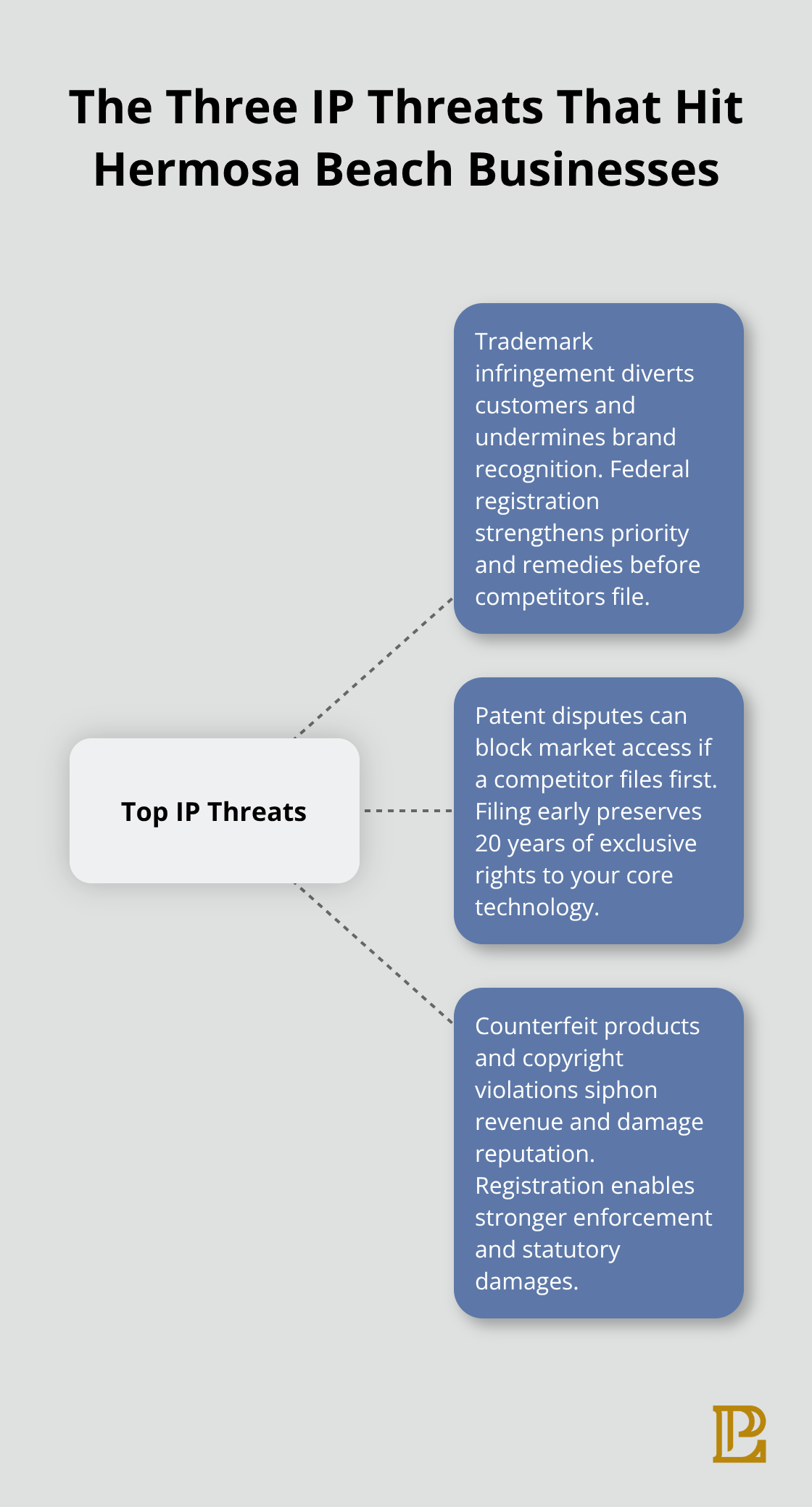
The USPTO receives over 600,000 trademark applications annually, and many of those filings attempt to register marks nearly identical to existing ones. If your trademark isn’t registered federally, you have no record at the USPTO proving your priority date, which means a later filer can claim rights in markets you haven’t yet protected. Unregistered marks also limit your remedies to actual damages, which are notoriously hard to quantify.
Federal registration costs roughly $300 to $400 per class and takes 4 to 6 months, but it gives you the legal foundation to protect your brand and stop infringers before they establish customer loyalty in your territory. That investment pays for itself the moment you need to enforce your rights.
Patent disputes lock you out of your own market
Patent disputes and technology theft follow a different but equally damaging path. Your product or business method represents years of development and capital investment. A patent grants 20 years of exclusive rights, but only if you file before a competitor does. The USPTO Patent Trial and Appeal Board handles thousands of disputes annually, many involving small tech companies that delayed filing because they thought their innovation was too niche or too obvious to patent.
Patent prosecution isn’t cheap-expect $5,000 to $15,000 for a basic utility patent-but the cost of losing exclusive rights to your core technology is far higher. Once a competitor reverse-engineers your product or process and files their own patent, they block you from your own market. Many Hermosa Beach businesses operating in tech, manufacturing, or specialized services don’t realize that software, business methods, and hardware designs all qualify for patent protection if they meet the novelty and non-obviousness standards.
Counterfeit products steal your brand identity and revenue
Copyright violations and counterfeit products round out the trio of threats. Counterfeit goods cost businesses an estimated $4.7 trillion globally annually according to the International Trademark Association, but that number masks a painful reality for individual owners: a single counterfeit seller on Amazon or Etsy can siphon off your entire customer base before you notice. Copyright registration with the US Copyright Office enables statutory damages up to $150,000 per infringement and attorney’s fees recovery, transforming a dispute from unwinnable to actionable. Without registration, proving actual damages for copied software, design files, or creative content requires detailed sales records and expert testimony-expensive and uncertain.
Counterfeiters rely on the fact that most small business owners don’t monitor their own listings or set up alerts. They operate for months or years undetected, building reviews and customer trust under your brand name. Setting up Google Alerts for your brand and checking marketplaces monthly stops this before it starts. A cease-and-desist letter often halts unauthorized sellers without litigation. DMCA takedown notices remove infringing content from platforms within days. Waiting weeks or months to respond gives infringers time to establish market presence and customer loyalty, making them harder to remove later.
These three threats share one common thread: they all accelerate when you fail to monitor and respond quickly. The next section shows you how to build a monitoring plan that catches infringement before it becomes a crisis.
Building Your IP Risk Assessment
Create a complete inventory of your IP assets
Start your assessment by creating a complete inventory of everything your business owns that has IP value. List every trademark you use, every product design, every piece of software code, every customer database, every manufacturing process, and every brand asset you’ve created. Most business owners in Hermosa Beach cannot answer basic questions about their own IP within the first hour of this exercise, which reveals how exposed they are. Write down the trademark you use for your main product or service, your logo, your company name, your tagline, any product names, and any distinctive packaging or design elements. Document which of these you’ve registered with the USPTO and which ones exist only through use. For patents, list any inventions, processes, or methods that give you a competitive edge. Note the filing dates, patent numbers, and expiration dates. For copyrights, identify your original works including software, graphics, written content, and product manuals. Check whether you’ve registered them with the US Copyright Office. For trade secrets, document confidential information like customer lists, pricing strategies, manufacturing processes, or proprietary formulas that you protect through access controls and NDAs. This inventory becomes your roadmap for what needs protection and what gaps exist.
Monitor your brand across all channels
Establish a monitoring system that runs automatically and continuously. Set up Google Alerts for your brand name, your product names, and your company name to catch unauthorized use across the web. Check Amazon, Etsy, eBay, and any marketplace relevant to your industry at least monthly for counterfeit or confusingly similar products. Search the USPTO trademark database quarterly to see if competitors are filing marks similar to yours in your industry classes.
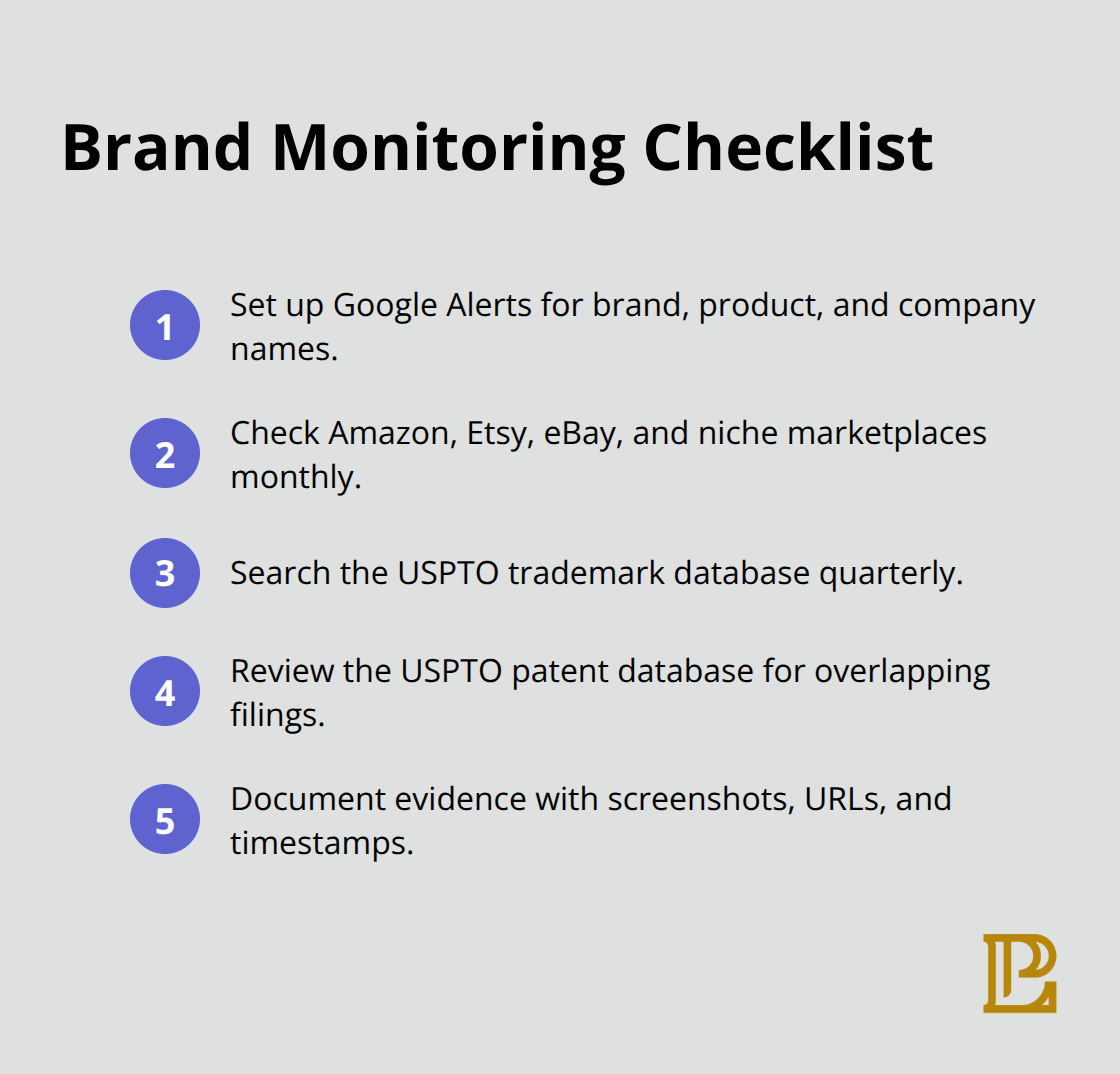
Review the USPTO patent database for any patents filed by competitors that might overlap with your technology or business methods. When you find potential infringement, document it immediately with screenshots, URLs, and timestamps.
Respond to infringement within 30 days
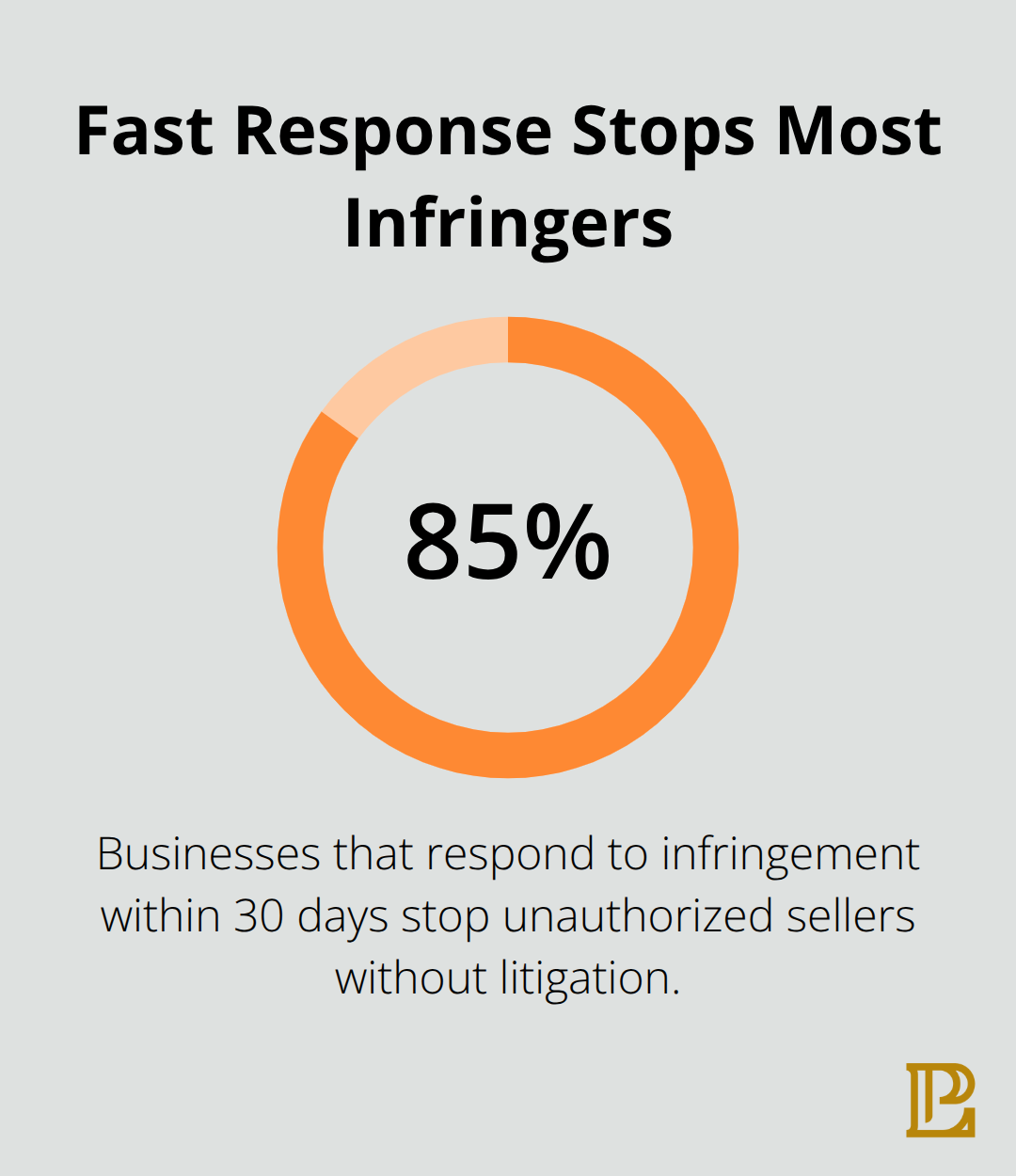
Create a response protocol that defines who handles takedown notices, who drafts cease-and-desist letters, and what timeline triggers escalation to legal action. The International Trademark Association reports that businesses that respond to infringement within 30 days stop unauthorized sellers 85 percent of the time without litigation. Waiting longer than 60 days allows infringers to establish customer loyalty, making removal far more difficult and expensive.
A cease-and-desist letter often halts unauthorized sellers without litigation. DMCA takedown notices remove infringing content from platforms within days.
Track competitor activity twice yearly
Conduct a competitive intelligence review at least twice yearly. Research what your top three competitors have registered with the USPTO, what patents they hold, and what trademarks they use in adjacent markets (including adjacent geographic regions and product categories). This identifies potential conflicts before they become disputes and reveals market opportunities where trademark or patent protection might strengthen your position. You’ll spot threats early and avoid costly overlaps with established competitors.
Final Thoughts
An IP risk assessment forms the foundation of protecting what you’ve built. Businesses in Hermosa Beach that stay ahead of infringement map their assets, monitor their markets, and respond to threats before they escalate. You now understand what IP vulnerabilities look like, where they hide, and how quickly they drain revenue when left unaddressed.
Start your IP risk assessment by inventorying everything your business owns that has IP value: trademarks, patents, copyrights, trade secrets, and brand assets. Document what you’ve registered and what gaps exist, then set up monitoring systems that run automatically through Google Alerts for your brand, monthly marketplace checks, and quarterly USPTO database searches. Create a response protocol that defines who handles takedowns and cease-and-desist letters, with a 30-day response window as your standard.
These steps cost far less than defending against infringement after it happens (federal trademark registration runs $300 to $400 per class, copyright registration costs under $100, and patent prosecution ranges from $5,000 to $15,000). Compare that to litigation costs, lost revenue from counterfeiters, or being locked out of your own market by a competitor’s patent. Contact Pierview Law to discuss your IP risk assessment and next steps.