
Your intellectual property is one of your business’s most valuable assets. Patent law and intellectual property protection can feel overwhelming, but understanding the basics makes the process manageable.
At Pierview Law, we help business owners in Hermosa Beach navigate these protections and secure what matters most. This guide walks you through patents, trademarks, trade secrets, and other tools to defend your innovations.
What Patents Protect and How They Work
A patent grants you exclusive rights to prevent others from making, using, or selling your invention without permission. The U.S. Patent and Trademark Office defines this protection as covering inventions that are novel, non-obvious, and useful. If you’ve developed a new product, process, machine, or composition of matter, a patent can shield your competitive advantage.
The scope of protection depends heavily on how you write your patent claims-the specific language that defines what your invention covers. Many business owners underestimate how narrowly or broadly their claims can be written, which directly affects enforceability. A poorly drafted claim might leave gaps competitors can exploit, while overly broad claims can face rejection during examination or invalidation later. Patents do not protect ideas or abstract concepts alone; they protect tangible, implementable inventions with real-world applications.
Understanding Patent Claims and Their Impact
Your patent claims determine what protection you actually receive. The U.S. Patent and Trademark Office examines each claim to verify it meets patentability standards. Narrow claims offer less competitive protection but face easier approval, while broad claims provide stronger coverage but encounter higher rejection rates. You must balance protection scope against the realistic chance of approval during examination.
Utility Patents: The Most Common Protection
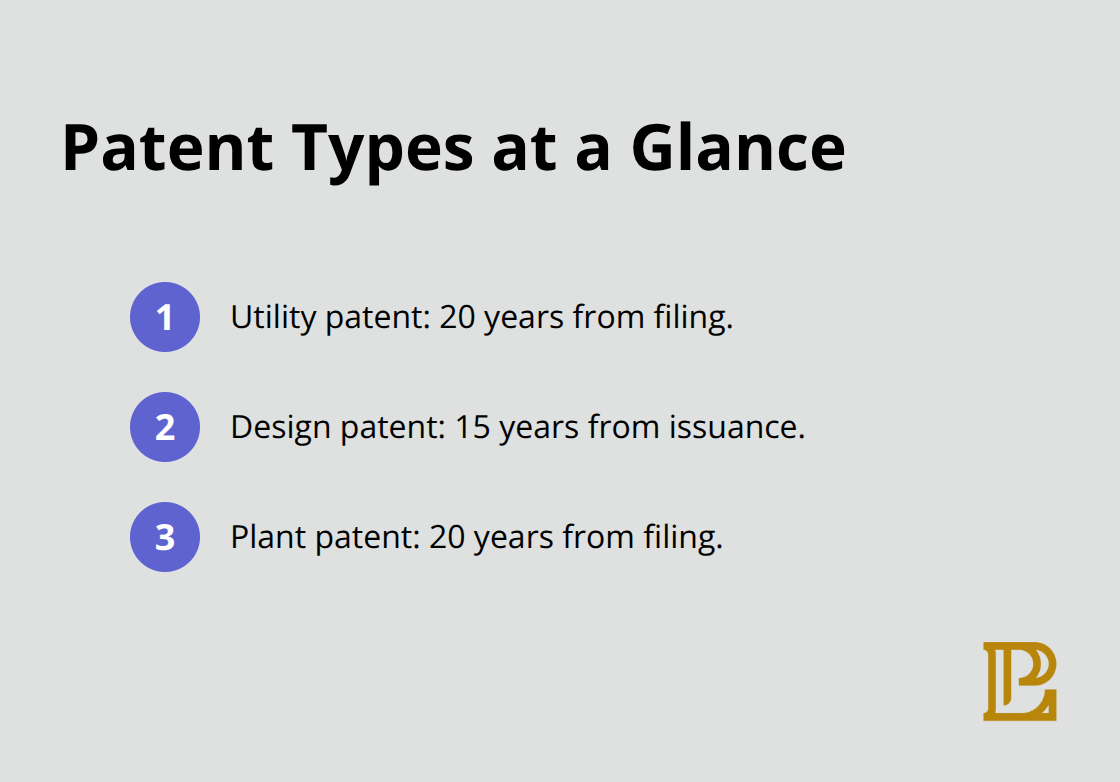
Utility patents cover the vast majority of inventions-machines, processes, compositions, and improvements to existing things. These last 20 years from your filing date and represent the strongest protection available. Most California businesses filing patents choose utility protection because it covers function and method, which typically delivers the highest commercial value.
Design Patents: Protecting Visual Appearance
Design patents protect the unique visual appearance of an object, lasting 15 years from issuance, and manufacturers often overlook them when they focus only on utility protection. A product could have both a utility patent (covering how it works) and a design patent (covering its distinctive shape or appearance). This dual protection strategy strengthens your overall competitive position.
Plant Patents and Multi-Category Strategy
Plant patents cover asexually reproduced plants and last 20 years, applying mainly to agricultural and horticultural innovation. Your invention might qualify for multiple patent types simultaneously. The Patent Trial and Appeal Board handles post-grant challenges to all three types, so patent strength matters regardless of category. Understanding which type fits your situation prevents costly mistakes before you move forward with your application strategy.
Moving From Idea to Patent Protection
Conducting a Prior Art Search
Before you file anything with the U.S. Patent and Trademark Office, you need to know whether your invention is actually new. A prior art search reveals existing patents, published applications, and public disclosures that might block your protection. The Patent Public Search tool on the USPTO website lets you search millions of patents and published applications at no cost, but many business owners miss critical references because they search too narrowly or use weak keywords.
Search variations of your invention’s function, appearance, and industry category. If you find something similar, that doesn’t automatically kill your chances-your invention just needs to differ in a meaningful way that wouldn’t be obvious to someone in your field. This is where many inventors stumble: they assume their idea is unique because they haven’t seen it advertised, but prior art includes abandoned patents, expired patents, and foreign filings that never reached the marketplace.
A thorough search takes hours, not minutes. Professional patent search services exist specifically because the process is complex and mistakes are expensive. If you’re serious about protection, investing in a professional search pays dividends by identifying obstacles early.
Preparing Your Patent Application
After you’ve confirmed novelty, you move into application preparation, which demands precision in how you describe your invention. Your specification must explain what the invention does, how it works, and why it’s better than existing alternatives. Vague or incomplete descriptions lead to rejections during examination and weaker enforceability later.
Your patent claims determine what protection you actually receive. The U.S. Patent and Trademark Office examines each claim to verify it meets patentability standards. Narrow claims offer less competitive protection but face easier approval, while broad claims provide stronger coverage but encounter higher rejection rates. You must balance protection scope against the realistic chance of approval during examination.
Filing and Managing Examination
The Patent Center is the official portal where you file, manage your application, and track examination progress. When you file, the USPTO assigns an examiner who will scrutinize your claims against prior art and patentability standards.
Most first applications receive a rejection letter called an office action, typically within six to eighteen months depending on the technology field. This doesn’t mean your patent is dead-it means you have the opportunity to narrow your claims, provide arguments, or submit new evidence addressing the examiner’s concerns. The examination back-and-forth can take two to four years total, and patience combined with strategic claim drafting often converts rejections into allowances.
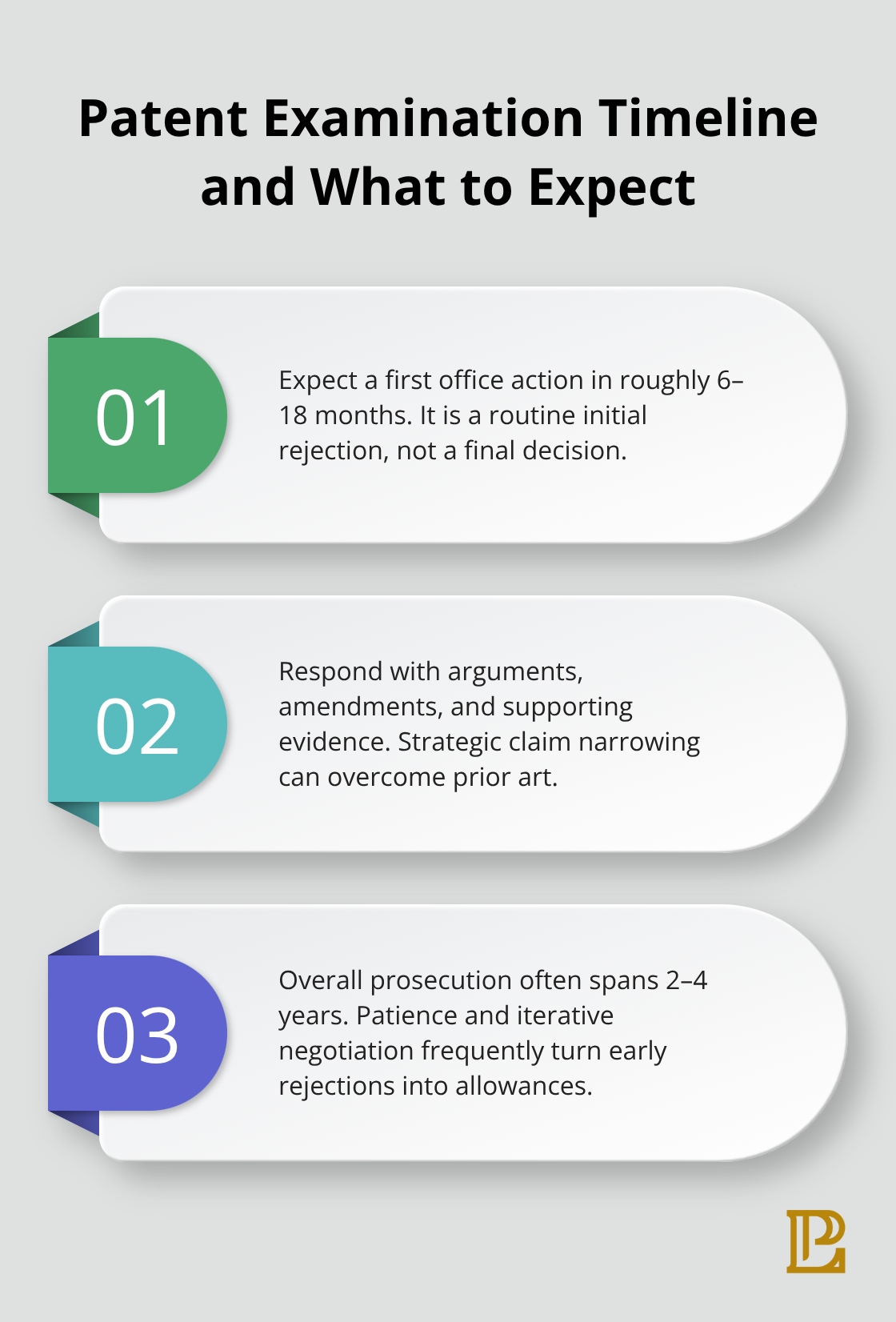
Many inventors give up after the first rejection because they don’t understand this is normal procedure, not a final verdict. The examiner’s initial response is a starting point for negotiation, not a conclusion.
Maintaining Your Patent After Grant
Maintenance fees also matter: once granted, utility patents require fee payments at 3.5 years, 7.5 years, and 11.5 years to stay in force. Missing these deadlines means losing your patent entirely, so calendar management is as important as the initial filing.
Understanding the full patent lifecycle-from search through examination to maintenance-positions you to protect your invention effectively. With this foundation in place, you can now explore how patents fit within a broader intellectual property strategy that includes trademarks, trade secrets, and other protections that work together to defend your competitive position.
Beyond Patents: Your Complete IP Protection Strategy
Patents protect your invention, but they’re only one piece of your intellectual property defense. Trademarks, trade secrets, and copyrights create overlapping protection that makes your business harder to copy and your brand impossible to steal. Many California business owners file a patent and assume they’re done, only to watch competitors use their brand name or steal their customer lists. A complete IP strategy treats these protections as interconnected tools, not isolated safeguards.
Trademark Registration and Brand Protection
Your brand name, logo, and slogan deserve federal registration with the U.S. Patent and Trademark Office, not just California state registration. Federal registration costs between $250 and $350 per class if you file online, and it gives you nationwide protection and the ability to sue for damages if someone infringes. State-level registration through the California Secretary of State is cheaper but limited to California, making it inadequate if you sell across state lines.
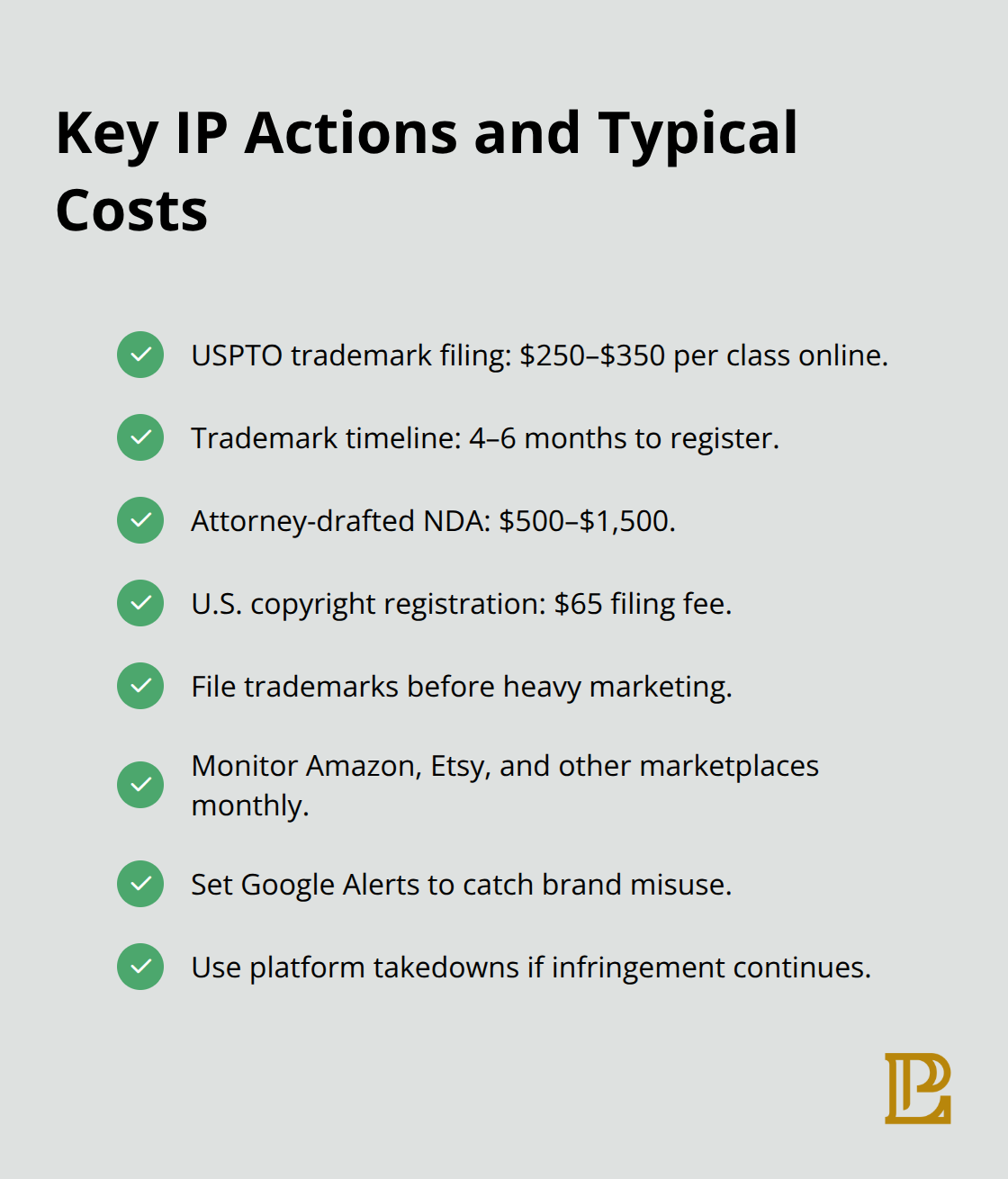
File your trademark before you launch heavy marketing because early filing strengthens your protection and prevents competitors from claiming they used similar marks first. The registration process takes four to six months, so don’t wait until your brand is famous to protect it. Once registered, maintain your trademark through consistent use and monitor for knockoffs on platforms like Amazon and Etsy. Set up Google Alerts for your brand name and check marketplace listings monthly.
When you find infringement, send a cease-and-desist letter immediately. Many small infringers stop when they receive formal notice, saving you litigation costs. If they continue, use platform takedown processes or escalate to your attorney.
Trade Secrets and Confidentiality Protection
Trade secrets and confidentiality agreements protect what patents cannot. Customer lists, pricing strategies, manufacturing processes, and software code qualify as trade secrets under California Business and Professions Code Section 3426 if you take reasonable steps to keep them confidential. This means implementing access controls, encrypting sensitive data, and restricting who sees what.
Many California businesses fail to include IP clauses in employee agreements, risking loss of digital creations when employees leave. Your employment contracts must state that work created during employment belongs to the company and that employees cannot disclose confidential information after departure. A well-drafted non-disclosure agreement costs $500 to $1,500 from an attorney and protects your ideas during discussions with potential partners, investors, or contractors. Without an NDA, you cannot prevent someone from taking your concept to a competitor.
Copyright Registration for Creative Works
Copyrights protect original works automatically upon creation, including your website code, product documentation, photos, and videos. Federal copyright registration with the U.S. Copyright Office costs $65 and provides the ability to sue for statutory damages and recover attorney fees if infringement occurs. Unregistered works can only recover actual damages, which are often impossible to prove.
Register your copyrights before infringement happens, not after. This three-part approach-trademark for your brand, trade secrets for confidential information, and copyrights for creative works-creates a fortress around your business that patents alone cannot provide.
Final Thoughts
Patent law and intellectual property protection demand action, not passive waiting. You now understand how patents work, which types fit your situation, and how to file strategically. Trademarks, trade secrets, and copyrights extend your protection far beyond what patents alone can provide, and combining these tools creates a competitive moat that competitors cannot easily breach. The biggest mistake business owners make is waiting for infringement to occur before taking action-proactive protection saves money and prevents loss of competitive advantage.
Start with a prior art search to confirm your invention is novel, file your trademark before heavy marketing begins, and implement confidentiality agreements with employees and partners. Register your copyrights for creative works and establish access controls for trade secrets. These steps cost far less than litigation and prevent competitors from stealing what you’ve built. Many California business owners delay because they think patent law and intellectual property protection feel too complex or expensive, but delaying actually costs more-every day without protection is a day someone could copy your invention or use your brand name.
At Pierview Law, we help business owners in Hermosa Beach and throughout Los Angeles County navigate intellectual property strategy and secure what matters most. Contact us to discuss your patent law and intellectual property needs, and we’ll provide business-oriented solutions tailored to your situation.