
Patent litigation in California can drain resources and threaten your business if you’re not prepared. The stakes are high, and the legal landscape is complex.
At Pierview Law, we help California business owners navigate these disputes and protect what they’ve built. This guide walks you through the realities of patent litigation and the strategies that actually work.
How Patent Disputes Actually Start in California Courts
Patent disputes in California rarely begin in a courtroom. They start when one company sends a cease-and-desist letter, accusing another of infringing their patent. Most disputes originate from product launches, licensing disagreements, or competitive conflicts where two parties claim ownership or usage rights to the same technology.
According to the American Intellectual Property Law Association, patent litigation costs between $1.5 million and $3 million on average when the case goes to trial, with cases involving more than $25 million at stake reaching $5 million or higher in legal fees alone. California hosts more patent cases than any other state except Texas, with the Central District of California handling hundreds of cases annually.
Why Documentation Matters Early
When companies face infringement claims, they often lack clear documentation of their development process, leaving them vulnerable to accusations they could have prevented. A solid record of your innovation timeline, design decisions, and technical specifications strengthens your position significantly. Companies that maintain detailed development records from day one find themselves in a much stronger negotiating position when disputes arise.
Where Federal Courts Handle Your Case
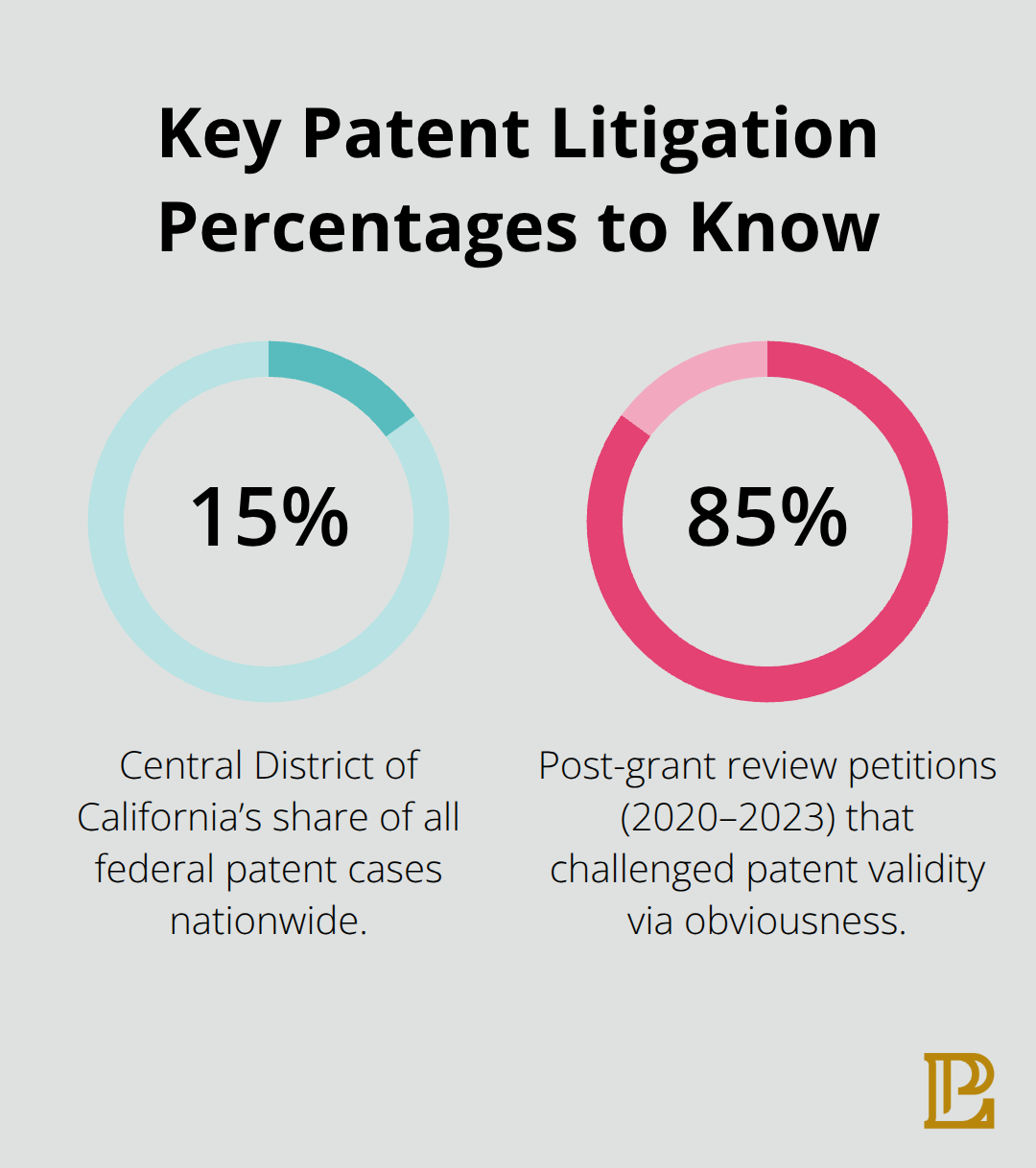
Federal courts handle all patent matters in the United States, which means your case won’t go to California state courts. The Central District of California, which covers Los Angeles County, receives roughly 15 percent of all federal patent cases nationwide. The U.S. District Court for the Central District of California has become a preferred venue for patent litigation because of its experienced judges and established procedures.
When defendants challenge where a case is filed, the court examines whether the defendant has sufficient contacts with the district. Most California patent cases take between two and four years from filing to trial, though many settle before reaching that stage. Discovery alone typically consumes six to eighteen months and generates hundreds of thousands of documents.
Appeals and Specialized Review
The Federal Circuit, located in Washington D.C., handles appeals of patent decisions. If you lose at trial, your appeal goes to specialized judges who focus exclusively on patent law rather than generalist appellate judges. This appellate structure means the judges reviewing your case understand patent complexities in ways that general courts do not.
Understanding where your case lands and how long the process takes helps you prepare financially and strategically. The next section covers the specific strategies that actually protect your patent rights throughout this process.
How to Build a Defensible Patent Case
Conduct a Thorough Prior Art Search
Prior art searches form the foundation of your defense, and waiting until litigation starts to conduct one costs far more money later. The U.S. Patent and Trademark Office database contains over 13 million patents, and a thorough search examines not just issued patents but also published applications, technical journals, and product documentation that predate your invention. When defendants challenge your patent’s validity, they will search aggressively for evidence that your innovation wasn’t actually new. Starting this work early means you understand your vulnerabilities before opposing counsel finds them.
A comprehensive prior art search typically costs between $2,000 and $5,000 when conducted properly, compared to hundreds of thousands spent later defending a patent that should never have been granted. Courts increasingly favor parties who can demonstrate they performed diligent searches during development because it shows good faith and strengthens your credibility. You should document every search result, every database you consulted, and every conclusion you reached. This documentation becomes evidence of your due diligence if litigation arrives.
Organize Your Evidence Portfolio Strategically
Your evidence portfolio determines how a judge or jury perceives your innovation and your defendant’s actions. You need to collect your development notebooks, email correspondence showing design iterations, prototypes with dates, test results, and any communications with the patent attorney who drafted your application. Technical evidence must be organized chronologically and cross-referenced to specific patent claims because courts evaluate infringement claim-by-claim rather than viewing your patent as a single unit.
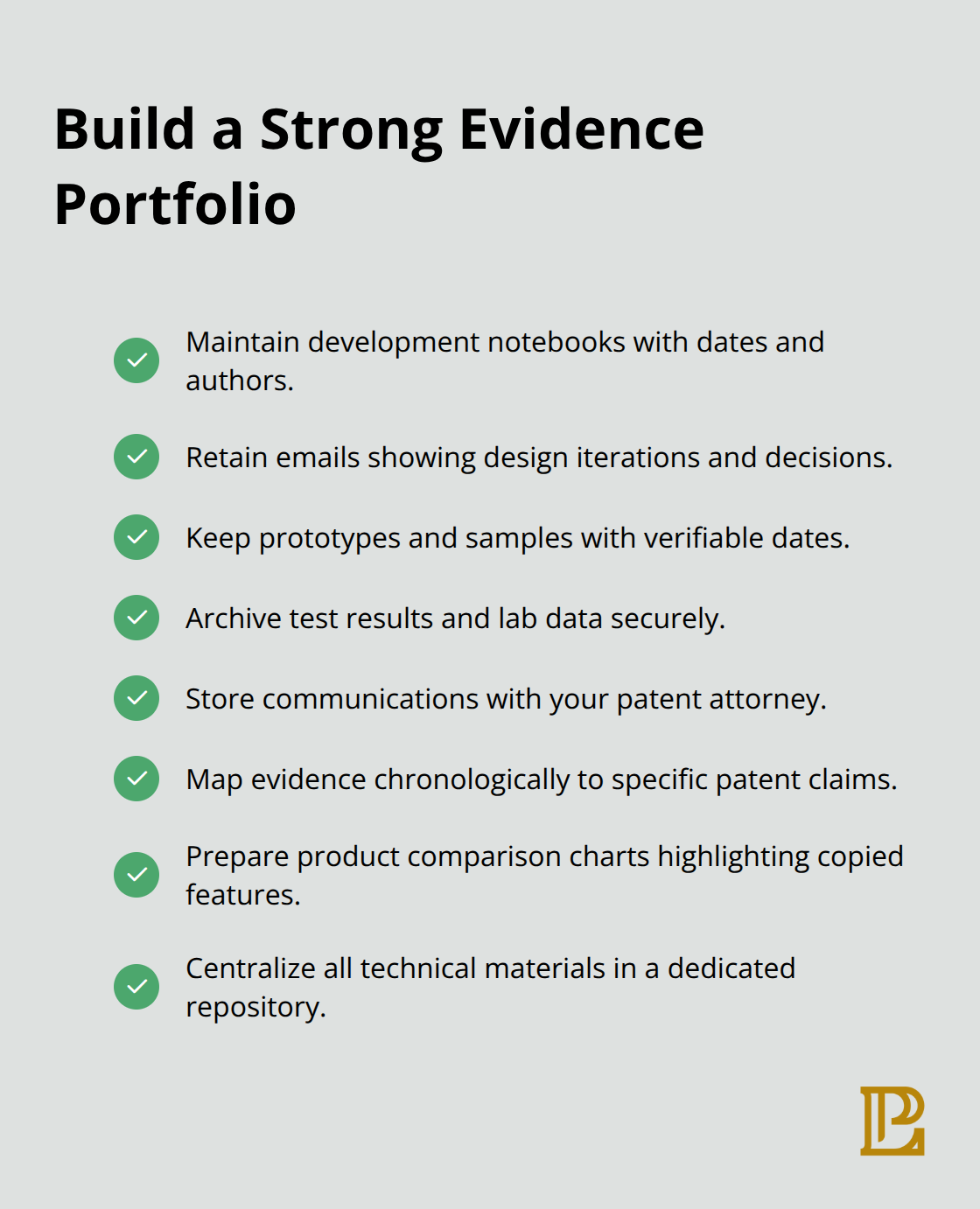
Product comparison charts that visually demonstrate how the defendant’s product copies your patented features prove far more effective than written arguments. If you can produce contemporaneous communications showing you disclosed your technology to third parties before the defendant’s product launch, that evidence strengthens your position significantly. You should maintain a dedicated file for all technical materials related to your patent because scattered documentation wastes months during discovery and weakens your presentation.
Preserve Technical Materials in Original Formats
Photographs, videos, and technical specifications require preservation in their original formats with metadata intact, as courts scrutinize whether evidence has been altered or manipulated. You must treat your evidence collection as an ongoing process rather than something you assemble only when a dispute emerges. The stronger your documentation practices are from the start (including development records, design decisions, and technical specifications), the more effectively you can defend your patent rights when challenges arise.
What Makes Patent Cases Technically Difficult to Win
Patent litigation forces you to translate innovation into evidence that judges and juries understand, and this translation process trips up most California business owners. Technical complexity becomes your biggest liability when opposing counsel exploits gaps in how you explain your invention. The U.S. District Court for the Central District of California reports that cases involving biotechnology, software, and semiconductor patents take significantly longer to resolve than mechanical patents because judges require more time understanding the technical foundations. You cannot win a patent case by being technically correct if you cannot communicate that correctness to the court. Many companies lose defensible cases because they present technical evidence poorly, not because their patents lack merit.
How to Present Technical Evidence Without Losing the Judge
Judges and juries lack your technical background, which means your evidence presentation determines whether they grasp your innovation or dismiss it as incomprehensible. Simplify your technical claims into visual demonstrations that show exactly what makes your patent different from existing technology. Create side-by-side comparisons of your patented features against the defendant’s product, using photographs, diagrams, or videos that highlight the specific differences claim-by-claim. When you must use technical terminology, define each term clearly the first time it appears, then use consistent language throughout the case. Courts increasingly favor parties who can explain complex technology in plain language because it demonstrates genuine understanding rather than reliance on jargon to obscure weaknesses.
Managing Discovery When Documents Multiply Uncontrollably
Discovery destroys budgets when you cannot manage the document volume effectively. The Federal Judicial Center reports that patent cases generate an average of 500,000 documents during discovery, and managing this volume without clear protocols costs hundreds of thousands in attorney time and review expenses. Start with strict document retention policies that identify which materials relate directly to your patent’s development, your defendant’s actions, and your damages calculation.
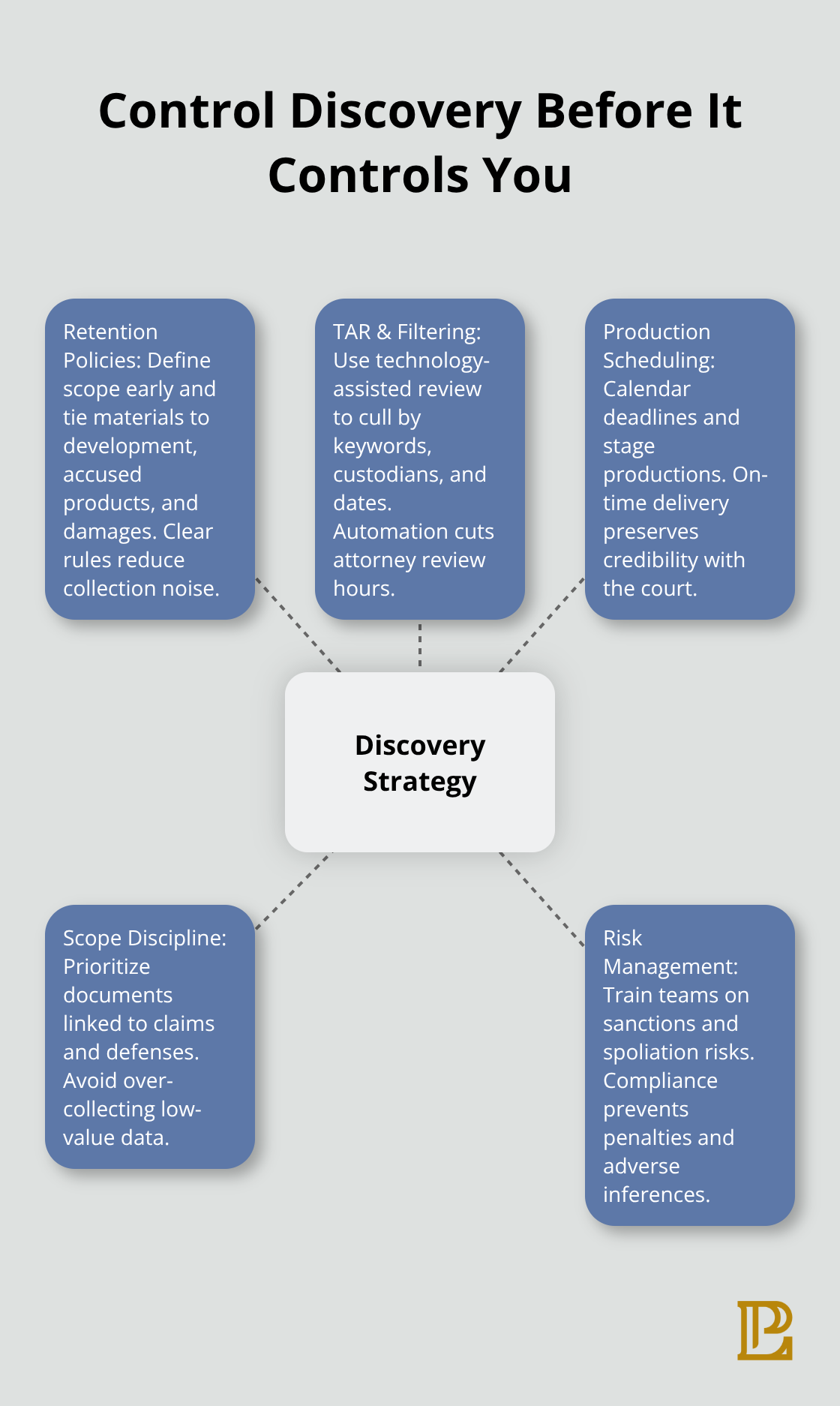
Technology-assisted review tools filter documents by keyword and date range, reducing manual review requirements significantly. You must produce documents on schedule because courts impose severe penalties for late production, including sanctions that damage your credibility with the judge.
Defending Against Validity Challenges Requires Documented Diligence
Defendants attack patent validity by arguing your invention was obvious or already existed before you filed your application, and these attacks succeed when you lack thorough documentation. The Patent Trial and Appeal Board reports that approximately 85 percent of post-grant review petitions filed between 2020 and 2023 challenged patent validity through obviousness arguments. Your prior art search from the development phase becomes your strongest defense because it demonstrates you investigated what existed before claiming your innovation as new. If you never documented this search, courts question whether you performed one at all, and that skepticism weakens your entire case. You need contemporaneous evidence showing you considered existing technology and why your invention advanced beyond it. Courts view parties who conducted diligent validity research as credible, while parties who appear to have rushed through development without investigation face unfavorable judgments regardless of actual merits.
Final Thoughts
Patent litigation in California demands preparation, documentation, and strategic legal guidance from the moment you recognize a dispute. The companies that successfully defend their patents share one common trait: they treat their intellectual property as a business asset requiring ongoing protection rather than something to address only when threatened. Your development records, prior art searches, and evidence organization determine whether you can defend your innovations effectively when litigation arrives.
The costs of patent litigation California cases justify investing in prevention and early preparation. Waiting until a cease-and-desist letter arrives to organize your evidence, conduct prior art searches, or gather technical documentation guarantees higher legal fees and weaker positioning. The companies that maintain detailed development timelines, document design decisions contemporaneously, and preserve technical materials in original formats enter litigation with significant advantages over unprepared competitors.
Contact Pierview Law to discuss your patent protection strategy and learn how we can defend your innovations in California courts. We help California business owners protect their intellectual property through strategic planning and aggressive defense when disputes arise. Our civil litigation team manages discovery, prepares pleadings, and represents you at trial or through alternative resolution forums.