
Your business name is your most valuable asset, and protecting it legally matters more than most owners realize. Trademark registration in California gives you the legal foundation to stop competitors from copying your brand and builds real value in your company.
We at Pierview Law help business owners in Hermosa Beach navigate the registration process and create IP portfolios that actually work. This guide walks you through everything from the initial search to long-term protection strategies.
Understanding Trademark Basics in California
What Actually Counts as a Trademark
A trademark is any word, phrase, symbol, design, or combination of these that identifies your business and distinguishes it from competitors. The U.S. Patent and Trademark Office received over 645,000 trademark applications in 2024, and California alone accounts for roughly 12% of all U.S. trademark registrations. Your business name qualifies, but so does a logo, a color scheme, a slogan, or even a sound associated with your brand. The key requirement is that it must be distinctive enough to prevent consumer confusion in the marketplace.
Many business owners mistakenly believe they need a fancy logo to protect their brand. A simple text-based name or phrase can receive the same legal protection as an elaborate design, provided it meets distinctiveness standards.
Federal Registration Beats State-Only Protection
California offers state-level trademark registration through the Secretary of State, but federal registration through the USPTO is substantially stronger for most businesses. Federal protection covers your trademark across all 50 states and U.S. territories, whereas state registration only protects you within California. The cost difference is minimal-federal registration typically runs $250 to $350 per class through the USPTO, while state registration costs around $70.
However, the legal advantages of federal registration are enormous. A federal registration creates a public record that deters competitors from adopting similar marks, gives you the right to sue in federal court, and allows you to register your trademark internationally. If you operate only in Hermosa Beach or limited areas of Los Angeles County, state registration might seem sufficient, but business expansion plans almost always make federal registration the smarter long-term choice.
Trademarks Directly Impact Business Valuation
Your trademark is a quantifiable business asset with real monetary value. Studies show that strong brand recognition increases customer loyalty by 40% compared to businesses without established trademarks. When you sell a business, the trademark often represents 10% to 25% of the total sale price (depending on the industry and brand strength).
Unregistered trademarks offer minimal protection-another business can legally use a similar mark and force you into expensive litigation to prove prior use. Registered trademarks eliminate this burden entirely and shift the legal advantage completely in your favor. Competitors face substantial legal and financial consequences for infringement, which makes them far less likely to risk copying your brand. Registration also prevents trademark squatters from registering similar marks before you expand into new markets or product categories.
Now that you understand what trademarks protect and why federal registration matters, the next step involves searching for existing marks and preparing your application.
Steps to Register Your Trademark in California
Search the USPTO Database Thoroughly
Before you file anything with the USPTO, you must search existing trademarks to avoid investing time and money in a mark that’s already registered or too similar to another business’s protection. The USPTO maintains the Trademark Electronic Search System, which is free and searchable by anyone. Most business owners assume a quick Google search is sufficient, but that misses the point entirely. The USPTO database contains over 2.3 million active trademark registrations, and your competitor might have registered a similar mark in a different industry that you’d never find through a standard internet search.
A comprehensive search requires you to check the USPTO database multiple times using different variations of your mark, search for phonetic similarities, check state trademark databases, and run common law searches to find unregistered marks in actual use. This step typically takes 2 to 4 hours of focused work. Skipping it is how business owners end up filing an application that gets rejected months later or facing a cease-and-desist letter after spending money on branding materials.
Prepare Your Application Materials Correctly
The USPTO rejects roughly 30% of initial applications due to incomplete or incorrect information, so you must prepare your application materials carefully. You’ll need to decide which goods or services your trademark will cover-the USPTO organizes these into 45 classes, and you pay a separate fee for each class you register in. A coffee shop registers a trademark only for beverages and perhaps merchandise, but a tech company might need coverage across multiple classes if they sell software, hardware, and consulting services.
Your application must include a clear specimen showing how you actually use the trademark in commerce (a product photo, website screenshot, or packaging label works), a detailed description of your goods or services written in proper USPTO format, and the correct filing basis-either you’re already using the mark in commerce or you have a bona fide intent to use it soon.
File Your Application and Manage the Process
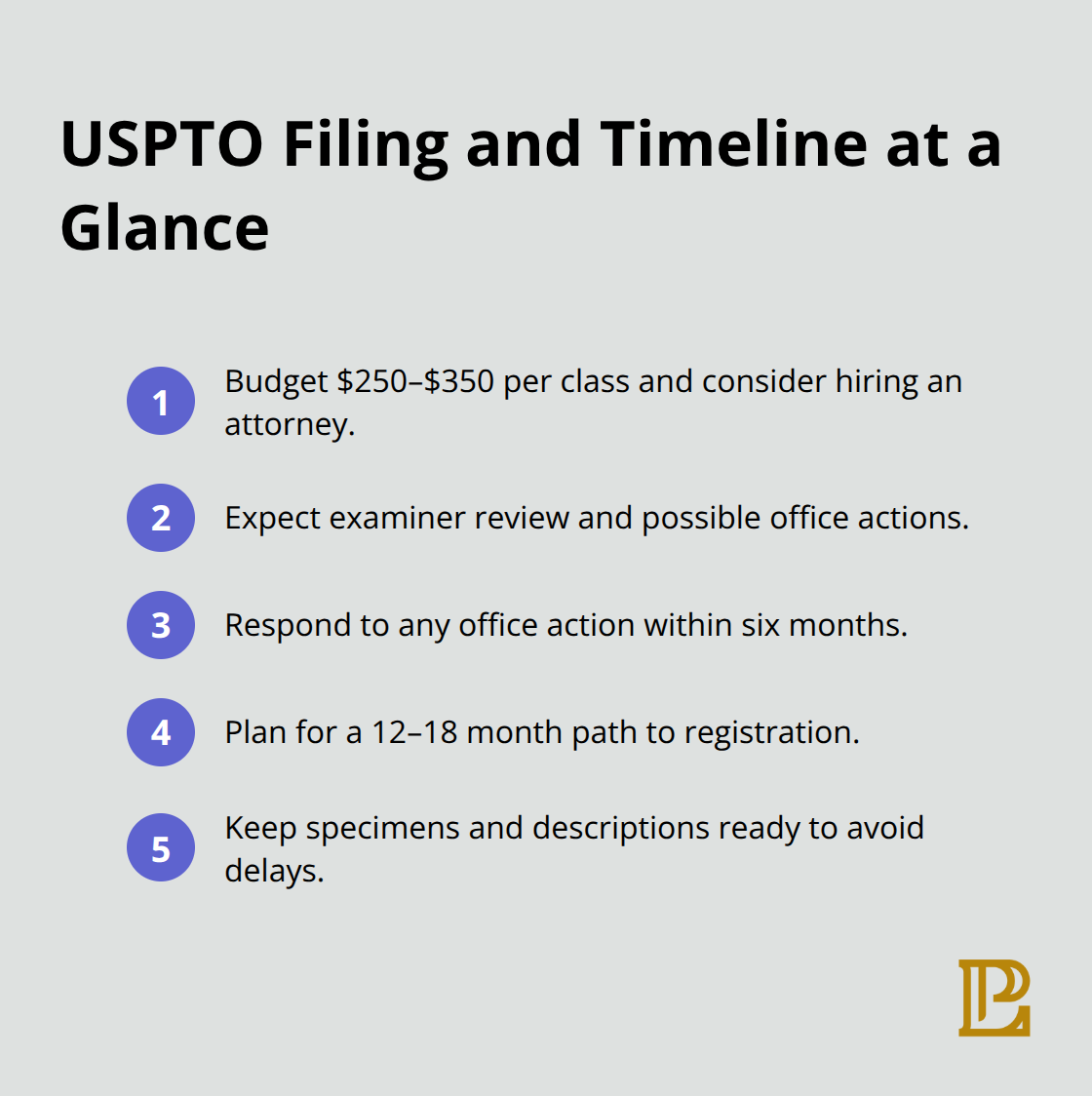
Filing fees run $250 to $350 per class through the USPTO, and while you can file online yourself, mistakes at this stage cost far more in delays and rejections than hiring a qualified attorney from the start. The USPTO examiner will review your application and may issue an office action requesting clarification or rejecting certain claims. You then have six months to respond to any office action, and the back-and-forth process typically takes 12 to 18 months from initial filing to final registration.
Once the USPTO approves your trademark, you receive a registration certificate that provides nationwide protection and creates a public record that deters competitors from adopting similar marks. This federal protection gives you the right to sue in federal court and allows you to register your trademark internationally. With your trademark now registered, the focus shifts to monitoring for infringement and planning how to expand your protection across additional product categories and geographic markets.
Protecting Your Trademark After Registration
Registering your trademark with the USPTO is the beginning, not the end. Most business owners treat registration as a finish line when it’s actually the starting point for active portfolio management. The real work involves monitoring the marketplace for unauthorized use, managing renewal deadlines that come every ten years, and strategically expanding protection as your business grows into new product categories and geographic markets.
Watch for Infringement Before It Becomes Expensive
Trademark infringement happens constantly, and waiting for it to damage your business significantly is a costly mistake. The American Intellectual Property Law Association reports that trademark litigation costs average between $190,000 and $350,000 through trial, but catching infringement early and sending a cease-and-desist letter often resolves the issue for a fraction of that cost. You need a systematic approach to monitoring, not occasional searches when you remember to check.
Set up Google Alerts for your trademark name and common misspellings. Monitor social media platforms where competitors operate. Check relevant marketplaces like Amazon or Etsy where counterfeit products appear regularly. Assign this task to someone on your team monthly rather than treating it as a sporadic activity.
If you discover a competitor using your trademark or something confusingly similar, document everything immediately with screenshots, dates, and URLs. Most infringers stop completely once they receive a formal notice from an attorney, which makes early intervention far more effective than ignoring the problem until it balloons into a major business threat.
Renew Your Registration on Schedule
Your trademark registration lasts ten years from the date of issuance, but the USPTO requires you to file a renewal application between the ninth and tenth year or face cancellation. Missing this deadline is remarkably common and entirely preventable. Set a calendar reminder at least eighteen months before expiration so you have time to prepare your renewal documentation.
The renewal process requires you to submit a specimen showing current use of your trademark and pay renewal fees of $125 to $225 per class. This straightforward step protects your investment and maintains your legal rights indefinitely (as long as you continue using the mark in commerce).
Expand Protection Into New Product Categories
As your business expands into new product categories or services, you should file additional trademark applications to cover those areas rather than assuming your existing registration automatically protects everything you sell. A restaurant owner who later opens a food delivery app needs separate trademark protection for that service, which requires filing in a different class.
This strategic expansion prevents competitors from registering similar marks in categories you plan to enter later. Many business owners also overlook international expansion opportunities. If you operate only in California now but see potential for growth into other states or countries, filing international trademark applications through the Madrid Protocol allows you to protect your brand in multiple countries with a single application, typically costing $900 to $1,200 for ten countries depending on complexity.
Final Thoughts
Trademark registration in California protects your business name, logo, and brand identity from competitors who would otherwise copy your work without legal consequence. The process requires upfront effort-searching existing marks, preparing documentation, and filing with the USPTO-but the payoff extends far beyond legal protection. Your registered trademark becomes a quantifiable business asset that increases company valuation, builds customer loyalty, and gives you the legal standing to stop infringement before it damages your revenue.
The real value emerges over time through consistent monitoring and strategic expansion. A trademark registration that sits unused holds no value, but one that you actively protect and expand across new product categories and geographic markets compounds in value year after year. Renewal deadlines arrive every ten years, and missing them costs you everything you built.
Many business owners in Hermosa Beach and throughout Los Angeles County underestimate how quickly trademark disputes escalate into expensive litigation. Catching infringement early through systematic monitoring and responding with a cease-and-desist letter typically resolves the problem without court involvement. We at Pierview Law help business owners throughout Los Angeles County navigate trademark registration California and build IP portfolios that actually protect your brands.