
Intellectual property agreements protect your business innovations, creative works, and proprietary information from unauthorized use. These contracts form the foundation of IP protection for Hermosa Beach companies.
We at Pierview Law understand that California’s unique legal landscape requires careful attention to state-specific requirements when drafting these agreements.
What IP Agreements Do Hermosa Beach Businesses Need
Hermosa Beach companies require three primary types of intellectual property agreements that protect their most valuable assets. Patent license agreements generate substantial revenue streams, with technology companies in California reporting average income of $2.3 million annually according to the U.S. Patent and Trademark Office. Trademark license deals protect brand identity while companies expand market reach, particularly important for the 73% of Hermosa Beach businesses that operate in service industries. Copyright assignments secure ownership of creative works, from marketing materials to software code, with proper documentation that prevents the costly disputes affecting 20% of small businesses annually.

California’s Unique IP Requirements
California Civil Code Section 985 requires written agreements for any intellectual property transfer that exceeds $500 in value, which makes verbal handshake deals legally worthless. The state’s work-for-hire doctrine operates differently than federal law and requires explicit written agreements to transfer employee-created IP to employers. California also enforces strict confidentiality standards under the Uniform Trade Secrets Act, with violations that carry damages up to three times actual losses plus attorney fees.
Common IP Pitfalls in Coastal Business Communities
Hermosa Beach businesses frequently encounter IP ownership disputes when multiple parties collaborate on projects without clear agreements. Software development partnerships create the most problems, with 45% of disputes that stem from unclear code ownership rights. Restaurant and hospitality businesses face trademark conflicts over business names and logos, especially when they expand beyond local markets. The proximity to major entertainment and technology hubs in Los Angeles County increases the risk of inadvertent infringement, making comprehensive IP agreements essential for protection against the $6 trillion economic impact that intellectual property contributes to California’s economy.
Technology Transfer Considerations
Tech companies in Hermosa Beach must address confidentiality and usage rights for software and hardware in their agreements to prevent legal issues. These businesses should conduct thorough legal risk assessments before they enter into agreements to safeguard their assets. Companies must stay informed about current trends in intellectual property law to make educated decisions about their IP strategy.
The next step involves understanding how to structure these agreements with the right ownership clauses and confidentiality provisions that protect your business interests.
What Makes an IP Agreement Legally Bulletproof
Ownership clauses must explicitly state who holds title to intellectual property created during the business relationship, with assignment language that transfers all rights immediately upon creation. California Civil Code Section 985 mandates written documentation for IP transfers that exceed $500, which makes verbal agreements worthless in court. Assignment clauses should include moral rights waivers and specify worldwide, perpetual rights to prevent future ownership disputes.
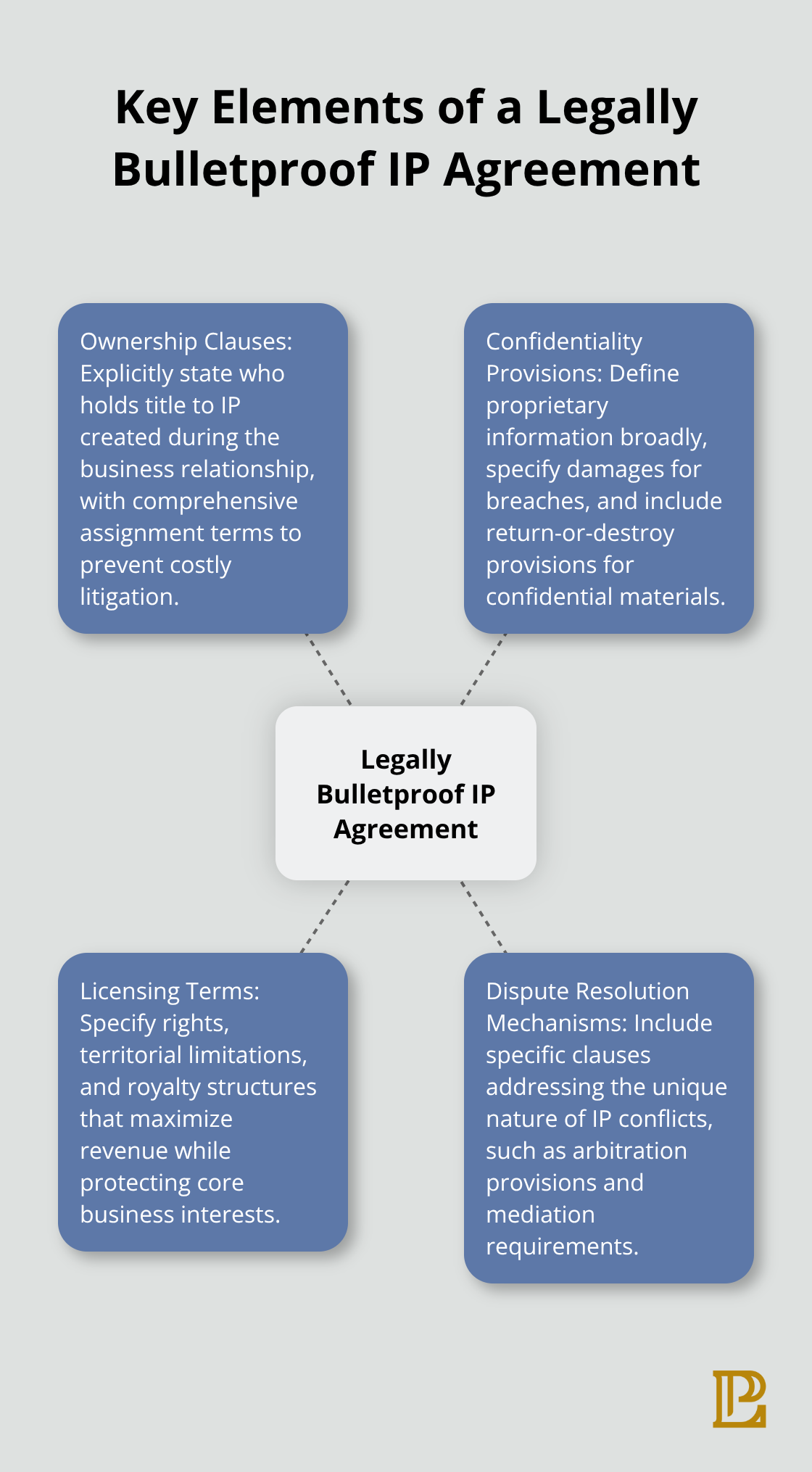
The most effective ownership provisions address derivative works and improvements, with language that assigns future modifications to the original IP owner. Companies that fail to include comprehensive assignment terms face costly litigation, with the average IP dispute that costs $650,000 according to the American Intellectual Property Law Association.
Confidentiality Provisions That Actually Work
Non-disclosure agreements within IP contracts must define proprietary information broadly while they exclude publicly available data and independently developed information. California’s Uniform Trade Secrets Act provides statutory protection, but contract terms should specify damages for breaches that include injunctive relief and attorney fees.
The most effective confidentiality clauses survive contract termination and bind third parties who receive confidential information. Over 80% of companies consider trade secrets their most valuable IP asset, yet standard boilerplate confidentiality language fails to protect against modern threats like data theft and reverse analysis. Successful NDAs include return-or-destroy provisions for confidential materials and specify jurisdiction for enforcement actions in California courts.
Licensing Terms That Generate Revenue
Licensing agreements should specify exclusive versus non-exclusive rights, territorial limitations, and field-of-use restrictions that maximize revenue while they protect core business interests. Royalty structures work best when they include minimum guaranteed payments and percentages that escalate based on sales volume (with technology companies that average $2.3 million annually from patent deals according to USPTO data).
Payment terms must address audit rights, currency conversion for international deals, and late payment penalties that incentivize timely remittance. The strongest provisions include termination triggers for non-payment or breach, with automatic reversion of rights to the licensor and clear procedures for inventory handling.
Dispute Resolution Mechanisms
IP agreements require specific dispute resolution clauses that address the unique nature of intellectual property conflicts. Arbitration provisions work well for licensing disputes but may limit injunctive relief options that patent holders need for immediate protection. California courts favor mediation requirements before litigation (which can reduce resolution costs by 40% according to state judicial statistics).
The agreement should specify which state’s laws govern the contract and establish jurisdiction for any legal proceedings. This becomes particularly important when parties operate across multiple states or countries, as conflicting IP laws can complicate enforcement efforts.
These foundational elements create the framework for protection, but California’s specific legal requirements add another layer of complexity that businesses must navigate carefully.
What California Law Demands for Valid IP Agreements
California Civil Code Section 985 makes written documentation mandatory for any intellectual property transfer that exceeds $500 in value. This eliminates the legal validity of handshake deals that many Hermosa Beach businesses still attempt to use. The state requires specific language that identifies the IP being transferred, the consideration paid, and signatures from all parties with notarization for transfers above $5,000 (according to California Civil Code requirements). Work-for-hire agreements need explicit written terms under California Labor Code Section 3351.5, as the state’s employment laws differ significantly from federal standards and can void IP assignments that rely solely on employment relationships.
California’s Strict Attribution Requirements
California Civil Code Section 3344 protects personality rights more aggressively than other states and requires IP agreements to address moral rights and attribution claims that survive ownership transfers. The Uniform Trade Secrets Act in California Business and Professions Code Section 16600 voids non-compete clauses but strengthens trade secret protection, which makes confidentiality provisions more important than restrictive covenants. Companies must include specific language about California’s right-to-know laws under Health and Safety Code Section 25249.6, which can affect trade secret classifications for chemical processes.
Common Template Mistakes That Void Agreements
The most dangerous mistake involves the use of standard contract templates from other states, as California’s unique requirements can void entire agreements and expose businesses to liability claims that average $850,000 per dispute (according to California State Bar litigation statistics). Standard boilerplate language may distribute ownership rights ineffectively and lead to costly implications for service providers. Companies should require representations and warranties from service providers to confirm their deliverables do not infringe on third-party IP rights.
Essential Protection Mechanisms That Work
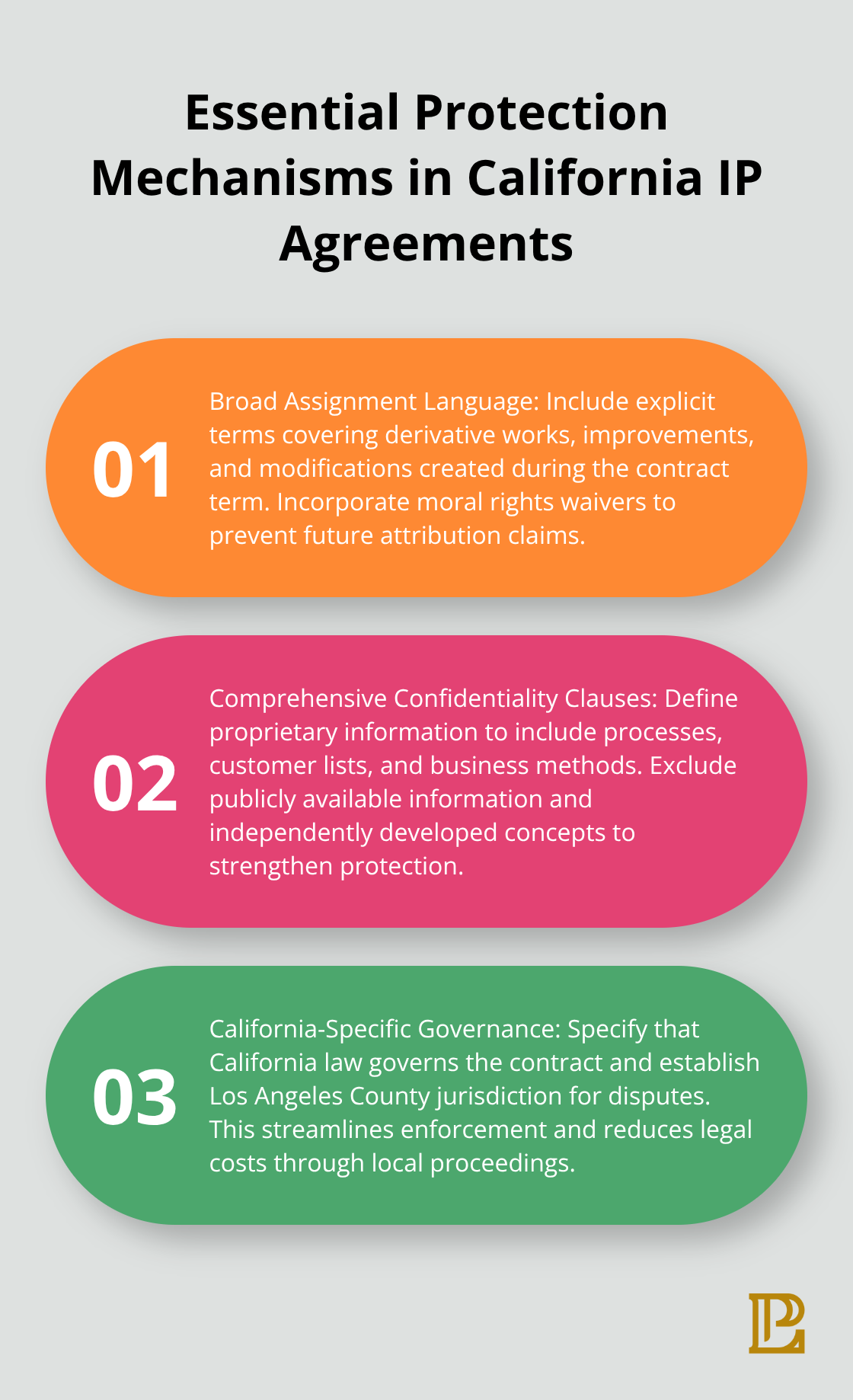
Successful IP agreements in California must include broad assignment language that covers derivative works, improvements, and modifications created during the contract term, with explicit moral rights waivers that prevent future attribution claims. Confidentiality clauses should define proprietary information to include processes, customer lists, and business methods while they exclude publicly available information and independently developed concepts. The strongest agreements specify that California law governs the contract and establish Los Angeles County jurisdiction for disputes, which streamlines enforcement and reduces legal costs through local proceedings.
Termination and Ownership Transfer Provisions
Termination provisions must address IP ownership after contract end, with clear procedures for the return of confidential materials and transfer of projects to prevent ownership disputes that affect 35% of California technology companies (according to California Chamber of Commerce data). These clauses should include termination triggers for non-payment or breach, with automatic reversion of rights to the licensor and clear procedures for inventory handling.
Final Thoughts
California’s complex legal requirements make proper intellectual property agreement documentation essential for business protection. The average IP dispute costs $650,000 according to the American Intellectual Property Law Association, which demonstrates why businesses need precise legal guidance. State-specific provisions differ significantly from federal standards and require careful attention to detail.
We at Pierview Law understand the unique challenges that face Hermosa Beach businesses in today’s competitive marketplace. Local attorneys provide distinct advantages through familiarity with Los Angeles County court procedures and California Civil Code requirements that govern IP transfers. Professional legal guidance helps businesses navigate the complexities of intellectual property law while they protect valuable assets.
The next step involves a consultation to review your current IP portfolio and identify protection gaps. Pierview Law offers comprehensive legal solutions for businesses throughout Los Angeles County from initial contract preparation to dispute resolution. Proper intellectual property agreement documentation starts with professional legal support and continues as your business grows in California’s dynamic environment.