
Business owners in Hermosa Beach face a critical decision when considering mergers or acquisitions to grow their companies. Each path offers distinct advantages and challenges that can significantly impact your business’s future.
At Pierview Law, we guide local entrepreneurs through these complex transactions daily. Understanding the key differences between these options helps you make the right choice for your specific situation.
What Separates Mergers from Acquisitions
Mergers combine two businesses into one new entity, while acquisitions mean one company purchases another. The Harvard Business Review reports that companies with diverse product offerings experience 15% higher customer retention rates, which makes the distinction between these approaches particularly important for Hermosa Beach businesses. In a merger, both companies dissolve to form a new corporation. This process requires board approval from both entities and shareholder votes that typically need majority support. Acquisitions allow the purchaser to maintain its identity while it absorbs the target business through either asset purchases or stock purchases.
Legal Documentation Creates Different Requirements
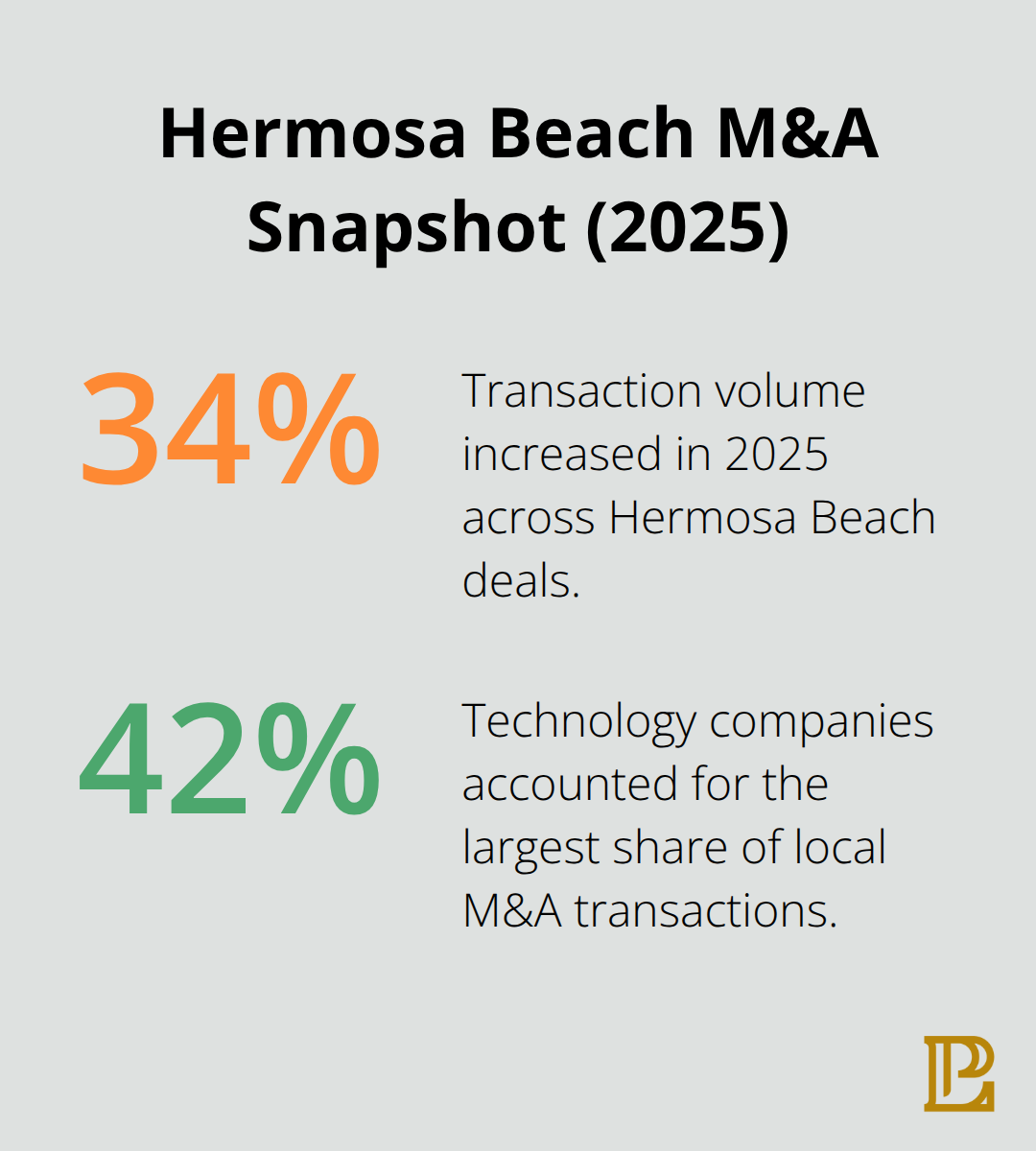
California requires a Certificate of Merger filed with the Secretary of State for mergers (following Chapter 11 of the California Corporations Code). Acquisitions demand different paperwork that includes purchase agreements, due diligence reports, and transfer documents. The Federal Trade Commission now scrutinizes horizontal mergers more aggressively in 2025, with preliminary reviews that average 120 days for deals above $50 million. Hermosa Beach’s M&A market surged 34% in transaction volume during 2025, with technology companies that lead at 42% of all transactions.
Transaction Types Shape Your Strategy
Purchase agreements must address Hermosa Beach-specific risks that include tsunami insurance and coastal erosion liability. Companies typically conduct 60-90 day due diligence periods that include environmental assessments and title searches. SBA loan approvals for M&A transactions now require 90-120 days due to increased scrutiny. Seller financing is common for deals under $10 million, with sellers who accept 20-30% notes over 5-7 year terms. Private equity firms frequently pay premium valuations of 8-12 times revenue for profitable tech ventures, while 15-20% of purchase prices are held in escrow due to regulatory uncertainty.
Market Conditions Influence Your Choice
Average deal values in the local hospitality sector reached $4.2 million per transaction. Economic pressures have compressed deal multiples by approximately 15% since early 2024. Valuation disagreements destroy 38% of M&A transactions in Hermosa Beach, often with gaps of 25-40% in price expectations between buyers and sellers. These market dynamics directly impact whether a merger or acquisition structure better serves your business objectives and timeline requirements.
When Should You Choose a Merger
Mergers work best when two companies want equal partnership and shared decision-making power. The National Association of Small Businesses found that successful mergers can increase revenue by up to 23% within the first year for businesses that combine complementary strengths. This approach makes sense when both Hermosa Beach companies bring valuable assets, customer bases, or market positions to the table.
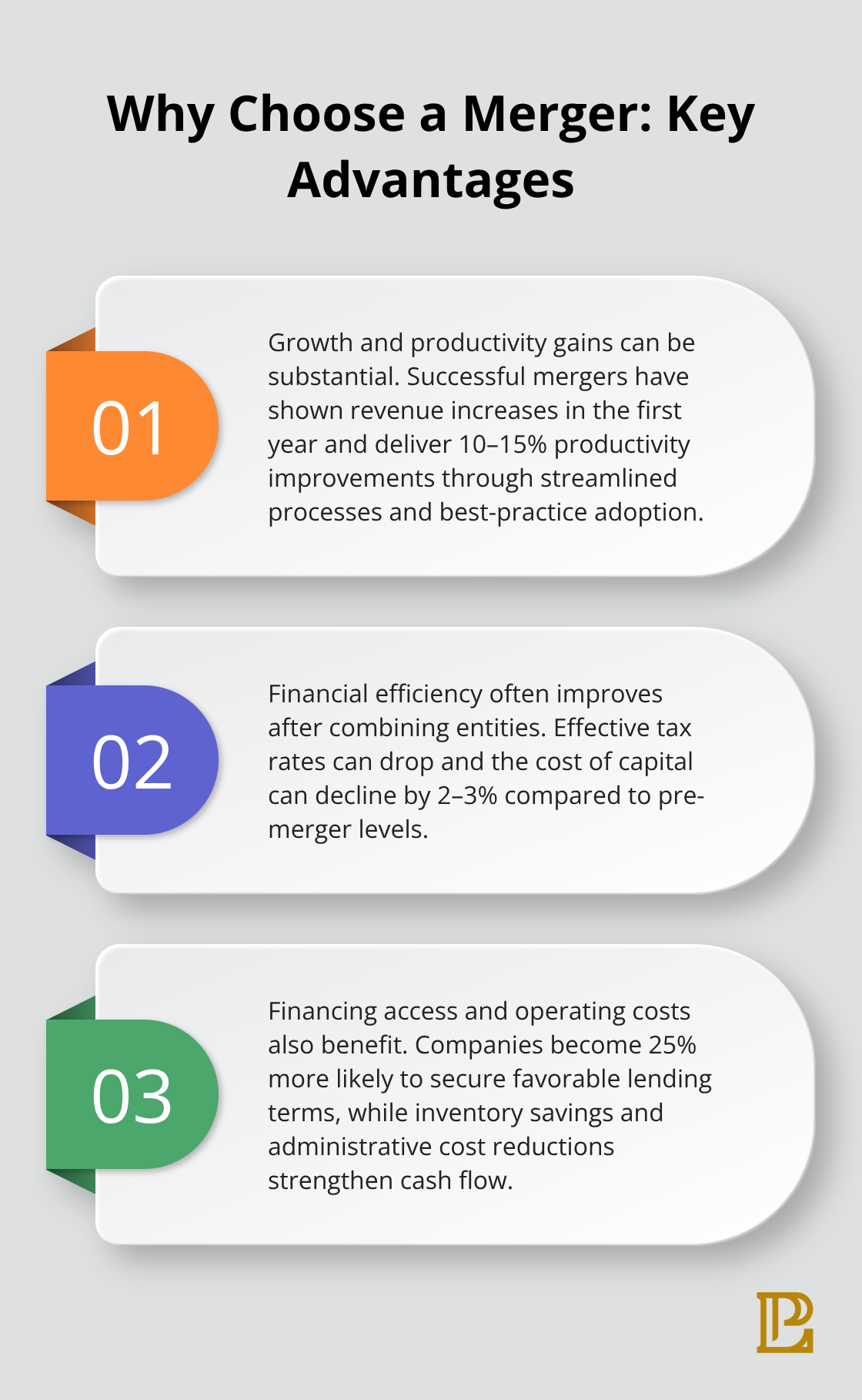
Shared control scenarios often emerge when businesses face similar challenges or want to pool resources against larger competitors. The MIT Sloan School of Management shows that merged operations can enhance productivity by 10-15% through streamlined processes and best practice adoption.
Tax Benefits Drive Merger Decisions
Companies that acquire competitors with accumulated losses can reduce their effective tax rate by up to 10% (according to the Tax Policy Center). Merged businesses achieve 2-3% reductions in their cost of capital compared to pre-merger situations, based on National Small Business Association surveys.
Companies that complete successful mergers are 25% more likely to secure favorable lending terms from banks, reports the Federal Reserve Bank of San Francisco. The combination of resources often results in cost savings of up to 15% on inventory through bulk purchasing power, while administrative costs can drop by 25% through consolidated operations.
Regulatory Approval Takes Time
Short-form mergers occur when one company owns 90% or more of another, which simplifies the approval process significantly. Standard mergers require board approval from both companies followed by majority shareholder votes from each entity.
The Federal Trade Commission’s increased scrutiny means preliminary reviews now average 120 days for deals above $50 million in 2025. California requires companies to file a Certificate of Merger with the Secretary of State under Chapter 11 of the California Corporations Code (post-merger integration plans prevent the 42% loss of anticipated synergies that cultural differences typically cause).
However, acquisitions offer different advantages that may better suit your business objectives and timeline requirements. Professional merger or acquisition due diligence ensures compliance and reduces transaction risks throughout the process.
When Do Acquisitions Beat Mergers
Acquisitions deliver faster results when you need immediate market expansion or want to maintain complete operational control. The Small Business Administration reports that companies controlling larger market portions are 30% more likely to survive economic downturns, which makes acquisitions particularly attractive for Hermosa Beach businesses that face competitive pressure.
Technology companies lead M&A activity in Hermosa Beach at 42% of all transactions. Private equity firms pay premium valuations of 8-12 times revenue for profitable tech ventures. Revenue per employee can increase by up to 20% through effective resource allocation from acquisitions (according to the California Hotel & Lodging Association).
Asset Purchases Provide Targeted Control
Asset purchases let you cherry-pick valuable components while you avoid unwanted liabilities. This structure works perfectly when target companies carry debt, face litigation, or have regulatory issues you want to avoid. Stock purchases transfer all liabilities but provide tax advantages through depreciation and amortization benefits.
Companies typically conduct 60-90 day due diligence periods that include environmental assessments and title searches. Buyers now hold 15-20% of purchase prices in escrow due to regulatory uncertainty. Post-acquisition operations failures cost $200,000 to $500,000 without detailed operational plans (making thorough due diligence non-negotiable).
Timeline Advantages Drive Acquisition Decisions
Acquisitions move faster than mergers because you avoid complex shareholder approval processes from multiple entities. Average hospitality M&A deals show revenue increases of 15-25% within the first year post-acquisition after successful integration efforts.
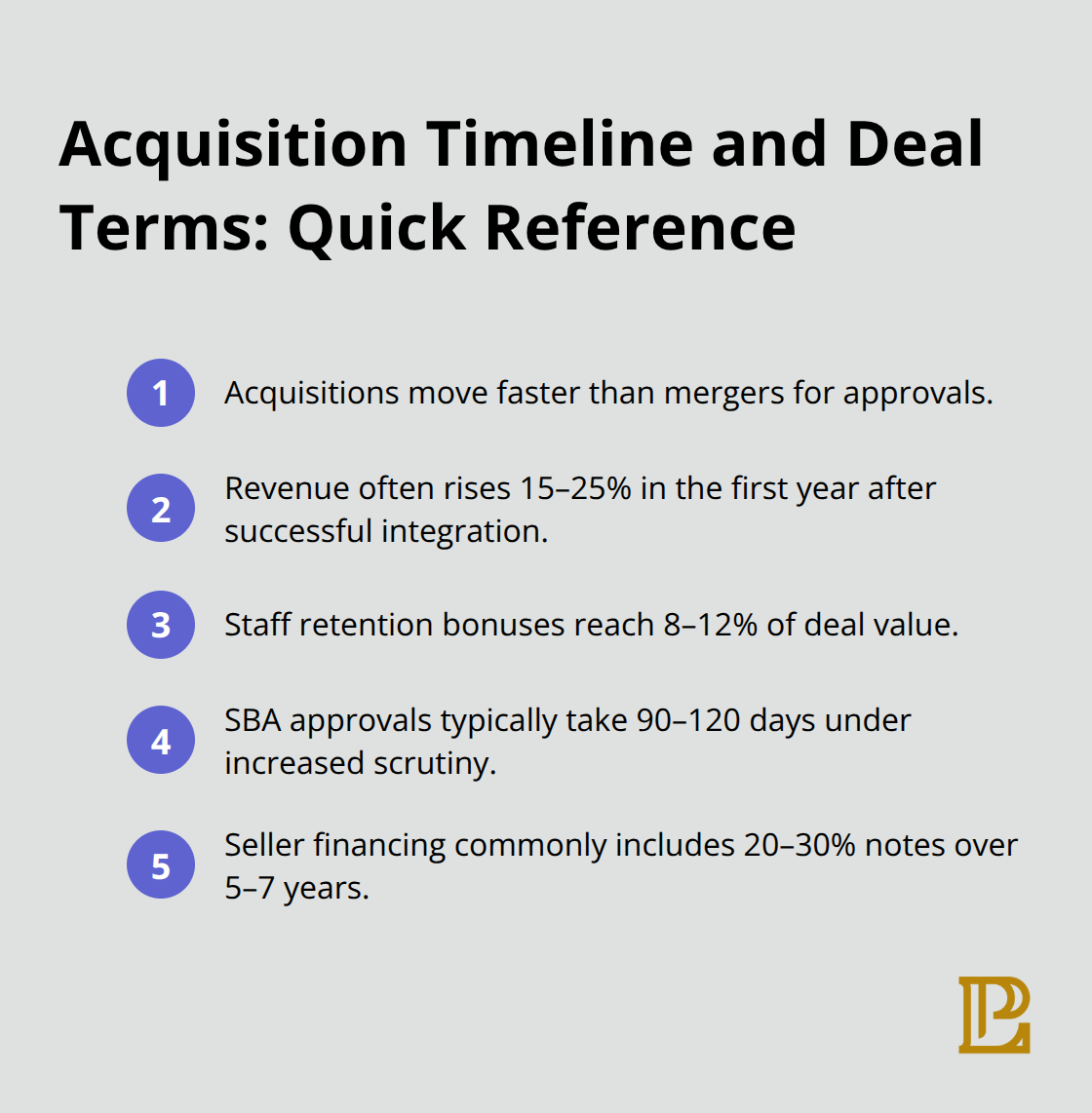
Staff retention bonuses now account for 8-12% of deal values as companies compete for talent in the local market. SBA loan approvals for M&A transactions require 90-120 days due to increased scrutiny, while seller finance is common for deals under $10 million with sellers who accept 20-30% notes over 5-7 year terms.
Strategic Growth Through Market Expansion
Acquisitions allow businesses to quickly expand their market reach and customer segments without lengthy development processes. Craft breweries acquire hop farms to better control supply chains amid rising operational costs. Digital payment companies and e-commerce platforms have seen major acquisitions that exceed $15 million each in recent months.
Companies that skip environmental assessments risk transaction collapse due to compliance issues. The combination of resources in acquisitions often results in increased operational efficiency and cost reductions that make this strategy attractive for local businesses.
Final Thoughts
Your business goals and financial position determine whether mergers or acquisitions serve your Hermosa Beach company best. Companies that seek equal partnerships with shared control benefit from mergers, while businesses that want rapid expansion and complete operational control should pursue acquisitions. Financial considerations play a major role in this decision, as mergers offer tax advantages through combined losses and reduced capital costs, while acquisitions provide targeted asset control and faster revenue growth.
Legal guidance becomes indispensable when you navigate California’s complex M&A requirements. Purchase agreements must address Hermosa Beach-specific risks that include tsunami insurance and coastal erosion liability (companies that skip proper legal preparation face transaction collapse and additional costs of $200,000 to $500,000). The 60% of recent M&A deals in Hermosa Beach driven by operational necessity rather than expansion shows how market pressures influence these choices.
We at Pierview Law help Hermosa Beach business owners structure successful transactions through our business law and corporate services. Our team handles everything from entity formation to contract drafting, while our civil litigation practice manages disputes that may arise during negotiations. Start by assessing your growth timeline, control preferences, and risk tolerance, then consult with legal counsel to structure the transaction that best serves your long-term business objectives in Hermosa Beach’s competitive market.