
Your business has valuable assets that need protection. The four categories of intellectual property-patents, trademarks, copyrights, and trade secrets-form the backbone of that defense.
At Pierview Law, we help Hermosa Beach business owners understand which protections apply to their specific situation. Without the right strategy, you risk losing competitive advantage to competitors or facing costly disputes.
Patents Protect Your Business Innovations
Patents grant you exclusive rights to an invention for a defined period, preventing competitors from copying your process, product, or design. In the United States, utility patents last 20 years from the filing date, design patents last 15 years from issuance, and plant patents last 20 years from filing. The USPTO requires full technical disclosure in exchange for these rights, meaning your invention details become public record once the patent issues. This transparency is the trade-off: you gain legal protection, but competitors learn exactly how your innovation works.
How Long the Patent Process Actually Takes
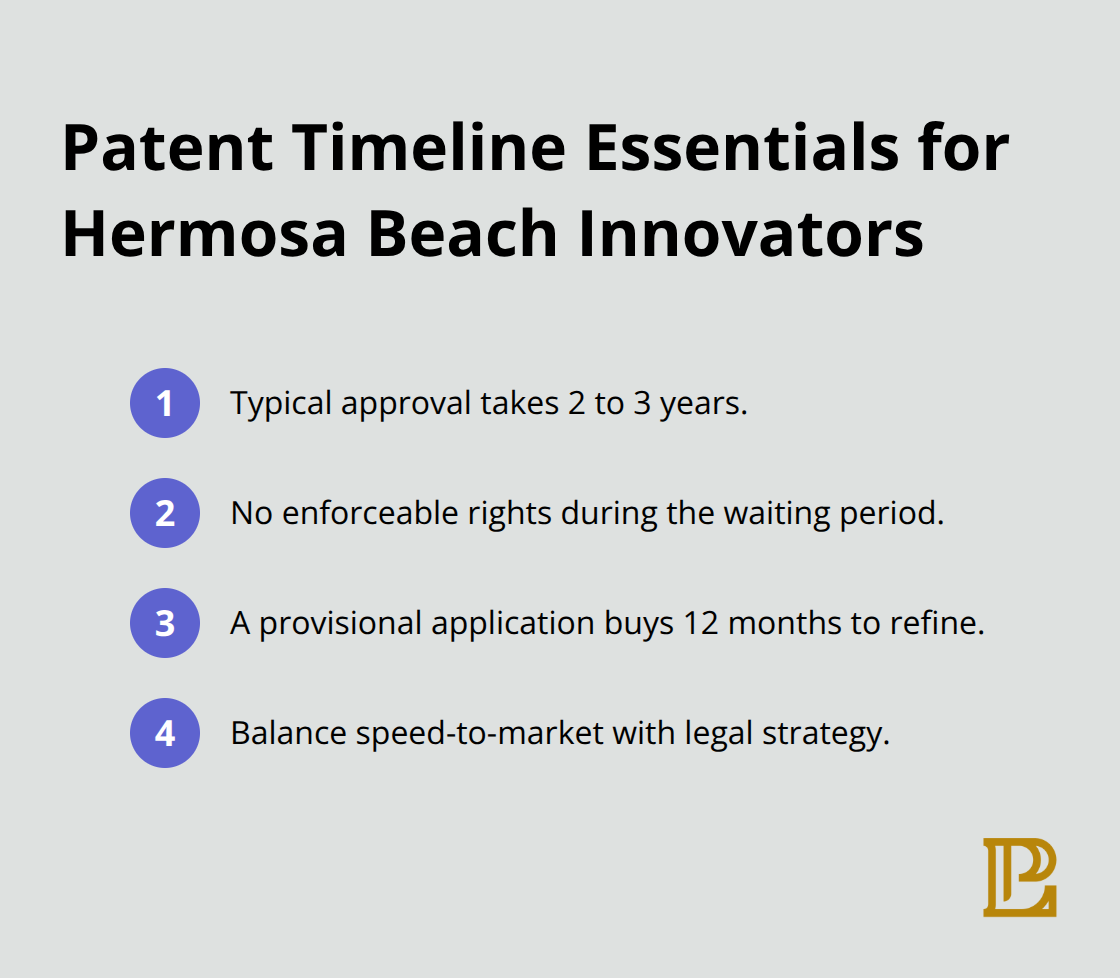
Most business owners in Hermosa Beach underestimate the timeline for patent approval. From filing to approval, the process typically requires 2 to 3 years, and some complex applications stretch even longer. During this waiting period, your invention receives no legal protection, making speed-to-market decisions critical. Many companies file a provisional patent application first, which costs less and buys you 12 months to refine your invention before committing to a full utility patent.
This approach gives you breathing room without excessive upfront legal fees.
What Actually Qualifies for Patent Protection
Patents cover functional inventions-machines, processes, compositions of matter, and articles of manufacture. They do not protect abstract ideas or methods of doing business without a technological component. If you’ve developed a manufacturing process that produces results faster or cheaper than existing methods, that qualifies. If you’ve engineered a new chemical compound or mechanical device, file for protection.
The USPTO conducts a prior art search before approving your application, meaning examiners verify your invention is truly novel and non-obvious compared to existing patents and published materials. This examination phase is where most applications face rejection or require substantial revision. Hiring an attorney to conduct your own prior art search before filing saves time and money by identifying potential obstacles early.
The Filing Strategy That Matters
International protection requires separate filings in each country where you want rights. Filing in the United States alone costs between $5,000 and $15,000 for an attorney-drafted utility patent application, not including USPTO fees. Adding international protection through priority filings multiplies those costs significantly. Many businesses file domestically first, then pursue international patents only in markets where revenue justifies the expense.
Trade secrets offer an alternative when public disclosure through patenting threatens your competitive edge. If your innovation relies on a formula, process, or technique that competitors cannot easily reverse-engineer, keeping it confidential may provide longer-lasting protection than a 20-year patent. This decision requires honest assessment: can you realistically maintain secrecy, or will competitors inevitably discover your method? Once you publish a patent application, the trade secret route closes permanently.
Your brand identity requires its own layer of protection-one that patents alone cannot provide. Trademarks safeguard the names, logos, and symbols that customers associate with your business, and understanding how they work is essential for any Hermosa Beach company.
Trademarks Protect What Customers Recognize
Your company name, logo, and slogan hold real monetary value. Trademarks protect these brand identifiers by preventing competitors from using confusingly similar marks that could mislead customers or dilute your brand value. A trademark can be a word, phrase, symbol, design, sound, or even a color combination that identifies your goods or services. Unlike patents, which expire after 20 years, trademark protection can last indefinitely as long as you continue using the mark in commerce and renew your registration every 10 years. The USPTO processes federal trademark applications in roughly 9 to 12 months, depending on examination complexity and whether office actions require responses. Filing federally costs significantly less than patent protection, typically ranging from $1,500 to $3,000 with attorney assistance, making it an accessible first step for most Hermosa Beach businesses. Before filing, search the USPTO database and state trademark records to confirm your mark does not conflict with existing registrations, because filing an application that conflicts with an existing mark wastes money and delays your protection.
Why Registration Matters More Than You Think
Using an unregistered trademark gives you common law rights based on actual use in commerce, but federal registration creates legal presumption of ownership nationwide and allows you to sue for infringement in federal court. Without registration, you can only enforce rights in geographic areas where you actively conduct business, leaving gaps competitors can exploit in regions where you haven’t established presence. Once the USPTO registers your mark, you gain the right to use the federal registration symbol and can recover statutory damages and attorney fees in infringement cases, which deters most violations before they become costly disputes. The Hermosa Beach Municipal Code illustrates how seriously governments take trademark protection, restricting use of city marks to official business only. This principle applies equally to your business: registration signals to the market that your brand is protected and monitored.
How to Stop Infringement Before Costs Spiral
Trademark disputes often resolve outside court when you act quickly. A cease-and-desist letter from a qualified attorney typically costs $500 to $1,500 and frequently persuades infringers to stop using your mark without litigation. Many disputes stem from confusion rather than intentional bad faith, particularly when a competitor unknowingly registers a similar mark in a different industry.
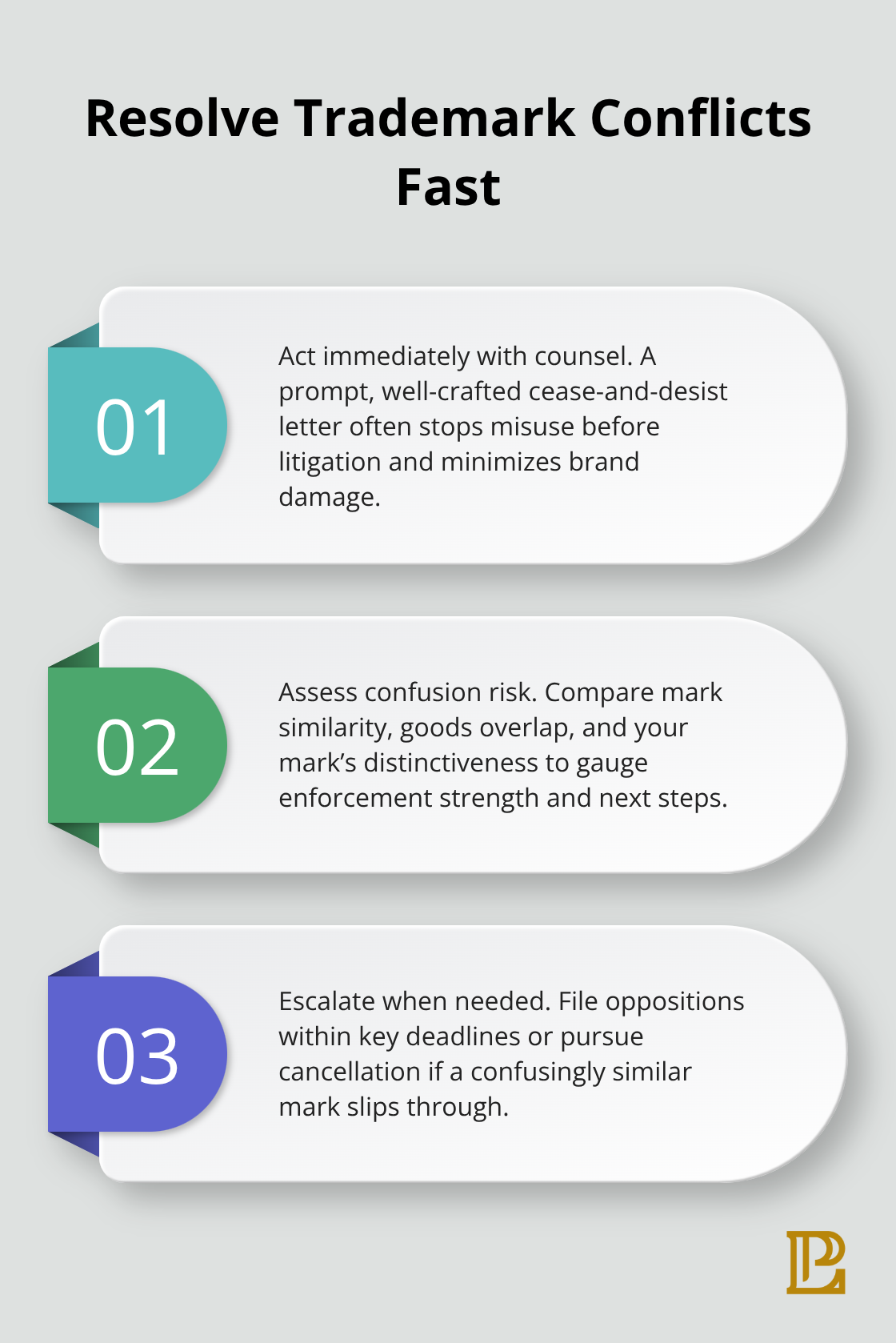
Courts evaluate trademark infringement based on likelihood of confusion, considering factors like mark similarity, goods or services overlap, and the strength of your trademark. A distinctive, fanciful mark like Xerox receives stronger protection than a descriptive mark like Software Solutions, which competitors can argue describes a category rather than a specific source. Document your continuous use and sales figures associated with your mark, because this evidence strengthens enforcement actions if disputes arise. If a competitor registers a confusingly similar mark, you have grounds to oppose their application within 30 days of publication or challenge it afterward through cancellation proceedings.
Protecting Your Mark Across Multiple Channels
Trademark protection extends beyond your primary business location. You must monitor use of your mark across online marketplaces, social media platforms, and domain registrations to catch infringement early. Many Hermosa Beach business owners discover counterfeit products or unauthorized sellers on third-party platforms months after infringement begins. Registering your trademark internationally (through the Madrid Protocol) protects your mark in multiple countries with a single application, though costs increase accordingly. The decision to pursue international protection depends on your business expansion plans and the markets where competitors most likely operate. Strong trademark management requires consistent use of your mark in the same form and context, because variations in how you present your brand can weaken protection claims.
Copyrights protect a different category of assets entirely-the creative works that distinguish your business from competitors and give customers reasons to choose you.
Copyrights Protect Your Original Business Content
Copyright protection applies automatically to any original work you create in fixed form-website content, marketing materials, product photography, software code, instructional videos, and design files all qualify immediately upon creation. You do not need to register, publish, or place a copyright notice on your work for protection to exist, though registration with the U.S. Copyright Office strengthens your legal position considerably. Copyright lasts for your lifetime plus 70 years after death, meaning the creative assets your Hermosa Beach business produces today will remain protected long after you retire.
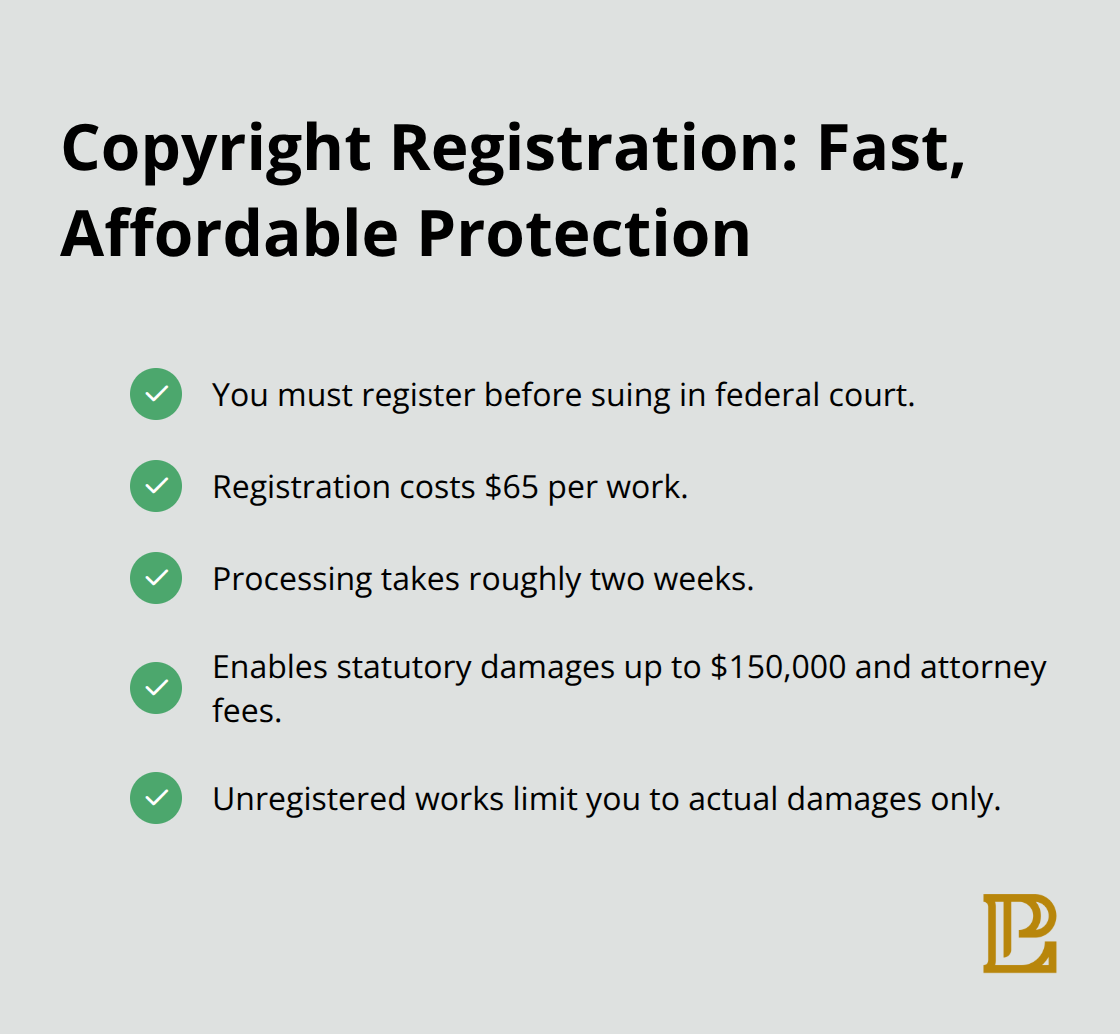
However, this automatic protection has a critical limitation: you cannot sue for copyright infringement in federal court without first registering your work with the Copyright Office. Registration costs $65 per work and takes roughly two weeks to process, making it an inexpensive insurance policy compared to the litigation costs you will face if infringement occurs without registration. A formal registration creates a public record of your ownership and allows you to recover statutory damages up to $150,000 per infringement and attorney fees, whereas unregistered works limit you to actual damages, which are often difficult and expensive to prove.
Inventory Your Copyrightable Assets Now
If a competitor steals your website design, copies your marketing copy, or reproduces your product photography without permission, you need that registration to pursue meaningful enforcement action. Conduct an inventory of copyrightable assets your business produces-blog posts, videos, graphics, software, product manuals-and register the most valuable ones within 30 days of creation to maximize your legal remedies. Many business owners wrongly assume that posting a copyright notice or registering a domain name provides adequate protection; neither does.
Written Agreements Determine Who Owns Your Content
Ownership of copyrighted work depends entirely on who created it and what agreements existed at the time of creation. When you hire a freelancer, contractor, or marketing agency to produce content for your business, that creator owns the copyright unless you have a written work-for-hire agreement transferring ownership to you. Many Hermosa Beach businesses discover too late that they cannot control how a designer, photographer, or developer uses their creations elsewhere because no written agreement addressed ownership.
A work-for-hire agreement costs $300 to $800 to draft properly and eliminates disputes by establishing that you own all work created under the agreement. Employees automatically create work-for-hire materials as part of their employment, but independent contractors do not unless a signed agreement specifies otherwise. When you acquire another business or its assets, verify that copyright ownership transferred to you through assignment agreements, because merely purchasing a company does not automatically transfer its creative assets.
If you want to license content rather than own it outright (perhaps using a stock photography service or licensed software), the licensing agreement defines exactly what uses you can make and whether you can modify or redistribute the work. Digital Rights Management tools and watermarking software help you track unauthorized use of your copyrighted materials online, particularly when competitors attempt to pass off your designs or content as their own.
Digital Infringement Spreads Faster Than You Can Respond
Copyright infringement online occurs constantly and often goes undetected until significant damage accumulates. Competitors scrape your website content and republish it on their sites, social media users repost your videos without attribution, and print-on-demand services manufacture products using your copyrighted designs without permission. The Digital Millennium Copyright Act provides a takedown notice mechanism allowing you to demand removal of infringing content from websites and platforms within days rather than months, making it far more cost-effective than litigation.
Send a DMCA takedown notice when you discover infringement, and most platforms comply within 48 hours to maintain their safe harbor protection. However, bad-faith takedown notices can expose you to liability, so verify the infringement is genuine before sending notice. International infringement complicates enforcement because copyright protection varies by country and foreign courts may not recognize U.S. registrations. If your business sells products internationally or licenses content abroad, consult an attorney about protection in your target markets before infringement occurs.
Many Hermosa Beach businesses lose thousands in revenue to digital piracy simply because they did not register their copyrights or monitor online use of their materials. The Copyright Act of 1976 establishes fair use exceptions allowing limited, non-commercial or transformative uses of copyrighted material, but this doctrine protects criticism, commentary, and parody-not competitive copying. Your competitors cannot legally republish your marketing materials, copy your website design, or reproduce your product photography claiming fair use.
Final Thoughts
Patents, trademarks, copyrights, and trade secrets form the four categories of intellectual property that protect your Hermosa Beach business from competitive threats and revenue loss. IP theft costs American businesses over $300 billion annually, and many violations occur simply because owners failed to register their assets or monitor unauthorized use. A competitor copying your website design, a vendor using your trademark without permission, or a contractor claiming ownership of content you paid for can each drain thousands in legal fees and lost revenue.
Registration costs between $65 and $3,000 depending on the asset type, yet provides legal remedies worth far more if disputes arise. Conduct an IP audit to identify what your business owns and catalog your trademarks, copyrights, patents, and trade secrets. Establish written agreements with employees and contractors that clarify ownership of work they create, then monitor online use of your brand and content regularly to catch infringement early.
We at Pierview Law help Hermosa Beach business owners protect their intellectual property through entity formation, contract drafting, and dispute resolution. Contact us to discuss your IP protection strategy and ensure your business assets remain secure.