
Transferring intellectual property between parties requires more than a handshake and good intentions. An intellectual property assignment agreement protects both sides by clearly documenting what’s being transferred, who owns it after the transfer, and what happens if something goes wrong.
At Pierview Law, we’ve seen too many business owners in Hermosa Beach skip this step and face costly disputes later. This guide walks you through what belongs in a solid assignment agreement and the mistakes that could undermine your protection.
What Actually Transfers in an IP Assignment
An intellectual property assignment agreement transfers complete ownership of specific intellectual assets from one party to another. This isn’t a limited permission or temporary arrangement-it’s a permanent shift of all rights, titles, and interests to the assignee. The four main types of intellectual property you can transfer are patents, trademarks, copyrights, and trade secrets.
Understanding What Each IP Type Includes
When you assign a patent, you transfer the exclusive right to make, use, and sell the invention. A trademark assignment gives the new owner control over the brand identity and goodwill associated with it. Copyright assignments hand over the exclusive right to reproduce, distribute, and display creative works. Trade secret assignments transfer confidential business information that provides competitive advantage.
Many business owners in Hermosa Beach mistakenly believe they can assign just one component of their intellectual property, but a solid agreement transfers the entire bundle of rights or clearly specifies which rights remain with the original owner. The distinction matters enormously because incomplete transfers create disputes and cloud ownership when investors or acquirers perform due diligence.
Assignment Versus Licensing-Why the Difference Matters
Assignment and licensing are fundamentally different transactions that serve different business goals. Assignment permanently transfers ownership; licensing grants limited permission while the original owner retains control. If you assign your trademark, you no longer own it. If you license it, you still own it but allow another party to use it under specific conditions.
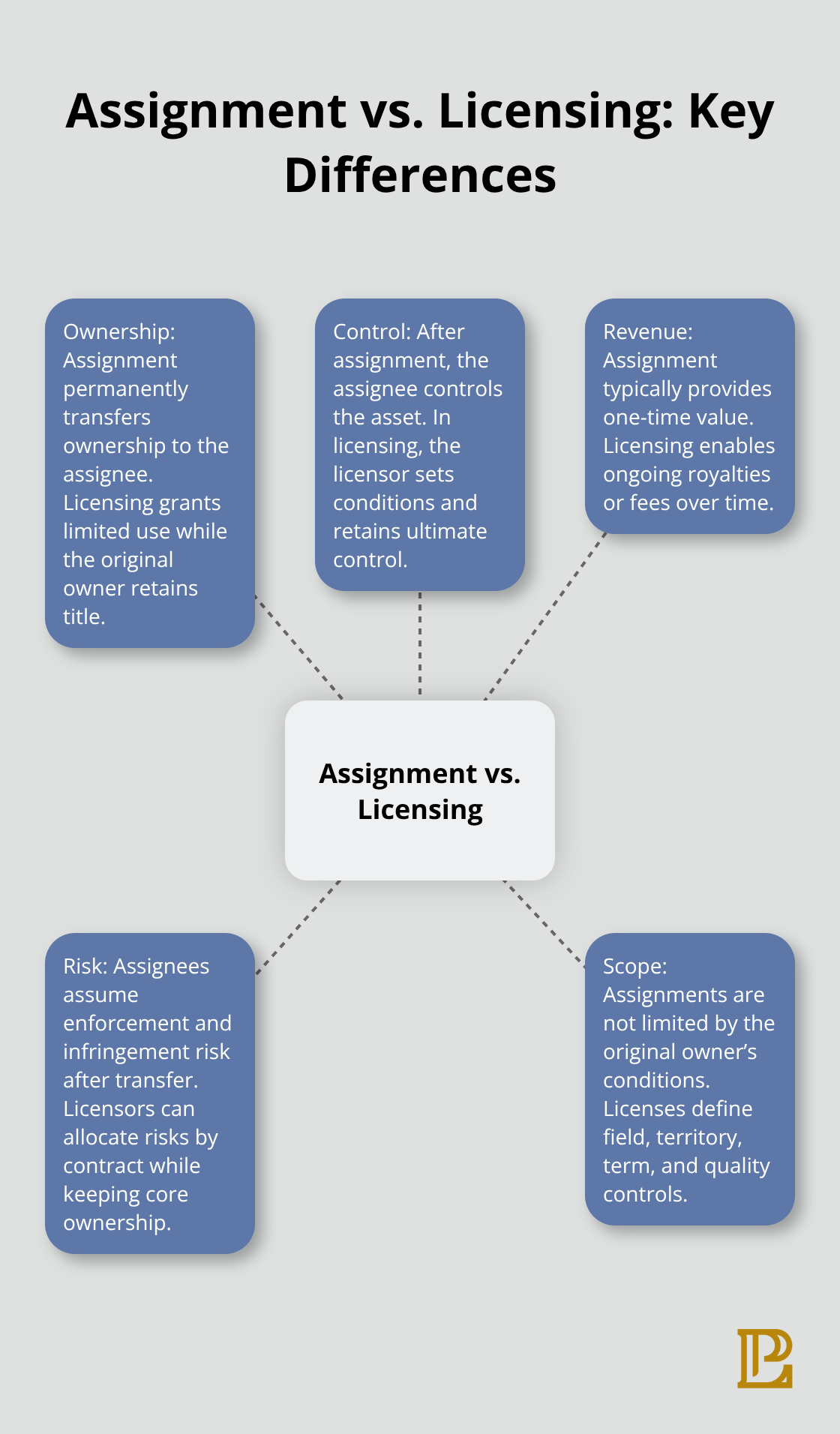
This distinction affects your tax situation, your ability to monetize the asset later, and whether you can enforce rights against unauthorized users. Many business owners confuse these concepts and end up with agreements that don’t reflect their actual intentions. The American Bar Association notes that disputes from unclear ownership rank among the most frequent and costly in business litigation, which underscores why getting this right upfront saves enormous expense. Choose assignment when you want to sell or transfer ownership completely. Choose licensing when you want to generate ongoing revenue while maintaining control or when you want to grant limited use rights to a specific party for a defined purpose.
When Your Business Needs an Assignment Agreement
You need a formal assignment agreement whenever ownership of intellectual property changes hands, regardless of whether money exchanges hands. A freelancer designing your company logo requires an assignment agreement to confirm you own the final work, not the freelancer. Transferring founder intellectual property to a startup entity demands a clear assignment to prevent future disputes about who created what. Selling a business with valuable intellectual property requires assignment agreements to prove you can actually transfer what you’re selling to the buyer. Licensing or purchasing intellectual property from another party requires assignment documentation to establish clear chain of title.
California Law and Employee Inventions
California Labor Code section 2870 adds another layer of complexity for Hermosa Beach businesses that employ inventors or developers. The law generally prohibits requiring employees to assign rights in inventions developed entirely on their own time without using employer equipment or facilities. However, if an invention relates to your company’s business or results from work performed for your company, you can require assignment.
Without explicit carve-outs in your employment agreements that address section 2870, you risk enforcing an unenforceable assignment clause. The practical takeaway is that every significant intellectual property transaction in your business needs a written assignment agreement tailored to your specific situation and California law. Understanding these foundational principles prepares you to navigate the essential elements that belong in any assignment agreement.
What Must Go Into Your Assignment Agreement
A solid assignment agreement contains specific elements that work together to transfer ownership cleanly and prevent disputes. The parties involved must be identified by their full legal names and addresses, not nicknames or business names alone. This clarity matters because when investors or acquirers review your company during due diligence, they need to confirm that the person or entity signing the agreement actually had authority to transfer the rights.
Identifying the Parties and Describing the IP
The intellectual property itself must be described with specificity that would satisfy a patent examiner or trademark office. Vague descriptions like “our software” or “the design work” will not hold up if someone challenges ownership. Include patent numbers if the IP is patented, trademark registration numbers if trademarked, and for copyrights or trade secrets, provide detailed descriptions of what exactly transfers. One Hermosa Beach technology company resolved a months-long dispute that a single paragraph could have prevented-it clearly identified the source code, file locations, and version numbers being assigned.
Stating Consideration and Protecting Both Parties
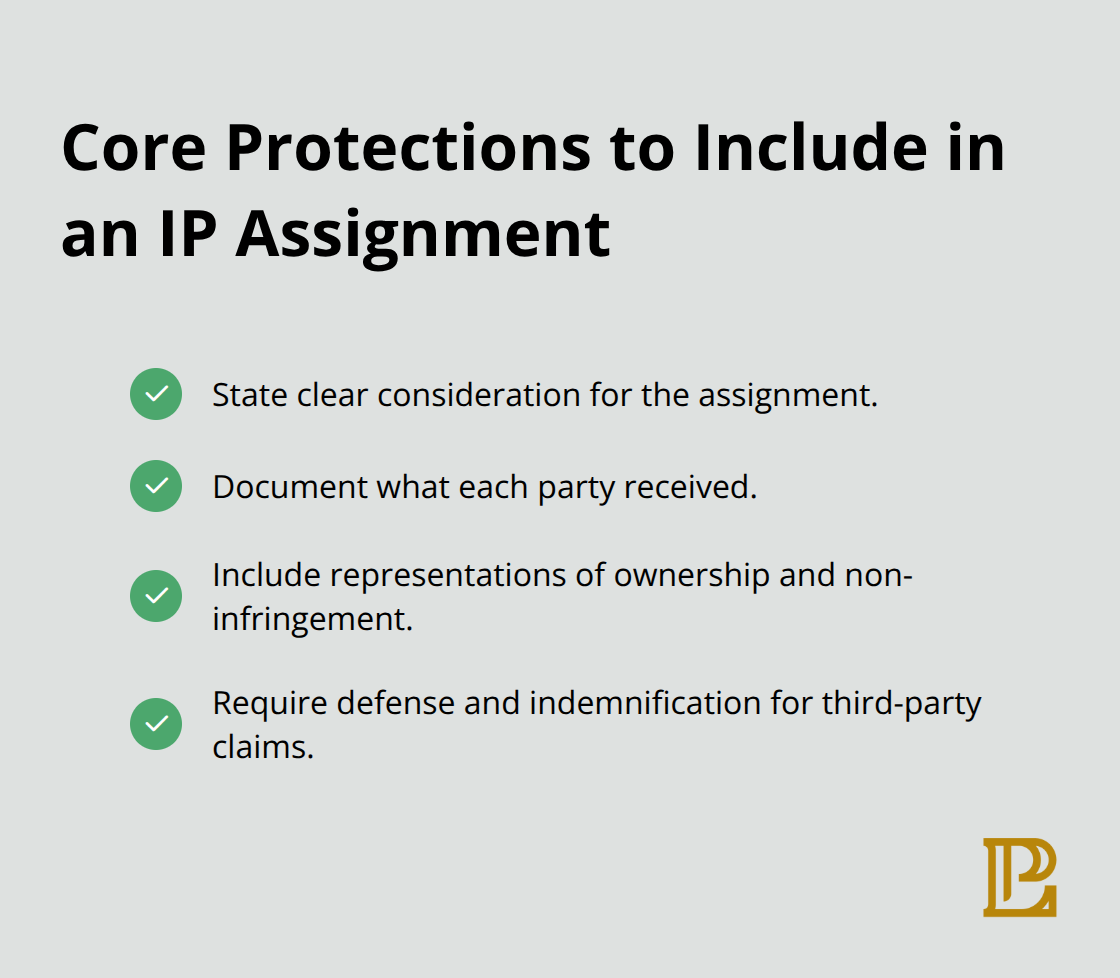
Consideration-the value exchanged for the assignment-must appear explicitly in the agreement, whether that’s cash, equity, services, or something else. Courts and the IRS both scrutinize assignments with no stated consideration, and you need documentation of what each party received. Representations and warranties protect the assignee by confirming that the assignor actually owns the IP, that it does not infringe on anyone else’s rights, and that no other claims or liens exist against it. These warranties should include a promise that the assignor will defend the assignee if a third party challenges ownership.
Confidentiality, Non-Compete Restrictions, and Future Works
Confidentiality and non-compete clauses prevent the assignor from immediately turning around and selling competing IP or disclosing trade secrets to competitors. California courts enforce reasonable non-compete restrictions tied to the assignment, particularly when the assignor received substantial consideration. The agreement should also address who owns improvements or derivative works created after the assignment takes effect-leaving this undefined creates a recipe for future litigation. Finally, specify that the assignment is governed by California law and identify a dispute resolution process, whether that’s arbitration or litigation in Los Angeles County courts.
These foundational elements establish clear ownership and protect both parties from costly disputes. The next section examines the common mistakes that undermine even well-intentioned assignment agreements and how to avoid them.
Mistakes That Sink Assignment Agreements
Most assignment agreements fail not because of what they include, but because of what they leave out or get wrong. The American Bar Association reports that disputes from unclear ownership rank among the most frequent and costly in business litigation, and many of those disputes trace back to sloppy drafting during the assignment process. Hermosa Beach business owners often assume that a basic assignment document covers all scenarios, but incomplete specifications about which rights transfer, missing provisions for future developments, and overlooked California requirements create exposure that grows worse over time.
Vague Descriptions and Mismatched IP Types
A vague assignment that doesn’t specify whether trademark goodwill transfers, patent maintenance obligations, or copyright derivative rights belong to the assignee leaves both parties arguing about ownership months or years later. The real damage emerges during due diligence when an investor or buyer discovers that your assignment agreement doesn’t clearly state who owns improvements made after the transfer, whether indemnification protections exist if someone challenges the IP, or whether the agreement complies with California Labor Code section 2870 for any employee-created work.
One critical mistake is treating all intellectual property the same way in a single paragraph. Patents require different handling than trademarks because trademarks involve goodwill transfer and ongoing use rights, while patents involve maintenance fees and potential improvements. Copyrights and trade secrets demand their own specificity about what qualifies as derivative work and who controls future versions. Federal recordation requirements also differ by IP type-patents and trademarks filed with the USPTO benefit from recordation to protect against claims by subsequent assignees, while copyrights registered with the Library of Congress have their own recording process.
Missing Indemnification and Warranty Language
Neglecting to include indemnification language leaves the assignee vulnerable if someone later sues claiming ownership or infringement, forcing the assignee to defend rights they thought they acquired cleanly. A solid assignment includes representations that the assignor actually owns the IP, that it doesn’t infringe anyone else’s rights, and that no liens or claims encumber it. Without indemnification language, the assignee has no recourse if those representations prove false.
Include indemnification that covers third-party claims, litigation costs, and damages if someone challenges the assignor’s ownership or claims infringement. These protections matter most when you discover problems months into the relationship and need the assignor to defend your position.
California Employment Law Carve-Outs
The second major failure point is underestimating California’s employment law overlay. If any part of your assigned IP was created by employees, California Labor Code section 2870 governs whether you can actually require assignment. The statute prohibits requiring employees to assign inventions developed entirely on their own time without employer resources, unless the invention relates to your business or resulted from work performed for you.
An assignment agreement that attempts to cover all employee inventions without carve-outs for independent work violates California public policy and becomes unenforceable. Practical protection requires explicit language in both your employment agreements and your assignment documents that identifies which inventions qualify for assignment and which fall outside employer control.
Undefined Future Developments and Derivative Works
The third mistake is ignoring future developments and derivative works. An assignment that transfers only the original work but stays silent about improvements, enhancements, or derivative versions creates ambiguity about ownership when those developments occur. If your company assigns source code to another party but the agreement doesn’t address who owns bug fixes, security patches, or new features built on the original code, you’ve set up a dispute waiting to happen.
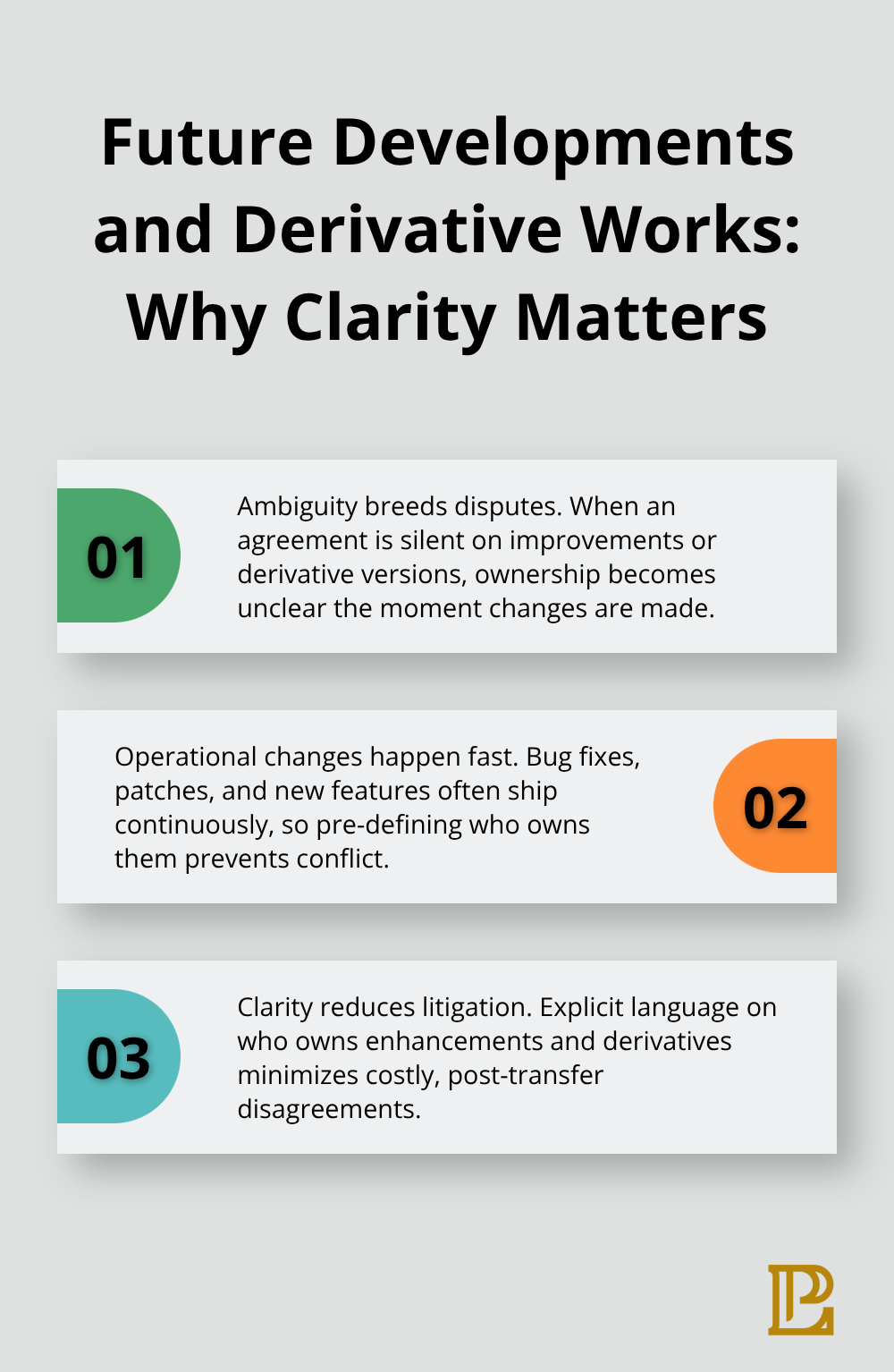
California courts have consistently held that clear language about future developments prevents costly litigation, so your assignment must explicitly state whether derivative works remain with the assignee or revert to the original owner. This specificity protects both parties and eliminates the most common source of post-assignment conflict.
Final Thoughts
An intellectual property assignment agreement only works when you invest care in creating it properly. Hermosa Beach business owners who rush through this process or rely on generic templates discover too late that vague language, missing provisions, and overlooked California requirements create disputes that cost far more to resolve than proper drafting would have cost upfront. The American Bar Association’s research confirms that ownership disputes rank among the most frequent and costly in business litigation, and most of those disputes stem from assignment agreements that lacked specificity about what transfers, who owns future developments, or how California employment law applies.
Getting this right requires more than understanding general principles-you need someone who knows how California courts interpret assignment language, how the USPTO handles recordation for patents and trademarks, and how to structure your intellectual property assignment agreement so that investors and acquirers see clean ownership during due diligence. The stakes grow higher when your intellectual property represents significant company value or when employee-created inventions factor into your business model.
We at Pierview Law work with Hermosa Beach business owners to draft assignment agreements that protect your interests and withstand scrutiny. Whether you’re assigning IP to a new business entity, transferring rights from a freelancer or contractor, or preparing your company for acquisition, we handle the specifics that matter. Visit us at Pierview Law to discuss your intellectual property situation and learn how we can help you protect what you’ve built.