
Hermosa Beach commercial leases come in many forms, each with different cost structures and flexibility options. Whether you’re a tenant seeking favorable terms or a landlord protecting your investment, understanding these lease types matters.
California law and local Hermosa Beach ordinances add another layer of complexity that many business owners overlook. We at Pierview Law help clients navigate these requirements to avoid costly mistakes.
What Lease Structure Works Best for Your Hermosa Beach Business
Gross leases, net leases, and their variations dominate the Hermosa Beach commercial market, but most business owners misunderstand which structure actually saves them money. In a gross lease, you pay one fixed monthly rent and the landlord covers property taxes, insurance, and maintenance. This sounds simple, but landlords bake these costs into your base rent-often at inflated rates that protect them against future increases. Net leases shift these costs to you as a tenant. A single net lease makes you pay property taxes; a double net adds insurance; a triple net (NNN) puts all three on your shoulders. According to LoopNet’s data, Hermosa Beach listings range from $45.48 per square foot annually for office space to $84.00 per square foot for larger blocks, but these quoted rates often exclude NNN costs that can add 15 to 30 percent to your total occupancy expense. Modified gross leases split the difference-you pay base rent plus a portion of operating cost increases above a base year threshold, which creates predictability for both parties.
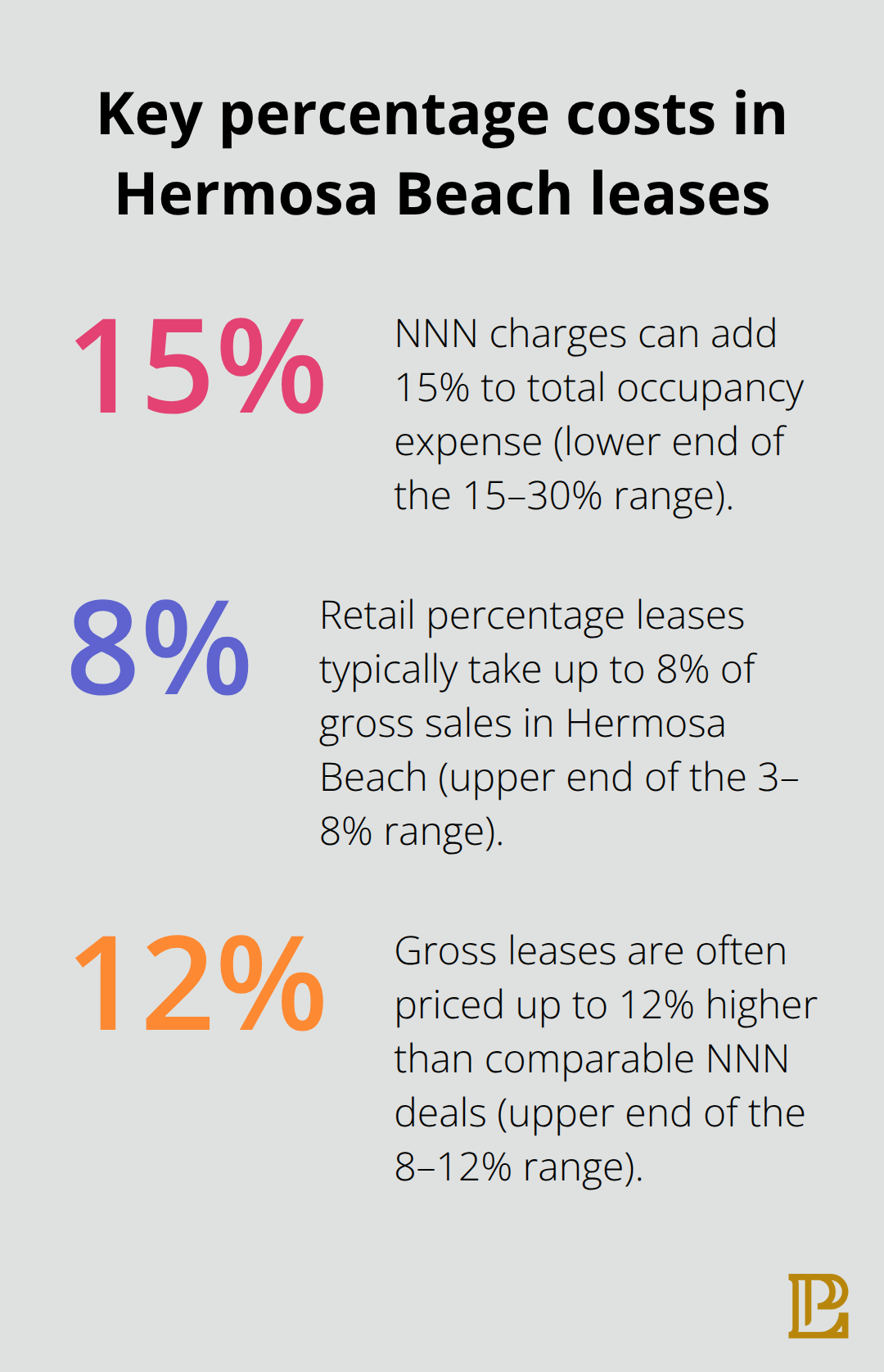
Percentage leases, common in retail along Pacific Coast Highway and Pier Avenue, combine a modest base rent with a percentage of your gross sales, typically 3 to 8 percent depending on your industry. This structure rewards landlords when your business thrives but can squeeze your margins during slow periods.
Triple Net Leases Demand Careful Cost Verification
Triple net leases are prevalent in Hermosa Beach but carry hidden risks that tenants regularly overlook. California Civil Code Section 1950.9 requires landlords to provide supporting cost documentation within 30 days if you request it, and landlords cannot change their cost allocation method during your tenancy without written notice. Request this documentation before you sign and verify that building operating costs include only maintenance of common areas, utilities not separately metered, and landlord’s taxes or assessments-not costs you pay directly to third parties or amounts insurance has already reimbursed. Many tenants discover mid-lease that their NNN obligation has doubled because the landlord shifted maintenance responsibility or altered the allocation formula. You should negotiate a cost cap or annual escalation limit upfront; without one, your occupancy costs can spiral beyond your business plan.
Gross and Modified Gross Leases Offer Stability With Trade-Offs
Gross leases provide cost certainty that appeals to tenants with tight budgets, but only if base rent reflects fair market value. In Hermosa Beach’s coastal market, landlords often price gross leases 8 to 12 percent higher than comparable NNN deals because they absorb inflation risk. Modified gross leases split this burden and work well if your lease term is short (three to five years) and the base year captures actual costs. You should insist on a clear definition of what costs are included, excluded, and how the landlord calculates your proportionate share if the property has multiple tenants. If you occupy 2,000 square feet in a 10,000-square-foot building, your share should be exactly 20 percent, not subject to landlord interpretation. You should request annual reconciliation statements that show how costs were calculated and reserve the right to audit if numbers seem unreasonable. These protections matter most during renovation cycles or when the landlord upgrades building systems-costs can jump significantly unless your lease explicitly caps landlord-initiated improvements that tenants must absorb.
Why Cost Transparency Shapes Your Lease Decision
The difference between what you think you’ll pay and what you actually pay often comes down to how clearly your lease agreements define operating costs and allocation methods. Landlords in Hermosa Beach frequently include vague language around “maintenance” or “common area expenses” that leaves room for interpretation. You need specificity: does maintenance include parking lot resurfacing, roof replacement, or only routine repairs? Does common area include the lobby, hallways, and landscaping, or does it extend to exterior signage and building facades? California law protects you here-Section 1950.9 prevents landlords from changing cost formulas mid-lease without notice, and you can demand documentation to verify charges. If your landlord refuses transparency or alters allocation methods without proper notice, you have grounds to challenge the increase and potentially recover damages. This is where working with a real estate attorney becomes valuable; they identify cost traps before you sign and structure language that protects your budget throughout the lease term.
How to Protect Your Interests Through Strategic Lease Terms
Hermosa Beach commercial leases rarely work out well for the party that accepts default terms without negotiation. Renewal options and early termination rights determine whether you can stay in a location that’s working or exit cleanly when circumstances change. Most landlords in Hermosa Beach push for long fixed terms without exit provisions because that locks in your occupancy cost and prevents you from relocating if market rates drop or your business needs shift.
Securing Renewal Options at Predictable Rates
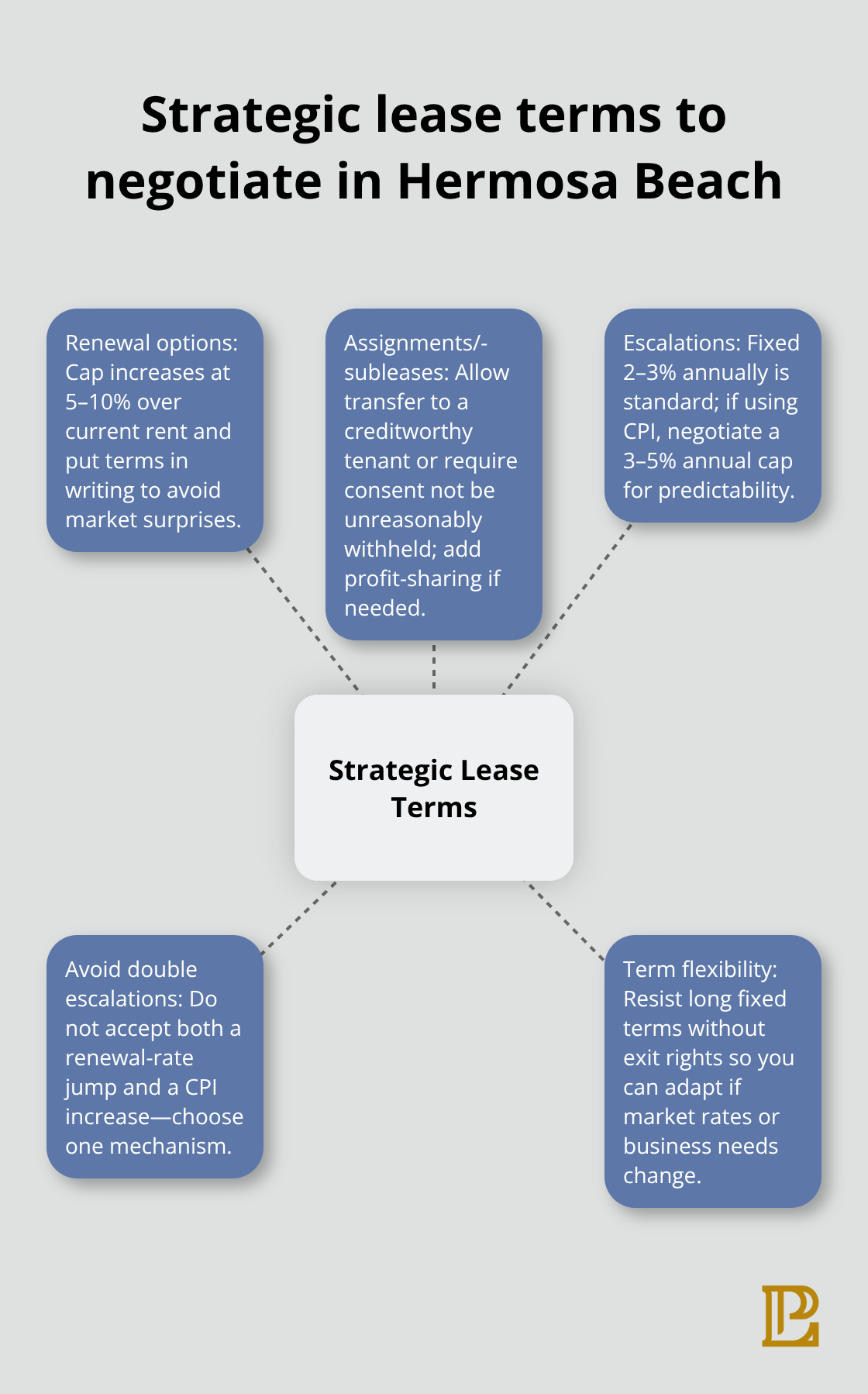
You should demand renewal options at predetermined rates-ideally capped at 5 to 10 percent above the current rent rather than open to fair market value renegotiation. Without this protection, you face the choice of accepting whatever rent the landlord demands or relocating at the end of your term. If you’re a retail tenant along Pacific Coast Highway or Pier Avenue where LoopNet shows rents ranging from $45.48 to $84.00 per square foot annually, a three-year renewal option locked at your current rate could save tens of thousands of dollars if market conditions shift.
California law also protects you through Civil Code Section 1946.1, which addresses termination rights on periodic tenancies. If your lease has no fixed term, either party can terminate with proper notice-landlords must give at least 60 days’ notice, or 30 days if you’ve occupied the space for less than a year. You should structure your initial lease to include specific renewal terms in writing rather than relying on informal handshake agreements that courts won’t enforce.
Assignment and Sublease Rights Create Operational Flexibility
Assignment and sublease rights matter equally because they give you flexibility if your business needs to downsize, relocate, or pivot. Many landlords restrict assignments to prevent unknown tenants from occupying their space, but overly strict language leaves you trapped in a lease that no longer fits your operations. You should negotiate language that allows you to assign or sublet to a creditworthy tenant in the same general business category without landlord consent, or at minimum requiring that consent not be unreasonably withheld. If your landlord refuses this, insist on a profit-sharing clause so that if you sublet at a higher rate than your base rent, you split the excess with the landlord-this aligns both parties’ interests in approving reasonable assignments.
Controlling Rent Escalation Through Clear Mechanisms
Rent escalation clauses need equal attention because they determine whether your occupancy costs remain predictable or become a moving target. Fixed escalations of 2 to 3 percent annually are standard in Hermosa Beach and manageable for business planning. Consumer Price Index (CPI) escalations shift inflation risk to you and can spike unexpectedly; if your landlord insists on CPI, negotiate a cap at 3 to 5 percent annually so you’re not blindsided. Percentage-based escalations tied to a base year work well only if the base year reflects actual costs-verify this through the cost documentation rights California Civil Code Section 1950.9 grants you. Some landlords propose double escalations where rent increases at renewal and again based on CPI, which compounds your cost burden unfairly. You should push back hard on this structure; accept either a renewal rate adjustment or a CPI escalation, not both.
Tenants in Hermosa Beach who fail to address these three areas-renewals, assignments, and escalations-often discover mid-lease that their lease has become an anchor holding them back from growth or preventing them from cutting losses when business conditions deteriorate. These provisions shape your lease’s real value far more than the quoted base rent rate. California’s SB 1103 adds another layer of protections for qualified commercial tenants, which means the compliance landscape continues to shift and requires attention to statutory notice requirements and rent increase limitations that your lease must accommodate.
California and Local Rules That Shape Your Lease
Hermosa Beach commercial leases operate under a dual regulatory framework that catches many business owners off guard. California state law, particularly Civil Code Section 1950.9 and the recent SB 1103, sets mandatory protections and disclosure requirements that override whatever language your lease contains. Local Hermosa Beach ordinances layer additional requirements around permits, signage, use restrictions, and building compliance that directly affect what you can do in your leased space and what costs you’ll face.
Permits and Timelines That Affect Your Move-In Date
The City’s streamlined permitting process means faster approvals for tenant improvements compared to many coastal markets, but you still need to budget for plan checks, building and safety inspections, and code enforcement reviews that can delay your occupancy timeline. Signage permits, limited live entertainment permits, and special event approvals all require advance planning and landlord coordination. If your business involves any outdoor dining, events, or media activity, these approvals become material lease negotiation points because they determine your customer visibility and operational flexibility.
SB 1103 Protections for Qualified Commercial Tenants
SB 1103 created a separate compliance burden that applies specifically to qualified commercial tenants-defined as microenterprises, restaurants with fewer than 10 employees, or nonprofits with fewer than 20 employees. If you fit this definition, your landlord must provide 30 days’ notice for rent increases of 10 percent or less, and 90 days’ notice for increases exceeding 10 percent. Your landlord must also translate lease agreements in full if negotiated in Spanish, Chinese, Tagalog, Vietnamese, or Korean, and failure to do so gives you the right to rescind the entire lease.
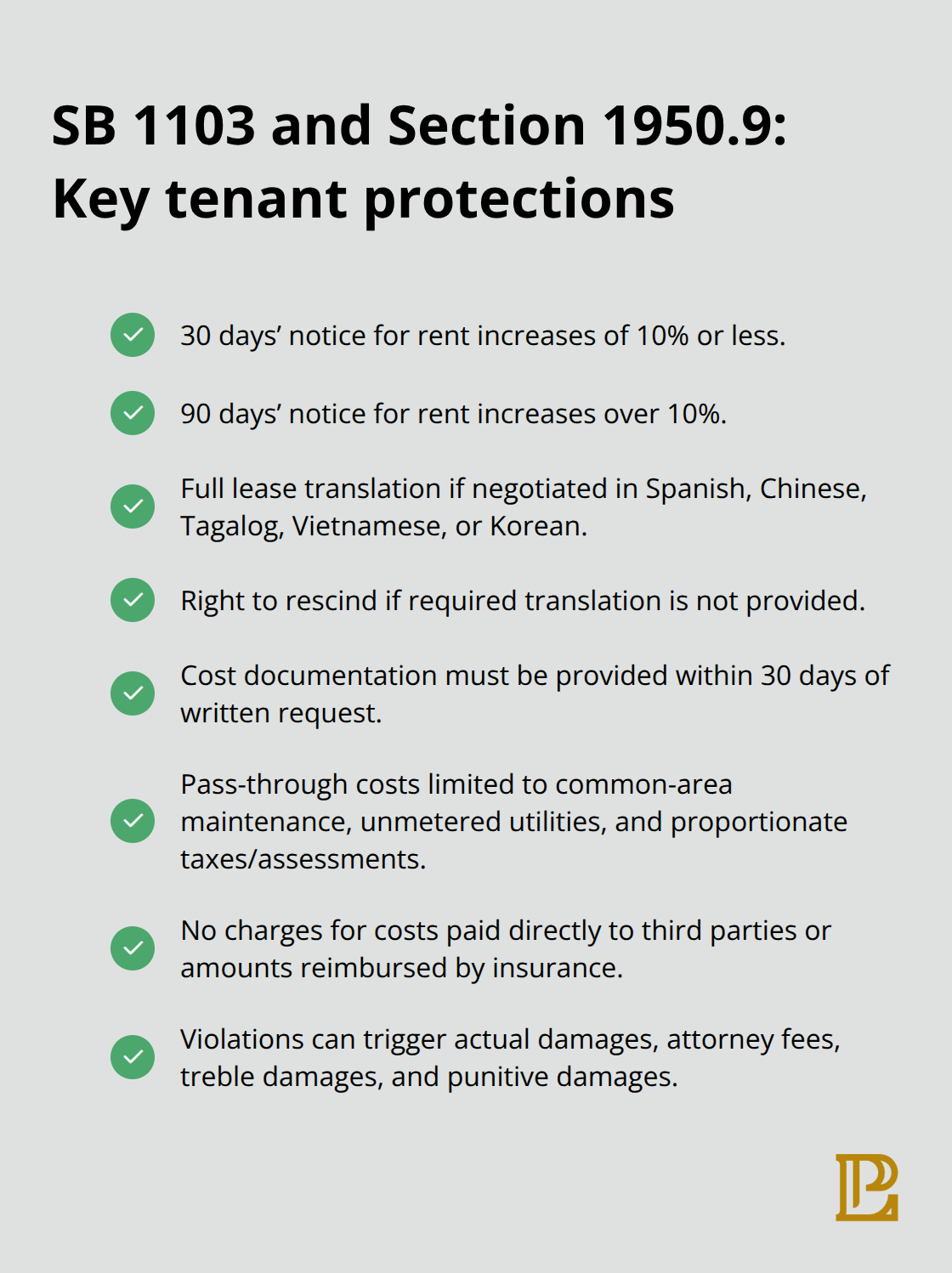
Building operating cost transparency under Section 1950.9 remains non-negotiable: your landlord must provide supporting documentation within 30 days of your written request, and costs must be limited to maintenance of common areas, separately unmetered utilities, and landlord’s proportionate property taxes or assessments. Landlords cannot charge you for costs you paid directly to third parties or amounts insurance reimbursed. If your landlord violates these protections willfully, oppressively, or fraudulently, you may recover actual damages, reasonable attorney fees, and treble damages plus punitive damages-a financial exposure that makes compliance essential for any landlord operating in California.
Maintenance Obligations and Liability Insurance
Maintenance obligations and liability protection require equally careful attention because they determine who pays when something breaks and who bears the risk if someone gets injured in your space. Your lease must clearly assign responsibility for structural repairs, roof and foundation work, parking lot maintenance, and common area upkeep to the landlord, while tenant-initiated improvements and interior finishes remain your responsibility. California commercial leases do not automatically grant tenants the same implied warranty of habitability that residential leases carry, so your lease language determines whether your landlord must maintain basic functionality like HVAC, plumbing, and electrical systems. Liability insurance requirements belong in your lease with specific coverage amounts-most Hermosa Beach landlords require tenants to carry general liability insurance of at least one million dollars and name the landlord as an additional insured.
Environmental Liability and Waste Compliance
You should verify that your lease addresses environmental liability, particularly if your business involves chemicals, food preparation, or waste disposal, because California environmental law can hold both landlord and tenant responsible for contamination. If your lease is silent on who maintains compliance with environmental regulations, you inherit unlimited liability. The City of Hermosa Beach’s waste, recycling, and hazardous waste policies add operational costs that belong in your lease budget; confirm whether your landlord or you handle compliance and cost responsibility. A real estate attorney identifies gaps in your lease language and structures provisions that allocate risk appropriately based on your business type and the property’s condition.
Final Thoughts
Hermosa Beach commercial leases demand attention to three critical areas that most business owners handle poorly: understanding which lease structure actually fits your budget, negotiating terms that give you flexibility as circumstances change, and complying with California state law and local ordinances that override whatever language appears in your lease. Gross leases offer cost certainty but lock you into inflated base rents that protect landlords against inflation, while triple net leases shift costs to you and require strict verification of building operating expenses to prevent mid-lease surprises. Modified gross and percentage leases split costs between parties, but only if your lease defines operating expenses with precision and caps annual increases.
Renewal options, assignment rights, and escalation mechanisms determine whether your lease becomes a strategic asset or an operational burden. Landlords in Hermosa Beach prefer long fixed terms without exit provisions because they lock in your occupancy and prevent you from relocating if market conditions shift. You should demand renewal options at capped rates, assignment rights that allow flexibility if your business needs change, and escalation mechanisms that remain predictable rather than tied to inflation indices that spike unexpectedly (California Civil Code Section 1950.9 and SB 1103 create mandatory protections around cost transparency and rent increase notice periods that your lease must accommodate, and violations expose landlords to treble damages and punitive liability).
The gap between what you think you’ll pay and what you actually pay comes down to lease language that either protects you or leaves you exposed. We at Pierview Law help business owners and landlords structure Hermosa Beach commercial leases that allocate costs fairly, define maintenance obligations clearly, and build in flexibility for the unexpected. Contact us to review your lease before you sign or to address problems in an existing agreement.