
Intellectual property strategy isn’t something you pick up overnight. It requires a blend of legal knowledge, business acumen, and hands-on experience in a competitive field.
At Pierview Law, we’ve seen firsthand how the best intellectual property strategists combine formal education with real-world problem-solving. This guide walks you through the exact steps to build that foundation and advance your career in IP strategy.
What Should You Study to Build an IP Strategy Career
Understanding the Three Core IP Protections
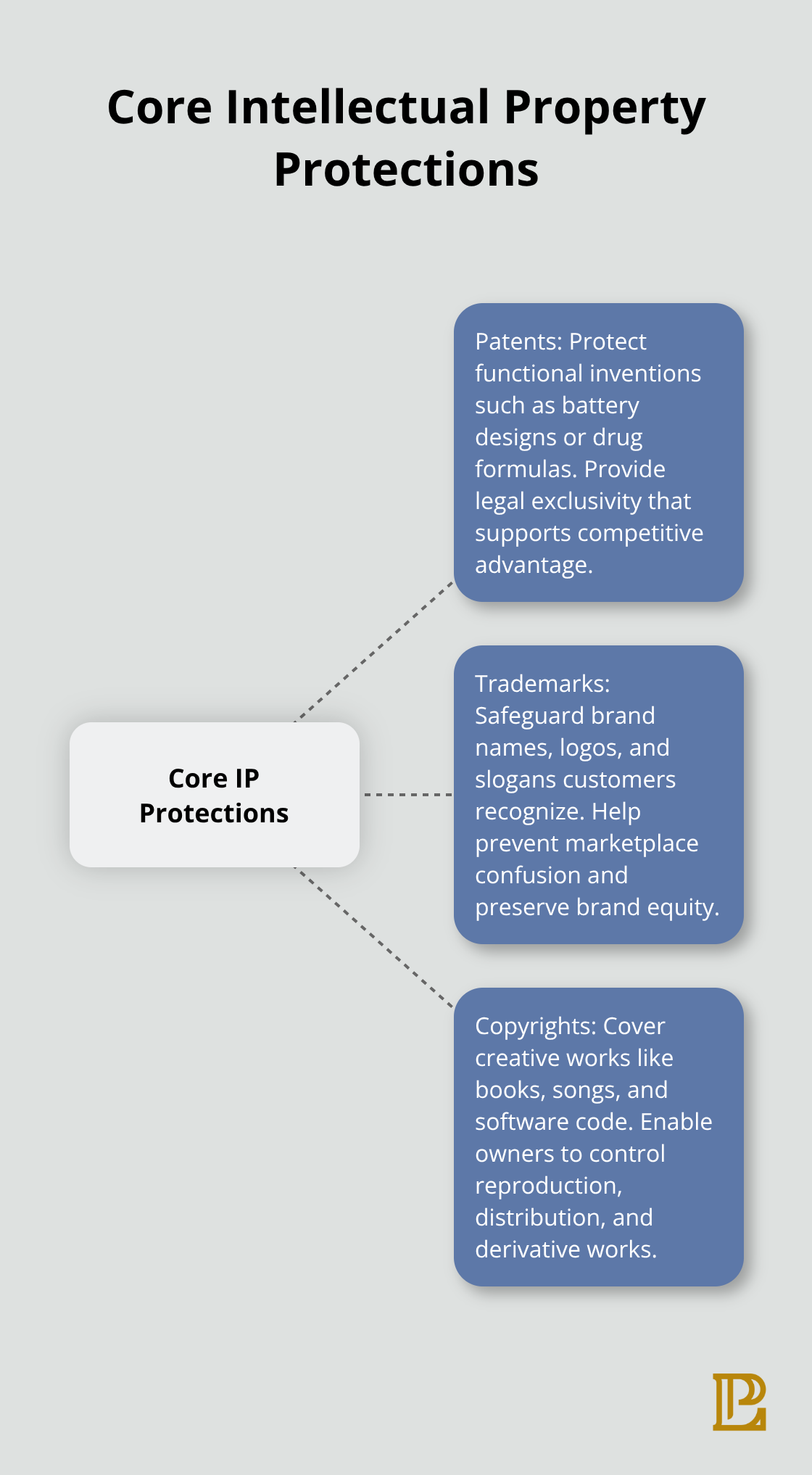
Patents guard functional innovations like battery designs or drug formulas. Trademarks protect brand identity and slogans that customers recognize. Copyrights cover creative works like books, songs, and software code. These aren’t abstract concepts-they’re assets that companies fight over in court and rely on for competitive advantage.
A Juris Doctor with IP coursework forms the foundation, but top law schools for this track include USC Gould, Loyola, UC Berkeley, Pepperdine, and Golden Gate University.
Building Essential Skills in Law School
The American Bar Association recommends building analytical thinking, problem-solving, critical reading, writing and editing, and oral communication skills through internships and hands-on work. In law school, pursue IP certificates covering copyright, patent, trademarks, and IP litigation. Many students also participate in IP moot court competitions like the Saul Lefkowitz Intellectual Property Competition to sharpen litigation skills before entering practice.
Choosing Your Undergraduate Path
Your undergraduate major matters less than you’d think, but it shapes which IP path opens fastest. For patent work, an engineering or science degree accelerates your trajectory because you’ll understand the technical innovations you’re protecting. Without that background, you can still practice patent law, but you’ll spend more time learning the technology. For trademark, copyright, or IP litigation, majors like history, English, political science, business management, or economics work equally well.
Gaining Real-World Exposure Through Internships
Early internships at IP firms, tech companies, or entertainment studios teach you how to analyze IP portfolios, draft licensing agreements, and spot infringement risks-skills that no classroom fully replicates. You’ll also learn that IP strategy isn’t just legal compliance; it’s about understanding your client’s business roadmap and aligning patent filings, trademark registrations, and licensing deals with growth milestones. That business mindset separates strategists from document processors, and it’s something employers actively seek when hiring. Once you understand how to connect legal protection to business outcomes, you’re ready to move beyond the classroom and into the hands-on work that shapes real IP portfolios.
From Classroom to Real IP Portfolios
Patent Prosecution Teaches You How Protection Actually Works
Theoretical knowledge crumbles the moment you face a real patent portfolio with overlapping claims, expired trademarks, and licensing agreements that contradict each other. That’s why the transition from law school to hands-on IP work matters more than your GPA. You need direct experience analyzing how patents actually protect business value, how trademark enforcement works in practice, and how licensing deals either unlock revenue or create legal landmines.
Start this phase by working in patent prosecution roles where you draft and file applications. This forces you to understand claim language, prior art searches, and the USPTO’s examination process. Patent prosecutors handle both utility and design patents, and you’ll quickly learn that a poorly drafted provisional patent filing wastes years of priority protection.

The U.S. Department of Labor reports median lawyer pay at roughly $120,000 annually, but IP practitioners with hands-on prosecution experience command approximately $130,000 on average, rising to $200,000 or more with bonuses when you’ve built a track record of successful filings and strategic counseling.
Connecting Patents to Business Growth Separates Strategists from Technicians
Your next critical skill is understanding how patents interact with business growth. When you sit with founders pitching to investors, you’ll see that a fragmented IP strategy-one that protects surface features instead of core innovations-signals amateur thinking. Strong IP strategists conduct freedom-to-operate analyses early, meaning they search existing patents to identify infringement risks before a company commits resources to development. This separates strategists from lawyers who only react to problems.
Litigation Experience Shows You Which Patents Actually Hold Up
Litigation and enforcement experience teaches you the other side: what happens when patents face challenges, when trademarks suffer infringement, or when licensing disputes escalate to court. Many IP strategists spend 2–3 years in litigation roles handling patent disputes, trademark opposition proceedings, and post-grant patent reviews at the Patent Trial and Appeal Board (PTAB). This experience proves invaluable because it shows you which patents hold up under pressure and which ones collapse under cross-examination.
Licensing Work Reveals Where Real Strategy Lives
Licensing work comes next, and this is where strategy truly lives. You’ll negotiate exclusive and non-exclusive licenses, structure royalty arrangements, and spot deal-breakers like conflicting ownership claims or vague field-of-use definitions that create disputes years later. Real licensing agreements include specific language around sublicensing rights, territory restrictions, and performance milestones. A strong IP strategist can read a licensing deal and immediately identify which provisions protect the licensor’s interests and which ones expose them to risk.
Collaboration With Technical Teams Makes Strategy Real
Throughout this phase, you must work with engineers, scientists, and product teams because IP strategy only works when it aligns with what the business actually builds. If you protect features that never ship, or ignore innovations that competitors can copy, your portfolio becomes theater. The Los Angeles Intellectual Property Law Association and the American Intellectual Property Law Association (which has over 14,000 members) offer panel discussions and conferences where you’ll hear how working IP strategists handle real-world challenges. Attend these events, ask questions, and build relationships with practitioners who’ve navigated the transition from technician to strategist. These connections will guide you toward the advanced specializations that separate senior strategists from mid-level practitioners.
What IP Trends Matter Most to Your Career
AI and Emerging Technologies Reshape Patent Filings
The IP landscape shifts faster than most lawyers realize, and staying ahead of those shifts determines whether you remain relevant or become obsolete. Emerging technologies like artificial intelligence, autonomous systems, and biotechnology create entirely new categories of IP challenges that didn’t exist five years ago. The American Intellectual Property Law Association, which represents over 14,000 members, regularly publishes research on how patent filings spike in specific technology areas. AI-related patents have grown exponentially, with thousands of applications filed annually across software, medical diagnostics, and manufacturing.
If you want to command higher rates and attract better clients, you need to position yourself in these high-velocity sectors where companies desperately need strategists who understand both the legal framework and the underlying technology. This means reading patent databases, tracking USPTO trends, and following what competitors are filing. Anticipate the problems coming next year and build your knowledge ahead of demand rather than waiting for a client to bring you a problem.

Build Specialization in High-Demand Technology Sectors
Networking within the Los Angeles Intellectual Property Law Association and the broader IP community isn’t optional if you want to advance beyond mid-level work. These associations host monthly panels, annual conferences, and working groups where senior strategists discuss real cases and emerging issues. Attend these events regularly, not occasionally. When you meet practitioners who’ve spent 20 or 30 years building IP portfolios, ask them which technology sectors they’re seeing the most activity in and where they expect growth.
This intelligence shapes your own specialization. The highest-paid IP strategists aren’t generalists who handle everything; they’re focused practitioners who’ve built deep knowledge in biotech, electronics, software, or entertainment IP. If you serve clients across Los Angeles County, positioning yourself in one of these high-demand areas means you’ll attract clients with bigger budgets and more complex problems.
Develop Credibility Through Focused Sector Work
Start this specialization now by taking on cases or projects in your chosen sector, building relationships with engineers and scientists in that field, and staying current with technical literature alongside legal developments. Within two to three years of focused work, you’ll have built enough knowledge and credibility to command rates significantly above the $130,000 average for IP practitioners with general experience. The market rewards depth over breadth, and clients in specialized sectors (biotech companies, software startups, entertainment studios) pay premium rates for strategists who speak their technical language and understand their competitive landscape.
Final Thoughts
The path to becoming an intellectual property strategist demands commitment across three phases: building legal foundations through formal education, gaining hands-on experience in prosecution and litigation, and then specializing in high-demand technology sectors where your knowledge commands premium rates. Real strategy emerges only when you’ve analyzed failing portfolios, defended weak patents in litigation, and negotiated licensing deals that either unlock revenue or create legal exposure. Your undergraduate major matters far less than your willingness to work with engineers and scientists who translate innovations into protectable assets.
The highest-paid IP strategists aren’t generalists-they’ve chosen a sector like biotech, software, electronics, or entertainment and built deep knowledge that clients in those fields desperately need. This specialization takes time, but it accelerates your move beyond the $130,000 average that general IP practitioners earn toward the $200,000-plus compensation that senior strategists command. Attend Los Angeles Intellectual Property Law Association events, build relationships with practitioners who’ve spent decades in the field, and position yourself in emerging technology areas where demand outpaces supply.
If you’re building an IP strategy for your business or need guidance on protecting your innovations, Pierview Law provides intellectual property services alongside business law and outside general counsel support to clients across Los Angeles County. The transition from learning IP law to practicing it as an intellectual property strategist happens when you stop treating patents and trademarks as compliance checkboxes and start viewing them as competitive weapons aligned with your client’s growth roadmap.