
An intellectual property lawsuit can threaten your business’s most valuable assets. Whether someone has stolen your invention, copied your brand, or misused your trade secrets, the stakes are high and the decisions you make now will shape your company’s future.
At Pierview Law, we’ve guided countless business owners through IP disputes in Hermosa Beach and beyond. This guide walks you through the essential steps to protect what you’ve built.
What IP Disputes Actually Look Like
Patent Infringement: The Expensive Path
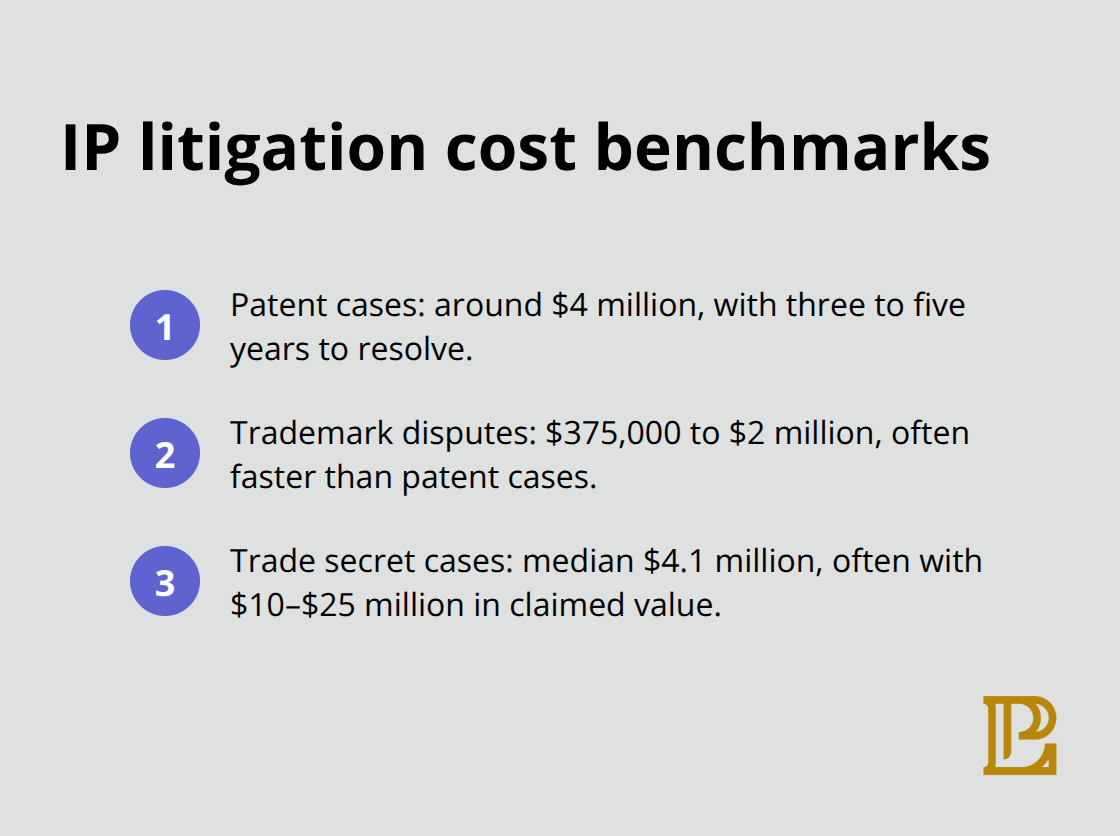
Patent infringement claims arise when someone manufactures, uses, sells, or imports an invention without permission-and these cases demand significant resources. According to Thomson Reuters, patent litigation typically costs around $4 million and lasts three to five years in civil court. The USPTO issues patents but does not enforce them; that burden falls on you to pursue enforcement in federal district court or through an International Trade Commission exclusion order. What makes patent cases particularly complex is claim construction, which often determines the outcome before trial even begins. Courts interpret your patent claims using the language in the document, the patent specification, and sources that reflect how someone skilled in your field would have understood the invention at the time you filed. This stage typically takes about two years, and if the court interprets your claims narrowly, your case weakens significantly.
Trademark and Copyright Violations: Faster Resolution
Trademark and copyright violations operate differently and tend to move faster than patent cases. Trademark infringement requires proving that someone’s mark creates a likelihood of confusion with yours, and Thomson Reuters reports that trademark litigation costs between $375,000 and $2 million, with trials often reaching resolution within a shorter timeframe than patent disputes. Copyright claims are more straightforward to establish-you need to prove you own a valid registered copyright and that someone copied your work-but federal court costs average around $278,000 according to the American Intellectual Property Law Association’s 2017 data.
Trade Secret Misappropriation: Immediate Action Required
Trade secret misappropriation is the third major category, and it demands immediate action because once confidential information spreads, the damage becomes permanent. Under the California Uniform Trade Secrets Act, you must show three things: the information has actual or potential independent economic value precisely because it isn’t generally known, it isn’t readily obtainable by legitimate means, and you took reasonable steps to keep it secret. The 2019 AIPLA report estimates median litigation costs for trade secret disputes at $4.1 million, often involving alleged values between $10 million and $25 million. The Economic Espionage Act imposes criminal penalties of up to $500,000 in fines and ten years in prison for individuals, or up to $5 million for corporations, plus government seizure of stolen materials.
Choosing Your Defense Strategy
Each dispute type requires a different legal approach, different evidence, and different timing. The path forward depends entirely on which category of infringement you face. Your first conversation with legal counsel should clarify exactly which type of IP violation occurred, because that determination shapes everything that follows-from the court where you file to the evidence you gather to the timeline you anticipate.
Move Fast: Your First 72 Hours Matter
Stop the Bleeding Immediately
The moment you realize you’re facing an IP lawsuit, time becomes your most valuable asset. The first three days determine whether you’ll control the narrative or chase it. Stop all potentially infringing activity immediately-don’t wait for a cease-and-desist letter or court order. If you’re the defendant, halting the disputed conduct now prevents courts from viewing you as willfully infringing later, which can triple damages under patent law.
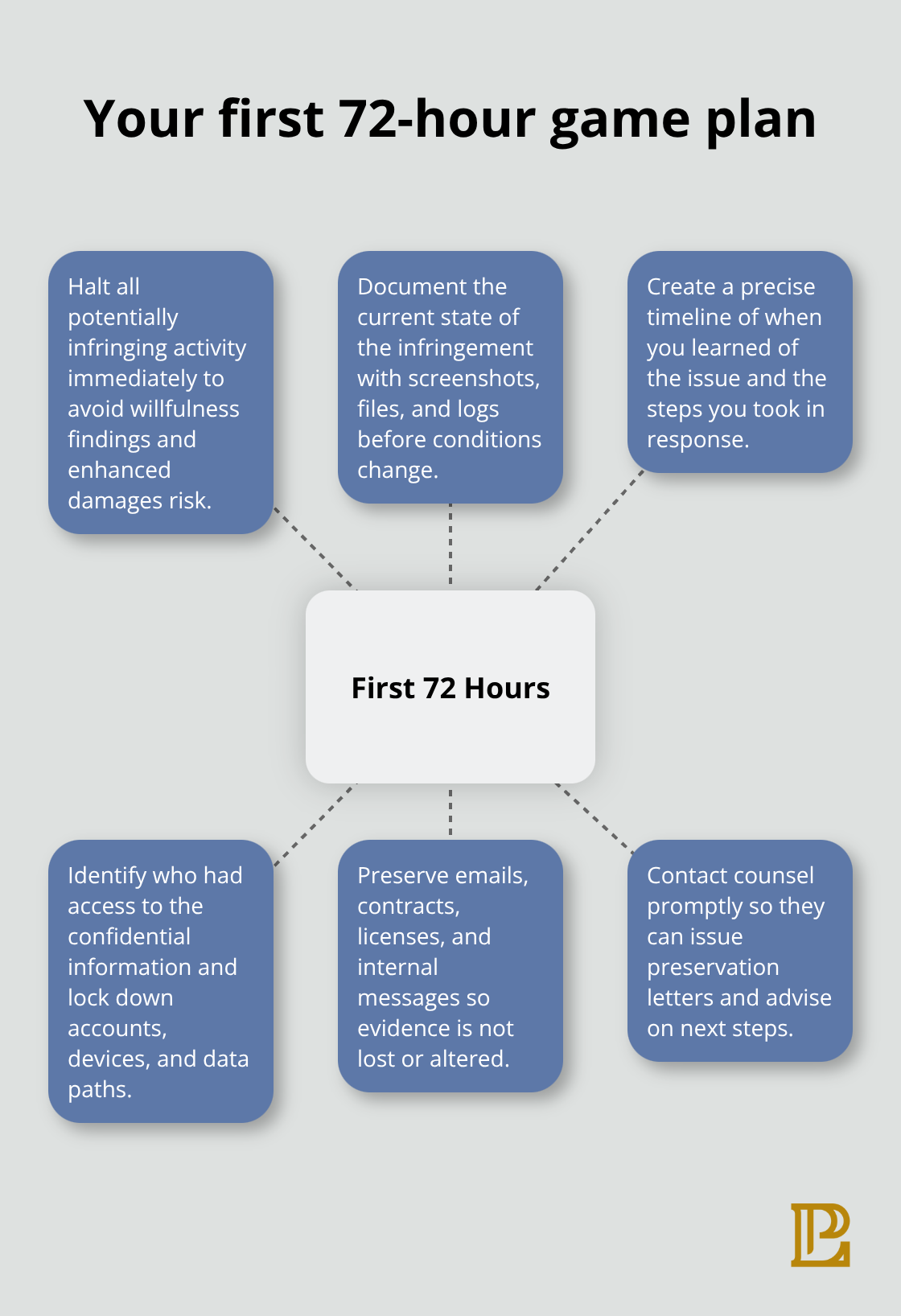
If you’re the plaintiff, document everything about the infringement as it exists right now, because evidence degrades quickly.
Gather Evidence Before It Vanishes
Pull communications with the other party, gather all contracts, licensing agreements, and design documents, and preserve emails, messages, and internal notes that reference the disputed IP. Create a timeline of when you became aware of the infringement and what steps you took in response. For trade secret cases specifically, this becomes critical-courts weigh whether you maintained reasonable safeguards, so identify who had access to the confidential information and review your confidentiality agreements with employees, contractors, and vendors. Thomson Reuters data shows that parties who gather comprehensive documentation early reduce litigation costs and accelerate resolution because they’re not scrambling to reconstruct facts months later.
Assess Your Legal Position Honestly
Your legal position isn’t abstract-it’s built on concrete evidence and honest assessment. Patent cases hinge on claim construction, which takes roughly two years, so you need to understand what your patent actually covers right now, not after depositions begin. Copyright disputes require proof of registration with the U.S. Copyright Office; if you haven’t registered, do it immediately because it unlocks the ability to recover statutory damages up to $30,000 per work through the Copyright Claims Board. Trademark cases depend on demonstrating likelihood of confusion, which means analyzing how similar the marks are and whether they target the same customers. Trade secret disputes demand proof that you took reasonable steps to keep information secret-vague security practices won’t survive discovery.
Contact an Attorney Within 72 Hours
The second critical action is contacting counsel immediately, not after you’ve spent weeks investigating alone. An attorney can send a preservation letter to the other party, stopping them from destroying evidence, and can advise whether you should respond to any demand they’ve sent. Many business owners delay this conversation thinking they’ll gather more information first, but that delay often means losing leverage and missing procedural deadlines that courts won’t excuse. Your attorney will also evaluate whether you face additional exposure-such as counterclaims or parallel proceedings before the Patent Trial and Appeal Board-that could affect your overall strategy and timeline.
How to Shift the Odds in Your Favor
Settlement and Licensing: The Path Most Cases Take
Most IP disputes never reach trial. According to Thomson Reuters data, the majority settle or resolve through negotiation, licensing agreements, or alternative dispute resolution before substantial discovery costs accumulate. This reality gives you immediate leverage: courts and opposing counsel know that litigation will cost $4 million in patent cases, $375,000 to $2 million in trademark disputes, and $4.1 million for trade secret misappropriation according to the 2019 AIPLA report. Your strategy should exploit this fact.
If you hold a strong position on claim construction in a patent case or can demonstrate clear trademark infringement through market confusion, use that strength to negotiate from a position of control rather than desperation. Settlement negotiations work best when both sides understand the true cost of fighting. Prepare a damages analysis showing what a jury might award, calculate the legal fees you’ll both spend over three to five years, and present realistic settlement ranges.
For patent cases, licensing agreements often make more financial sense than litigation because they generate ongoing royalties without the years of discovery and appeals. Trademark disputes frequently resolve through coexistence agreements that define geographic territories or product categories where each party can operate. Trade secret cases rarely settle for less than an injunction preventing further use, so your negotiation position must include non-negotiable protection of confidential information.
Prepare Detailed Claim Charts and Market Analysis
The moment settlement talks begin, shift your litigation preparation into high gear rather than backing off. Prepare detailed claim charts that map every element of the alleged infringement directly to your patent claims or copyright registration, because these documents become the foundation for both settlement discussions and trial. Gather market data showing the size of the addressable market and potential royalty rates; Thomson Reuters reports that cases with $10 to $25 million in claimed value require this level of specificity to support damages projections.
Organize Discovery and Protect Confidential Information
For discovery, assume the other side will request everything: internal communications, product development timelines, financial records, and customer lists. Create a document management system now that segregates privileged attorney communications from discoverable materials, because courts will sanction you for withholding responsive documents. In trade secret cases specifically, request protective orders that limit which of your employees can view the other side’s confidential information during discovery.
Build Your Trial Team Early
Build your trial case by identifying expert witnesses early-patent cases require technical experts who can explain claim construction to a jury, trademark cases need consumer confusion experts, and trade secret cases need forensic specialists who can trace how information was misappropriated. The strongest defense combines realistic settlement positioning with relentless trial preparation, forcing the other side to take your case seriously while keeping your options open.
Final Thoughts
An intellectual property lawsuit tests your business’s resilience and decision-making under pressure. The cases that resolve fastest and most favorably are those where you act decisively in the first 72 hours, gather comprehensive evidence, and bring legal counsel into the conversation immediately rather than months later. Your IP assets define your competitive position, and protecting them requires speed, clarity, and the right legal guidance.
The three core takeaways from this guide are straightforward. First, identify which type of IP infringement you face because patent cases, trademark disputes, copyright violations, and trade secret misappropriation each follow different timelines and cost structures. Second, move fast during those critical first three days by stopping infringing activity, preserving evidence, and contacting an attorney who understands your specific situation.
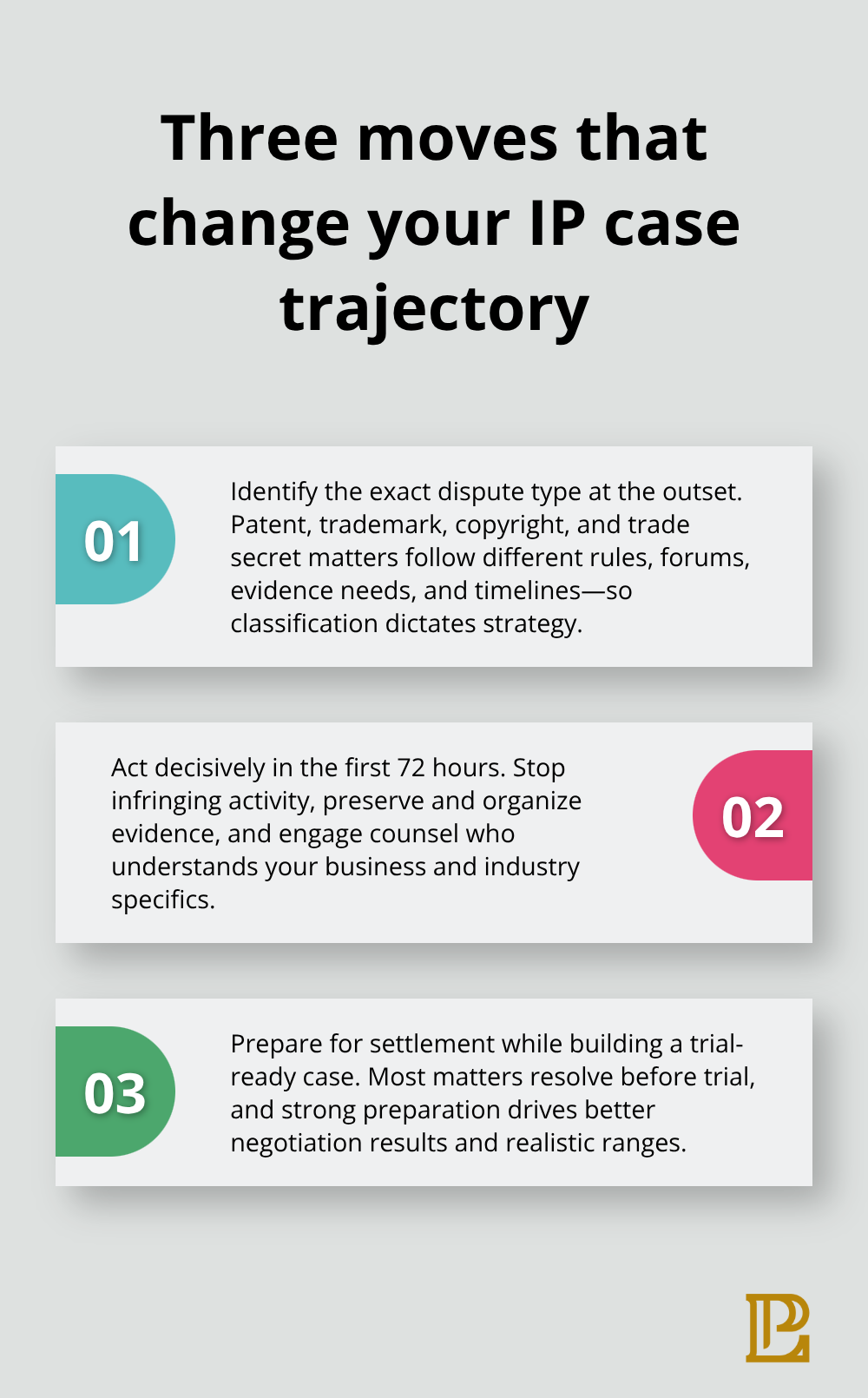
Third, recognize that most disputes settle before trial, which means your settlement position depends entirely on how thoroughly you’ve prepared your case and how realistically you’ve assessed your legal standing.
Early legal intervention isn’t a luxury reserved for large corporations with unlimited budgets-it’s the difference between controlling the narrative and reacting to it, between negotiating from strength and negotiating from desperation. An attorney can identify exposure you haven’t considered, send preservation letters that protect your evidence, and evaluate whether parallel proceedings or counterclaims will complicate your timeline. We at Pierview Law have guided business owners through intellectual property lawsuits in Hermosa Beach and throughout Los Angeles County, and our civil litigation team prepares pleadings, manages discovery, and represents you at trial or alternative resolution forums when disputes arise. Contact us for a case evaluation if you’re facing an intellectual property lawsuit or suspect infringement is occurring.