
Mergers and acquisitions advisory involves complex legal and financial processes that can make or break business deals. Companies in Hermosa Beach face unique challenges when navigating these transactions.
We at Pierview Law understand the intricacies of M&A deals and the potential pitfalls that await unprepared business owners. The right guidance can save millions and protect your company’s future.
What Do M&A Advisors Actually Do
M&A advisors act as financial architects who structure deals, conduct valuations, and manage the complex legal framework that governs business transactions. They create detailed financial models that determine fair market value through comparable company analysis, discounted cash flow calculations, and precedent transaction studies. According to PwC data from 2025, deals with professional advisory support achieve completion rates 73% higher than those handled internally. These advisors coordinate due diligence teams, negotiate purchase agreements, and manage regulatory filings with agencies like the FTC when transactions exceed $101 million in value under Hart-Scott-Rodino requirements.
Financial Analysis and Deal Structuring
The valuation process requires extensive financial models that use three primary methodologies. Comparable company analysis examines trading multiples of similar businesses, typically yielding enterprise values between 8-15 times EBITDA (depending on industry sector). Discounted cash flow models project future earnings and apply weighted average cost of capital rates, currently at 9.2% for mid-market companies. Precedent transaction analysis reviews recent deal multiples, with median global M&A multiples that fell to 10.8x in 2025 according to recent market data.
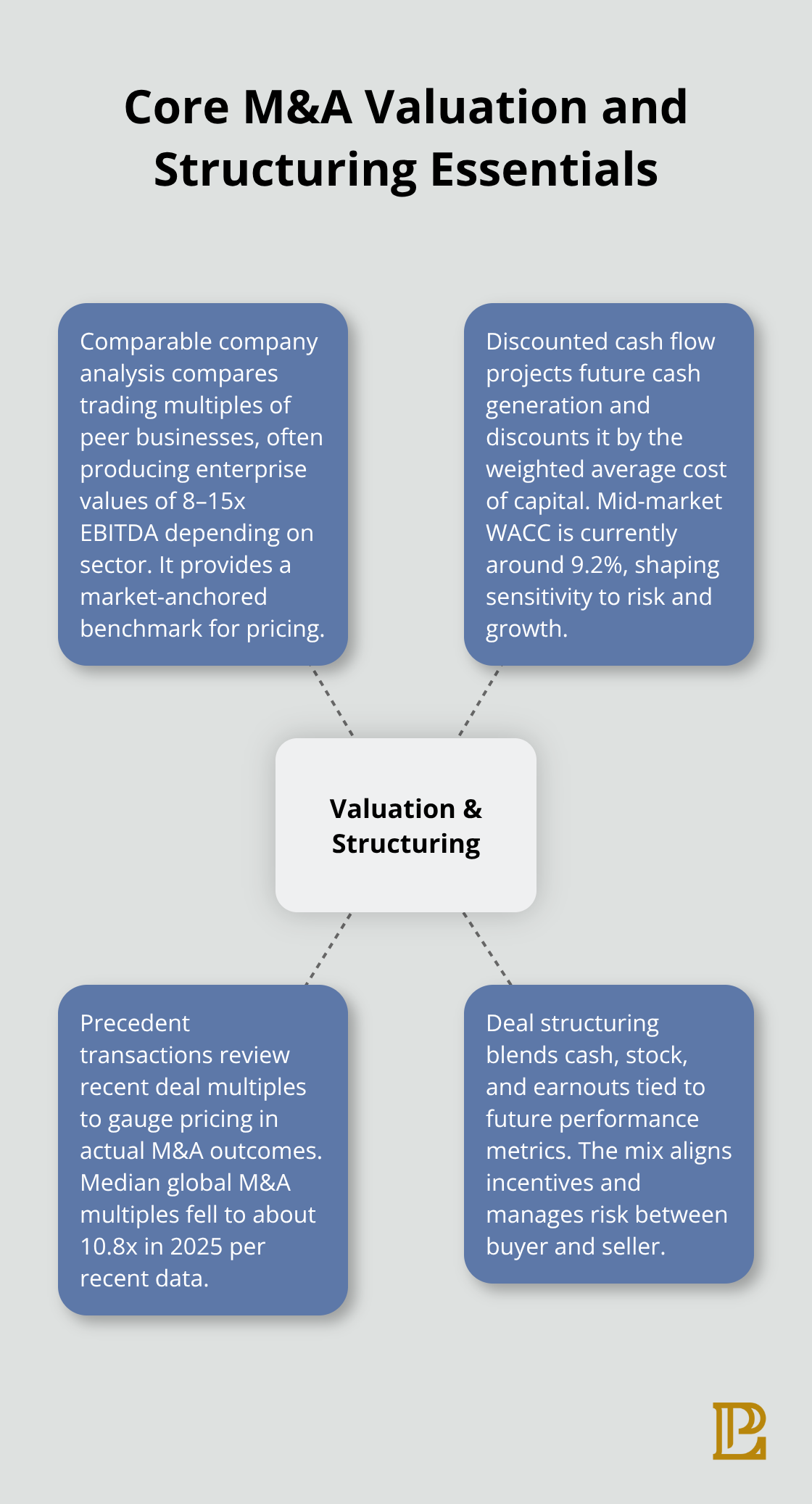
Professional advisors also structure payment terms, including cash components, stock exchanges, and earnout provisions that tie final payments to future performance metrics.
Legal Framework and Compliance Management
M&A transactions demand strict adherence to securities regulations, tax code requirements, and industry-specific compliance standards. Advisors coordinate with legal counsel to prepare disclosure documents, manage shareholder approvals, and handle regulatory notifications. The due diligence process typically spans 60-90 days and involves review of 10-15 years of financial records, examination of all material contracts, and management interviews. Risk assessment protocols identify potential liabilities including pending litigation, environmental concerns, and intellectual property disputes that could impact final transaction value by 15-30% according to recent deal analysis.
These complex processes require careful attention to regulatory requirements and potential legal challenges that can emerge during any transaction.
Legal Hurdles That Block M&A Deals
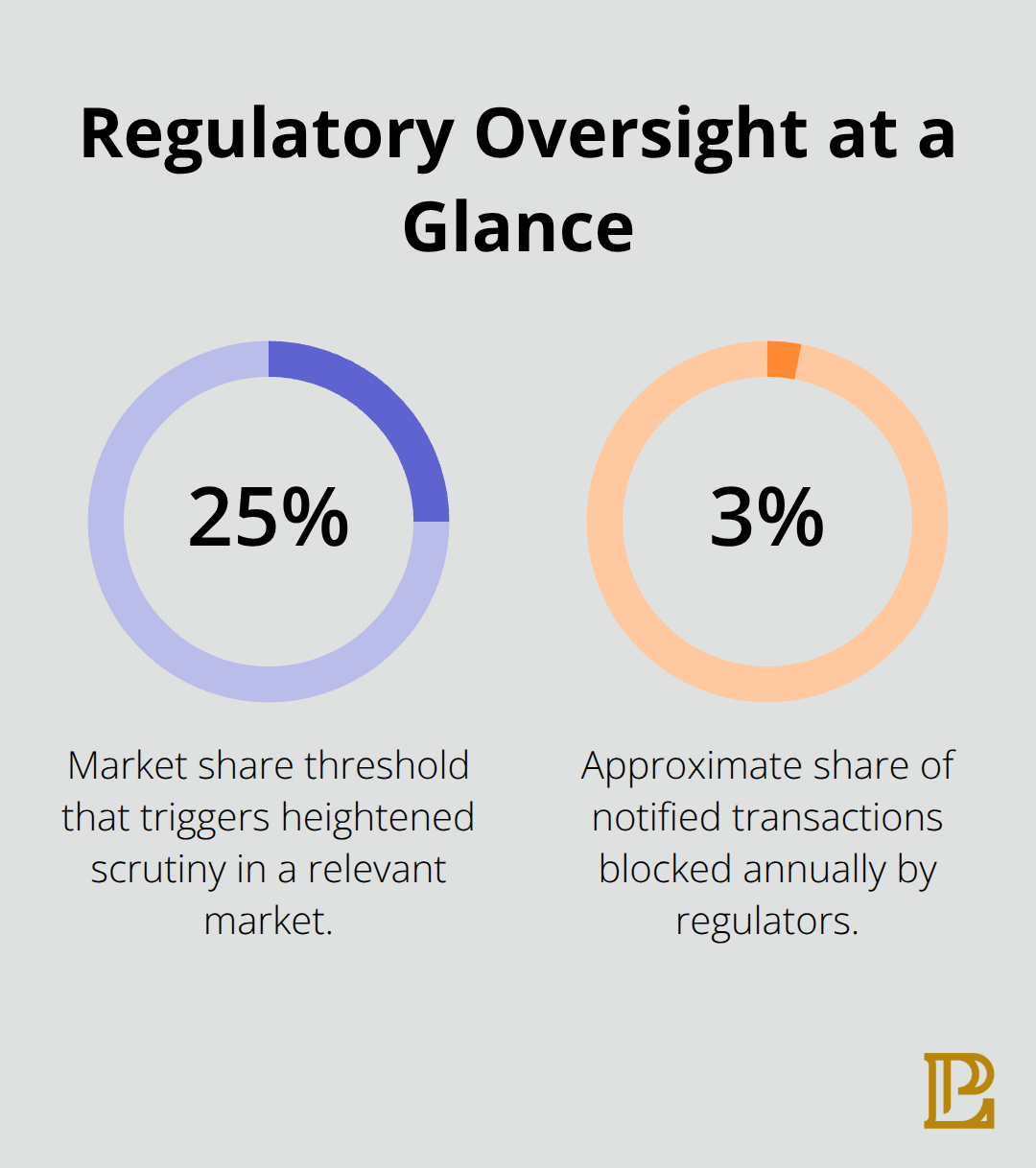
M&A transactions face stringent regulatory oversight that can derail deals worth millions. The Hart-Scott-Rodino Act requires pre-merger notification for transactions that exceed $101 million, which triggers a 30-day waiting period during which the FTC or DOJ reviews potential antitrust violations. Companies with combined market share above 25% in any relevant market face heightened scrutiny, with regulatory agencies that block approximately 3% of notified transactions annually.
The Clayton Act Section 7 prohibits mergers that substantially reduce competition, while the Sherman Act targets monopolistic behavior. International deals face additional complexity through foreign investment reviews, with CFIUS that evaluates transactions between foreign buyers and US companies in sensitive sectors like technology or defense.
Contract Terms That Make or Break Deals
Purchase agreements contain specific provisions that determine deal success or failure. Material adverse change clauses protect buyers from significant negative developments between contract execution and deal completion, typically defined as events that reduce company value by more than 8-10%. Representation and warranty provisions allocate risk between parties, with sellers who provide detailed statements about business condition, financial status, and legal compliance. Indemnification clauses establish liability limits, commonly that cap seller exposure at 10-25% of purchase price for general claims and 50-100% for fundamental representations like corporate authority and ownership. Escrow arrangements hold back 10-15% of purchase price for 12-24 months to cover potential claims. Working capital adjustments protect buyers from normal business fluctuations, while earnout provisions tie 15-30% of consideration to future performance metrics over 2-3 years.
Risk Management Through Legal Protection
Due diligence reveals hidden liabilities that can devastate deal value if parties leave them unaddressed. Environmental assessments identify contamination risks that average $2.8 million in cleanup costs per site (according to EPA data). Intellectual property audits uncover patent infringement claims, license disputes, and trade secret vulnerabilities that threaten core business operations. Employment law reviews identify wage and hour violations, discrimination claims, and pension obligations that create financial exposure. Tax compliance examinations reveal unpaid obligations, audit risks, and transfer pricing issues that can trigger penalties that exceed 40% of unpaid amounts. Insurance coverage analysis confirms adequate protection levels and identifies gaps that require additional coverage or increased reserves.
These legal complexities create significant challenges, but they pale in comparison to the operational difficulties that emerge once deals move toward completion.
What Derails M&A Deals After Legal Approval
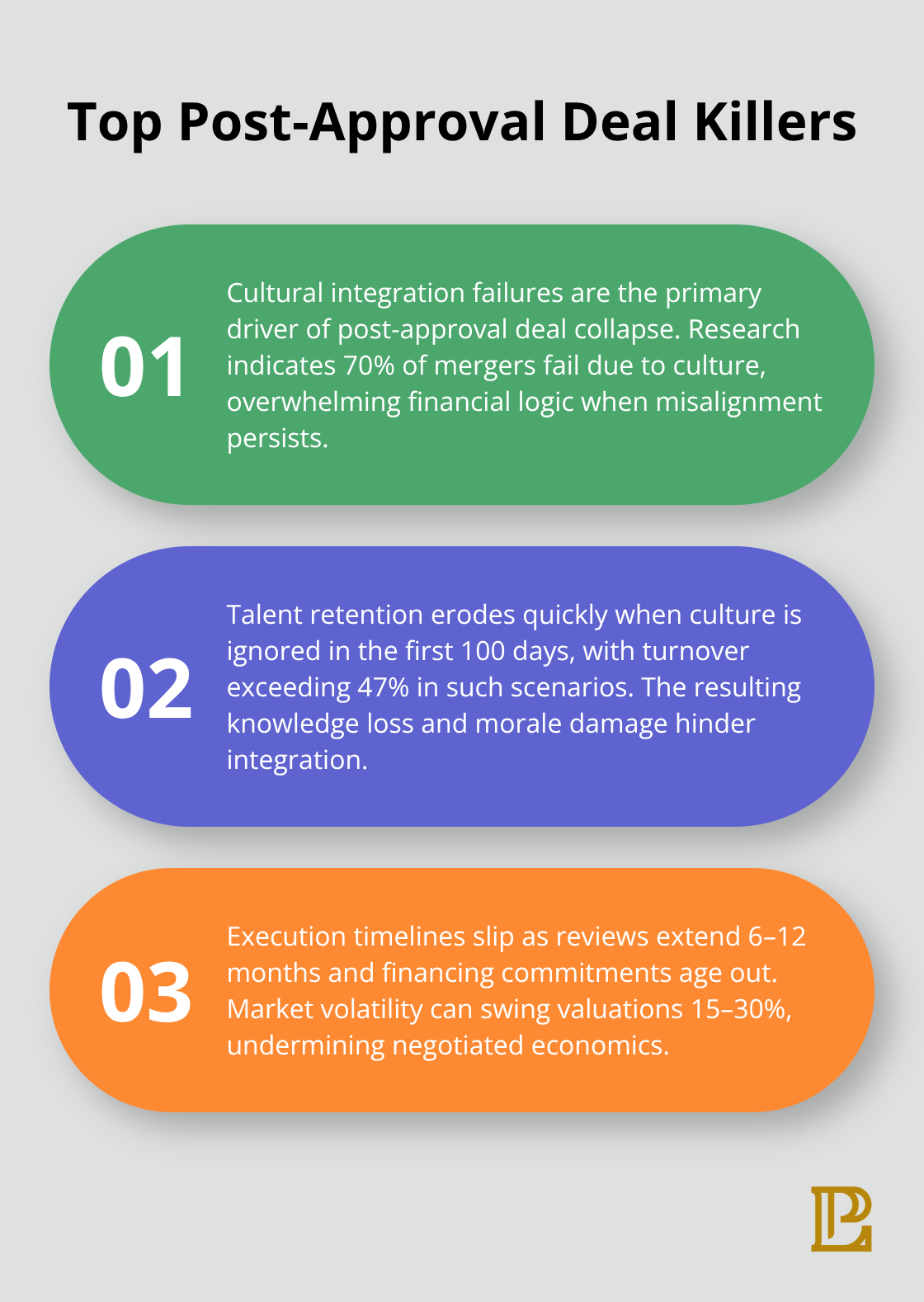
Cultural misalignment destroys more M&A deals than any financial miscalculation. Research from Harvard Business Review shows that 70% of mergers fail due to cultural integration problems, not financial issues. Companies that ignore cultural differences during the first 100 days post-merger experience employee turnover rates that exceed 47% (according to Deloitte studies). The integration process becomes particularly challenging when management teams operate under different decision-making frameworks or communication styles.
Cultural Assessment Requirements
Acquiring companies must conduct cultural assessments before deal completion. These assessments map leadership styles, communication patterns, and operational philosophies between organizations. Failed cultural integration costs companies an average of $2.1 million per month in productivity losses during the transition period. Management teams need to identify potential conflicts early and develop specific integration protocols that address communication gaps and operational differences.
Tax Complications That Destroy Deal Value
Tax implications can eliminate 25-40% of expected deal synergies if companies structure transactions incorrectly. Stock purchases trigger different tax consequences than asset purchases, with stock deals that create potential successor liability for unknown tax obligations. Section 338(h)(10) elections allow asset treatment for stock purchases but require unanimous shareholder consent and specific timing requirements.
International transactions face transfer pricing regulations, with IRS audits that challenge 43% of cross-border deals according to recent enforcement data. Depreciation recapture on asset sales generates ordinary income tax rates up to 37%, while capital gains rates remain at 20% for qualifying transactions. State tax considerations add complexity, with California that imposes additional 13.3% rates on high-income transactions.
Timeline Pressures That Kill Momentum
M&A transactions operate under strict deadlines that create cascading failures when milestones slip. Due diligence periods typically span 60-90 days, but regulatory reviews can extend timelines by 6-12 months for complex deals. Financing commitments expire within 180-365 days, which forces companies to renegotiate terms or accept higher interest rates if deals drag beyond commitment periods.
Material adverse change periods allow buyers to withdraw if significant negative events occur between signing and closing. This makes speed critical for deal preservation. Employee retention becomes problematic during extended transaction periods, with key personnel that begin seeking alternative employment after 4-6 months of uncertainty. Market conditions can shift dramatically during prolonged processes, with recent volatility that changed deal valuations by 15-30% within quarterly periods.
Final Thoughts
Successful M&A transactions demand meticulous preparation, comprehensive legal oversight, and experienced guidance throughout every phase. Data shows that deals with professional advisory support achieve 73% higher completion rates, while cultural integration failures destroy 70% of mergers despite financial success. Companies that skip professional mergers and acquisitions advisory face significantly higher failure rates.
Business owners in Hermosa Beach who consider M&A transactions face complex regulatory requirements, tax implications that can eliminate 25-40% of deal synergies, and timeline pressures that create cascading failures. The Hart-Scott-Rodino Act, material adverse change clauses, and cultural assessment requirements demand careful navigation to avoid costly mistakes. These challenges require sophisticated legal knowledge and strategic planning (particularly for transactions that exceed regulatory thresholds).
We at Pierview Law handle complex business transactions and provide the legal guidance that protects your interests throughout the M&A process. Our team manages entity formation, contract drafts, and dispute resolution when conflicts arise during transactions. Pierview Law serves clients throughout Los Angeles County with personalized attention to your M&A objectives and develops strategies that position your company for successful deal completion.