
Your intellectual property is worth real money. Many Hermosa Beach business owners sit on valuable patents, trademarks, and proprietary processes without generating revenue from them.
IP licensing strategies let you monetize what you’ve built while keeping control of your core business. We at Pierview Law help local companies structure licensing deals that actually pay off.
Three Licensing Models for Hermosa Beach Businesses
Exclusive Licensing: Higher Rates, Single Partner Risk
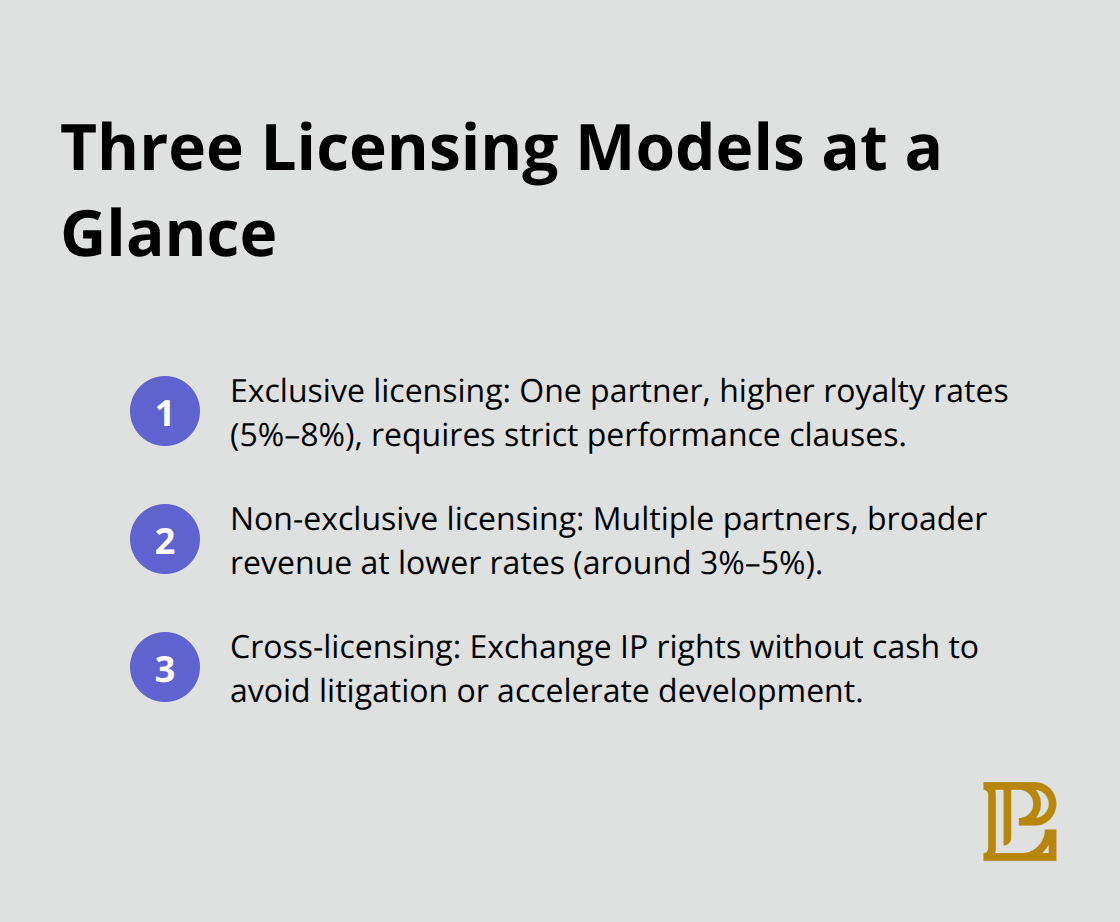
Exclusive licensing grants one partner sole rights to use your IP in a specific market or field. This arrangement typically commands higher royalty rates between 5% and 8% because the licensee gains competitive advantage and market exclusivity. However, you depend entirely on that one partner’s performance and market execution.
Exclusive arrangements demand performance guarantees built into the contract. Set minimum sales targets, marketing spend requirements, and shelf-share commitments so the licensee stays motivated and you have grounds to terminate if they underperform. Without these safeguards, a lazy or underfunded licensee can sit on your valuable IP while you collect minimal royalties.
Non-Exclusive Licensing: Broader Revenue, Lower Rates
Non-exclusive licensing lets multiple partners use the same IP simultaneously, generating broader revenue streams but at lower rates around 3% to 5%. The licensee faces direct competition from other licensees, so they accept reduced exclusivity in exchange for lower fees.
Non-exclusive deals work when you have strong brand recognition or patent portfolios that multiple licensees can monetize independently. Trademark licensing across different product categories illustrates this model well-one company might license your brand for apparel while another handles accessories, each reaching different customer segments without direct competition.
Cross-Licensing: Trading IP Without Cash
Cross-licensing lets two companies exchange IP rights without cash changing hands. This model works best when both parties hold valuable patents or technologies and want to avoid litigation or accelerate product development. You must conduct a thorough IP audit first to confirm both sides hold genuinely valuable assets; otherwise you’re giving away rights for minimal return.
Defining Boundaries and Catching Underreporting
Territory and field-of-use restrictions matter in all three models. Define exactly which geographic regions the licensee can serve and which industries or product lines they can target, since vague boundaries create disputes later. Global sales of licensed merchandise reached 369.6 billion USD in 2024, according to Licensing International’s 2025 Global Study, showing that well-structured licensing deals drive substantial income across industries.
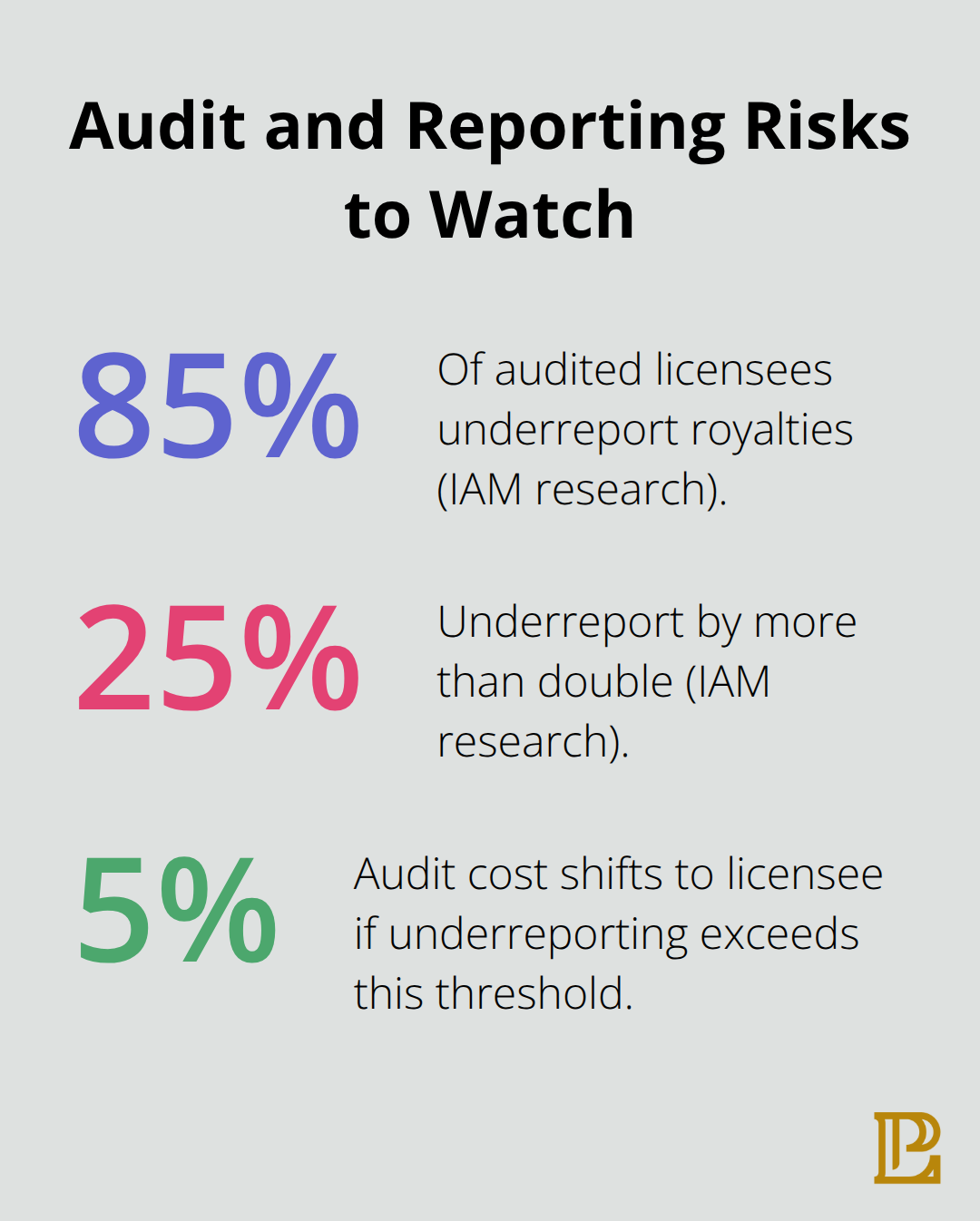
Royalty audits catch underreporting early. IAM research shows 85% of audited licensees underreport royalties, so you must embed audit rights into every agreement regardless of which model you choose. This protection matters whether you grant exclusive or non-exclusive rights-licensees often misreport sales figures or apply incorrect deductions unless you build in regular verification mechanisms.
Hermosa Beach business owners often overlook these structural details, leaving revenue on the table and creating enforcement headaches. The next section covers how to set royalty rates that reflect your IP’s true market value and protect your income stream.
How Much Should You Charge for Your IP
Research Comparable Licenses to Set Your Rate
Royalty rates determine whether your licensing deal generates meaningful income or leaves money on the table. Hermosa Beach businesses licensing patents or trademarks typically see rates between 3% and 8% depending on exclusivity, market strength, and licensee bargaining power. Non-exclusive trademark licenses in consumer goods average around 3% to 5% of net sales, while exclusive patent licenses in technical fields can reach 8% to 15% or higher.
Most business owners anchor rates to industry averages without analyzing what your specific IP is actually worth in the market. Start by researching comparable licenses in your field. If you license a manufacturing patent, find what similar patents licensed for in recent years through USPTO records or licensing databases. This research grounds your negotiating position in real market data rather than guesswork.
Calculate the Licensee’s Profit Margin
Next, calculate the licensee’s expected profit margin on products using your IP. If they’ll make 40% gross margin, a 5% royalty leaves them healthy room for marketing, distribution, and overhead while you capture legitimate value. This approach aligns both parties’ financial interests and creates a sustainable partnership.
Structure the royalty as a percentage of net sales, not gross revenue, since licensees will push back on paying royalties on returns, discounts, and freight costs they cannot control. Set payment terms quarterly or semi-annually so you catch underreporting faster than annual audits allow. This frequency keeps both parties accountable and prevents large discrepancies from accumulating.
Front-Load Revenue With Upfront Fees and Milestones
Upfront payments and milestone bonuses shift financial risk and create performance incentives that royalty-only deals cannot match. Demand an upfront license fee between 10,000 and 50,000 dollars depending on market size and exclusivity-this money hits your account immediately and compensates you for legal costs and opportunity cost.
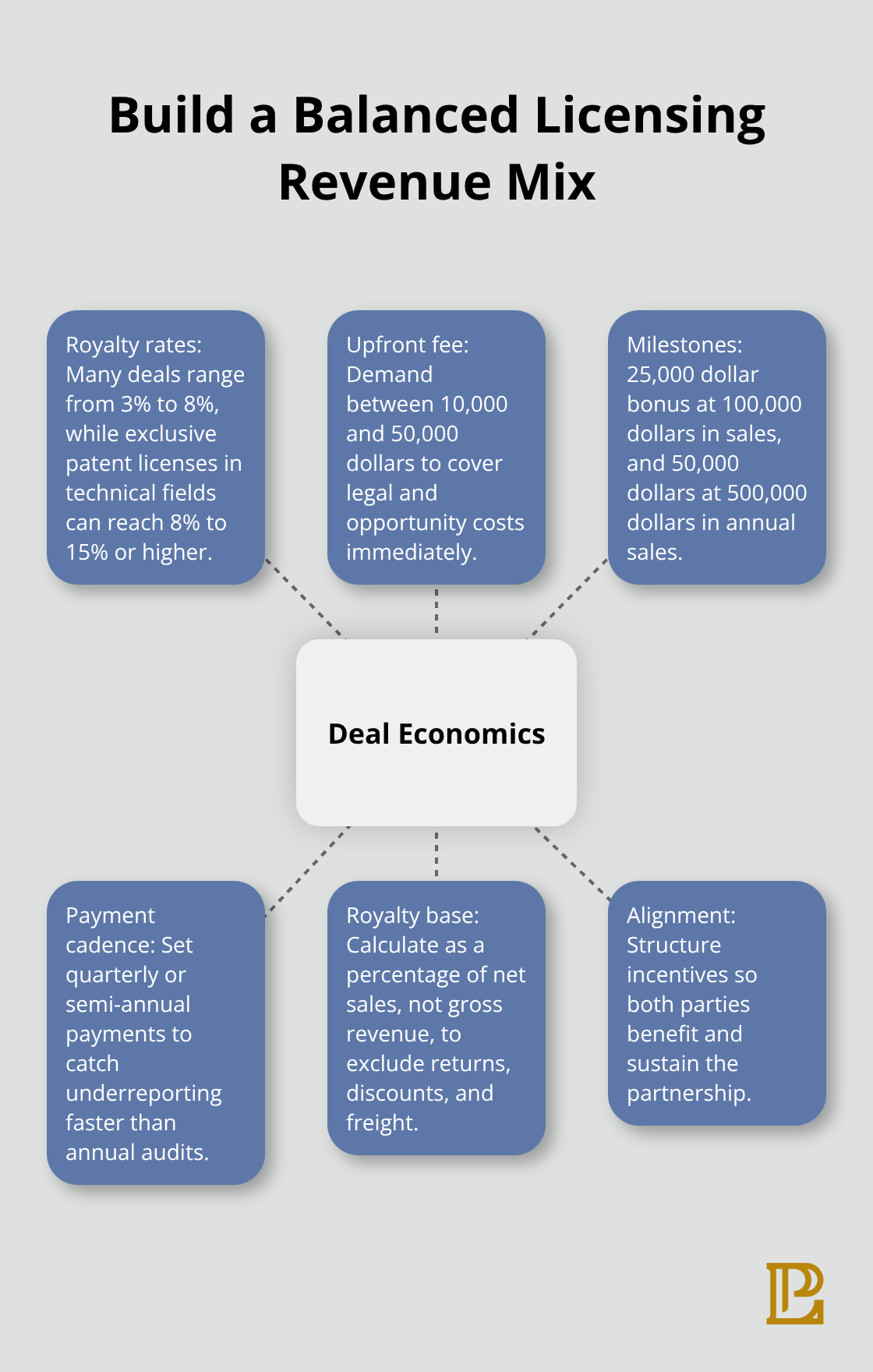
Then tie additional payments to real achievements: first 100,000 dollars in licensee sales triggers a 25,000 dollar bonus, reaching 500,000 dollars in annual sales unlocks another 50,000 dollar payment. These milestones motivate the licensee to actually commercialize your IP instead of sitting on it while you collect minimal royalties. Performance-based payments also reduce your risk if the licensee fails to execute effectively.
Lock Down Territory and Field-of-Use Restrictions
Territory restrictions and field-of-use limits prevent the licensee from expanding into adjacent markets without renegotiating or paying additional fees. If you license a software patent for healthcare applications, explicitly prohibit the licensee from using it in financial services or manufacturing-those become separate licensing opportunities. Geographic boundaries matter equally: granting North American rights costs more than West Coast rights alone, so price accordingly.
Vague territory language creates disputes when licensees claim they can serve new markets under the original deal. Write that the licensee can sell in California, Nevada, and Arizona only-not the Western United States, which invites interpretation arguments. Licensees will test boundaries aggressively if you leave them loose, so specificity protects both your revenue and the relationship.
These rate-setting and territorial strategies form the foundation of a profitable licensing deal, but they only work if you build enforcement mechanisms into your contract. The next section covers the contract language and audit rights that actually protect your income stream when licensees underreport or breach their obligations.
Where Licensing Deals Fall Apart
Vague Contract Language Costs You Real Money
Most Hermosa Beach business owners lose money on licensing deals not because they set the wrong royalty rate, but because their contracts lack the language and enforcement mechanisms needed to actually collect what they’re owed. Vague contract language creates gray areas that licensees exploit deliberately. If your agreement says the licensee owes royalties on net sales but doesn’t define what deductions are allowed, they’ll deduct marketing costs, freight, returns, and anything else that reduces the number they owe you royalties on.
IAM research confirms this pattern: 85% of audited licensees underreport royalties, with 25% underreporting by more than double. That’s not coincidence-it’s what happens when contracts lack specific audit clauses, clear definitions of the royalty base, and consequences for misreporting. Your agreement must specify exactly which costs are deductible, require quarterly sales reports with supporting documentation, and grant you unannounced audit rights including access to production records, shipping logs, and customer contracts.
Build Teeth Into Your Audit Rights
Without enforcement mechanisms, you’re hoping licensees report honestly instead of guaranteeing it. Include a clause that requires the licensee to maintain detailed records for at least five years and pay for the audit if underreporting exceeds 5% of reported royalties. This penalty transforms audits from theoretical rights into real consequences that motivate accurate reporting.
Protect Trade Secrets Before You Share Them
Trade secrets and confidential information vanish when licensing agreements don’t explicitly protect them. You’re sharing proprietary manufacturing processes, customer lists, pricing models, or technical specifications with a licensee who might become a competitor tomorrow. Non-disclosure agreements must extend beyond the license term-if the deal ends, the licensee still cannot use or disclose what they learned.
Require confidentiality agreements signed before you share any sensitive information, not after. Specify exactly what qualifies as confidential: manufacturing specs, formulations, supplier contacts, cost structures, and anything marked confidential in writing. Most importantly, demand that the licensee implement physical and digital security measures (locked facilities, password protection, employee confidentiality agreements) so you’re not relying on good faith alone. If the licensee sublicenses your IP, they must impose identical confidentiality obligations on their sublicensees, creating a chain of protection.
Stop Undervaluing What You’ve Built
Undervaluing your IP happens when Hermosa Beach business owners anchor their asking price to what they think is reasonable rather than what the market will actually pay. A 3% royalty sounds low until you realize it’s 60% below market rate for similar patents in your field. Research what comparable IP actually licensed for, not what industry averages suggest.
If you license a manufacturing patent, pull recent licensing agreements involving similar patents through USPTO databases or industry publications. Patent licensing rates in technical fields often reach 8% to 15% or higher, yet many business owners accept 2% or 3% because they lack market data. Set your minimum acceptable rate before negotiations start so you don’t get pressured downward. If a licensee claims your IP is worth less than your research shows, ask them to justify it with comparable licenses or market analysis. Most cannot.
Demand Upfront Advances to Protect Your Position
Demand an upfront advance against royalties-not as a one-time fee, but as money that reduces future royalty payments. This protects you if sales disappoint and gives you immediate capital to cover legal costs and opportunity loss. A 25,000 dollar advance on a 5% royalty deal ensures you’re compensated even if the licensee generates minimal sales in year one.
Final Thoughts
IP licensing strategies work only when you combine solid contract language with realistic market rates and genuine enforcement. Hermosa Beach business owners who succeed at licensing research what comparable IP actually commands in the market, build audit rights and performance milestones into every agreement, and protect trade secrets before sharing them with licensees. The numbers prove this approach matters: global licensed merchandise sales hit 369.6 billion USD in 2024, yet 85% of audited licensees underreport royalties because most agreements lack the specific language and enforcement teeth needed to catch it.
Your contract must define the royalty base precisely, require quarterly reporting with supporting documentation, and grant unannounced audit rights. Territory and field-of-use restrictions prevent licensees from expanding into adjacent markets without renegotiating, while upfront advances and milestone payments shift financial risk and create performance incentives that royalty-only deals cannot match. These structural details separate licensing deals that generate meaningful income from those that leave money on the table.
We at Pierview Law help Hermosa Beach businesses structure licensing agreements that protect your revenue and enforce your rights when licensees underreport or breach their obligations. Contact us at https://pierviewlaw.com to discuss your IP licensing strategy and learn how we build agreements with the specific language and audit mechanisms that prevent disputes. We serve all of Los Angeles County and understand the local business landscape where your innovations operate.