
Many business owners in Hermosa Beach confuse business law with corporate law, treating them as interchangeable terms. They’re not.
Business law and corporate law operate in different spheres, with distinct rules, compliance requirements, and implications for your company. At Pierview Law, we help clients understand which area applies to their situation so they can make informed decisions about their legal structure and obligations.
What Does Business Law Actually Cover
Business law is the legal framework that governs how your company operates day-to-day. It’s not about the internal structure of your company-that’s corporate law’s domain. Business law focuses on the relationships your business builds with customers, employees, vendors, and suppliers, plus the contracts and compliance obligations that come with those relationships. In Hermosa Beach and across Los Angeles County, business owners need to understand this distinction because it directly affects which legal issues require immediate attention. If you’re drafting a service contract with a vendor, managing employee hiring and firing, protecting your intellectual property through trademarks, or ensuring your business complies with local licensing requirements, you’re operating in the business law space.
Choosing the Right Business Structure Matters
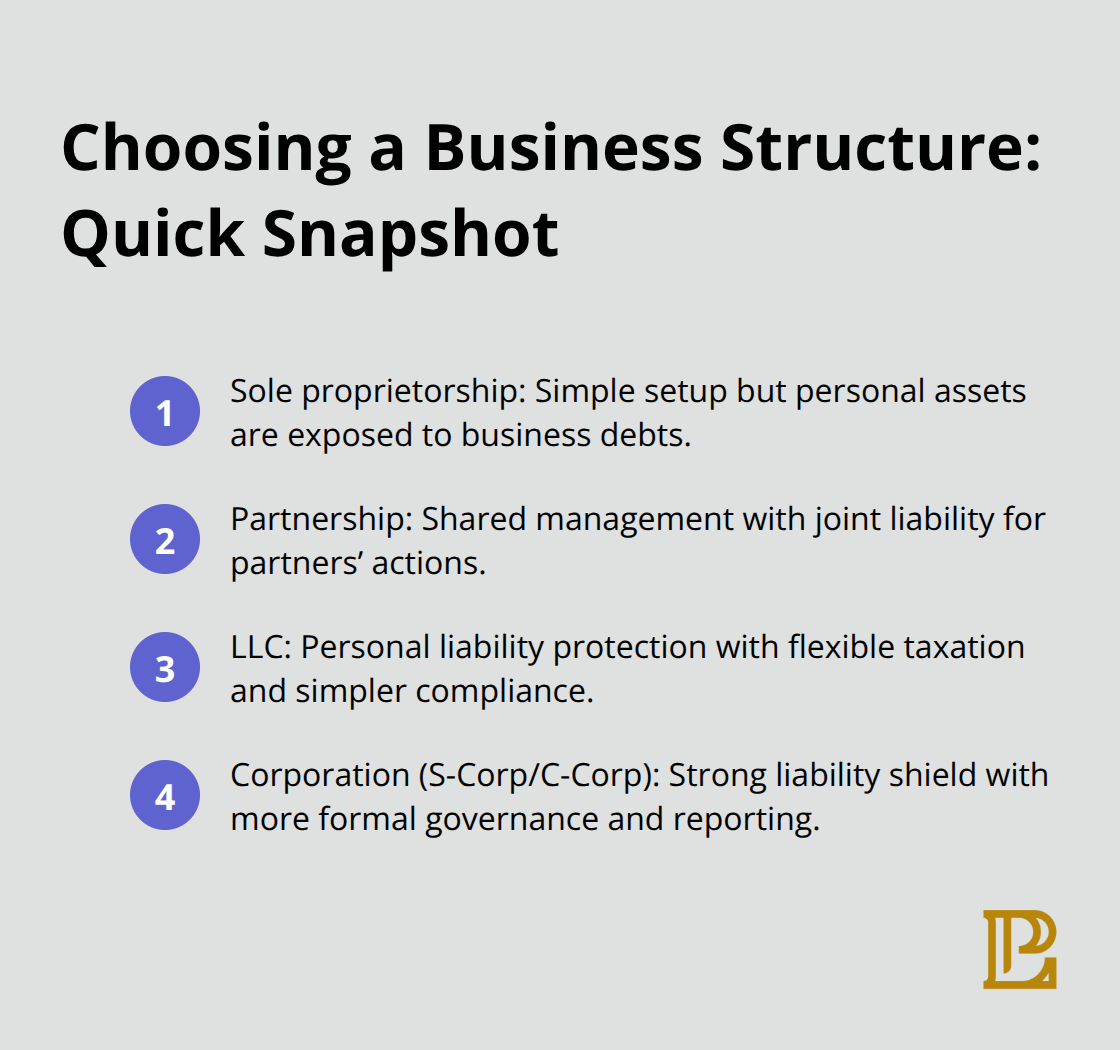
The structure you select for your business-whether a sole proprietorship, partnership, limited liability company (LLC), or corporation-shapes your personal liability, tax obligations, and operational flexibility. In California, four primary structures dominate the business landscape. A sole proprietorship offers simplicity but exposes your personal assets to business debts and lawsuits. Partnerships allow shared management but create joint liability for all partners’ actions. An LLC provides personal liability protection while maintaining tax flexibility and simpler compliance requirements than corporations. A corporation, whether an S-Corp or C-Corp, offers the strongest liability shield but demands more formal governance and reporting. The choice carries immediate financial consequences. If your LLC faces a lawsuit and loses a judgment, creditors cannot typically reach your personal bank account or home. As a sole proprietor, they can.
This structural decision shapes your entire legal and financial future.
Compliance and Licensing Requirements Vary by Industry
Every business in Hermosa Beach must secure the appropriate licenses and permits to operate legally. The specific requirements depend on your industry and location. A contractor needs a California Contractors State License Board (CSLB) license; a real estate agent needs a California Department of Real Estate (DRE) license; a salon needs a cosmetology license from the California Department of Consumer Affairs. Beyond industry-specific licensing, your business needs a general business tax registration certificate from the California Department of Tax and Fee Administration if you earn income. Many Hermosa Beach businesses also require local city permits and approvals. Failing to secure proper licensing results in fines, forced shutdowns, and personal liability. Additionally, depending on your industry, you face ongoing compliance obligations-employment law requirements like maintaining proper wage and hour records, workplace safety standards under Cal/OSHA, and anti-discrimination policies under the California Fair Employment and Housing Act (FEHA). These aren’t one-time boxes to check; they’re continuous obligations that evolve as your business grows and your operations expand into new areas.
How Business Law Protects Your Daily Operations
Business law covers the practical contracts and agreements that keep your company running. Service agreements with vendors establish payment terms, delivery schedules, and dispute resolution procedures. Employment agreements and independent contractor agreements define worker obligations, compensation, and intellectual property ownership. Non-disclosure agreements (NDAs) protect your confidential information and trade secrets-especially important in California, where non-compete agreements typically lack enforceability. These documents aren’t optional extras; they’re foundational protections that prevent costly disputes down the road. When conflicts arise with customers, employees, or vendors, business law provides the framework for resolution. Your business also operates within regulatory boundaries that extend beyond licensing. Data privacy laws (including the California Consumer Privacy Act), consumer protection regulations, and industry-specific compliance standards all fall under business law’s umbrella. Understanding these obligations prevents regulatory violations that could shut down your operations or trigger significant penalties.
Corporate Law Handles What Business Law Doesn’t
While business law manages your day-to-day operations and external relationships, corporate law addresses your company’s internal structure and governance. Corporate law determines how your company is formed, how decisions get made, how profits are distributed, and how shareholders exercise their rights. If you’re raising capital, issuing stock, or planning a merger or acquisition, corporate law becomes your primary concern. The distinction matters because the legal documents, compliance obligations, and strategic considerations differ significantly between the two areas. Understanding where business law ends and corporate law begins helps you identify which legal issues need immediate attention and which counsel to consult.
How Corporate Law Shapes Your Company’s Internal Structure
Corporate law governs the internal mechanics of your business entity. While business law handles your relationships with customers and vendors, corporate law determines how your company makes decisions, distributes profits, and manages ownership. This distinction becomes critical the moment you move beyond a sole proprietorship. If you operate as an LLC, S-Corp, or C-Corp in Hermosa Beach, corporate law applies to bylaws, board resolutions, shareholder agreements, and the fiduciary duties that directors and officers owe to the company and its owners. The practical impact is immediate: improper corporate structure or governance exposes you to personal liability, creates tax inefficiencies, and complicates future fundraising or exits.
Formation and the Separate Legal Entity
When you form a corporation, you create a separate legal entity. This separation shields your personal assets from business debts and lawsuits, but it requires you to maintain formal governance procedures. Directors must act in the company’s best interest under what’s called the duty of care, meaning they make informed decisions.
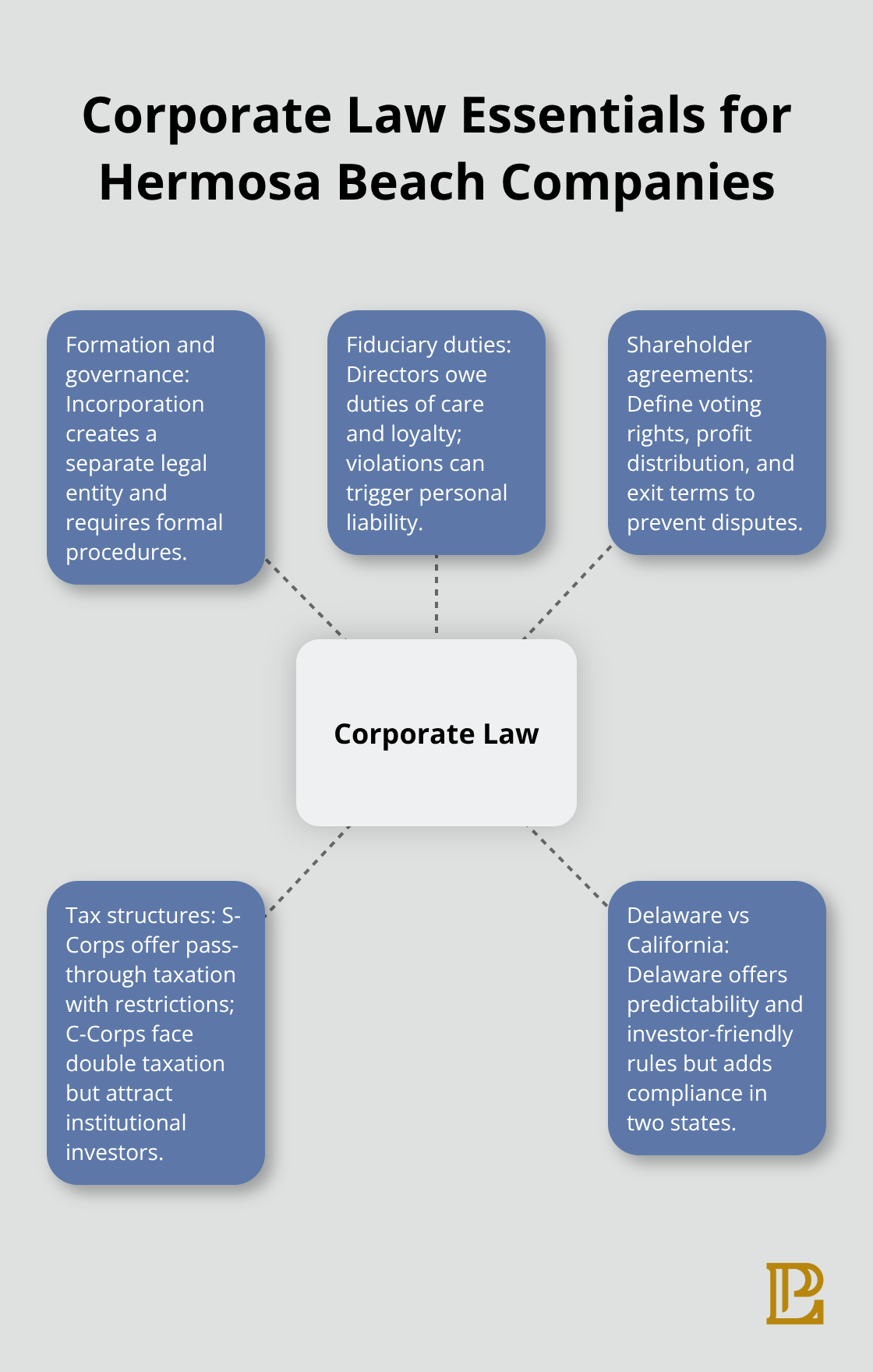
They also owe a duty of loyalty, preventing them from self-dealing or competing with the company. California law enforces these duties strictly, and violations expose directors to personal liability.
Shareholder agreements establish voting rights, profit distribution, and what happens if an owner wants to exit. Without a clear agreement, disputes over control and money become expensive litigation. The IRS also cares about corporate structure. S-Corps offer pass-through taxation but require specific ownership and stock structure. C-Corps face double taxation on corporate profits and shareholder dividends, but they allow unlimited shareholders and offer flexibility for venture capital investment. Delaware incorporation, popular among venture-backed startups, provides predictable corporate law and investor-friendly structures, though it requires registered agent services and ongoing compliance in two states.
Tax Implications and Capital Structure
Your corporate structure directly affects your tax bill and your ability to raise capital. S-Corps pass income through to shareholders, avoiding the double taxation that C-Corps face. However, S-Corps restrict ownership to U.S. citizens and limit the number of shareholders. C-Corps allow unlimited shareholders and attract institutional investors, but the corporation pays taxes on profits, and shareholders pay taxes again on dividends. This structure matters most when you plan to raise investment capital or eventually sell the company.
Securities laws apply whenever you sell equity to investors, regardless of company size. You must provide proper disclosures, avoid unregistered securities violations, and comply with accredited investor requirements if you raise from institutional investors. These rules protect investors, but violations carry criminal penalties and civil liability.
Ongoing Compliance Obligations
Corporate compliance in California demands ongoing attention. Corporations must file annual statements with the California Secretary of State and pay annual franchise taxes. C-Corps face more rigorous requirements: they maintain corporate records, hold shareholder meetings, and file detailed tax returns. Missing deadlines or failing to maintain corporate formalities can result in piercing the corporate veil, which means courts may hold you personally liable for company debts. Even private corporations in Hermosa Beach must comply with California Corporations Code provisions around stock issuance, dividend payments, and merger procedures.
Governance Documents Shape Your Future
Corporate structure isn’t a one-time decision. It shapes your tax bill, your personal risk, your ability to raise capital, and how disputes get resolved. Choosing between an LLC and a corporation, deciding on Delaware versus California incorporation, and establishing clear governance documents require careful analysis of your specific situation and long-term goals. The decisions you make now affect whether you can attract investors, whether you face personal liability, and how smoothly you can exit the business later. As your company grows and your circumstances change, corporate law becomes increasingly important to your overall strategy. Understanding these structural choices positions you to make decisions that align with your business objectives and protect your interests.
Where Business Law and Corporate Law Diverge
Business law reaches into nearly every corner of your daily operations, while corporate law focuses narrowly on your company’s internal structure and governance. This distinction matters more than most Hermosa Beach business owners realize because it determines which legal problems demand immediate attention and which ones surface only when you raise capital or plan an exit. Business law governs your contracts with vendors, your employment relationships, your data privacy obligations, your consumer protection compliance, and your intellectual property protection. If you sign a service agreement with a contractor, hire an employee, collect customer data, or register a trademark, you operate in business law territory. Corporate law, by contrast, handles bylaws, shareholder agreements, board resolutions, stock issuance, and the fiduciary duties that directors and officers owe to the company. The two areas operate on different timelines and trigger different compliance obligations.
How Violations Impact Your Business Differently
A business law violation might shut down your operations tomorrow, while a corporate law violation might expose you to personal liability years later when a shareholder sues or a court pierces your corporate veil. Small businesses in Hermosa Beach often skip corporate law entirely because they operate as sole proprietorships or simple LLCs, but they cannot skip business law. Every business needs enforceable contracts, proper employment documentation, data privacy safeguards, and regulatory compliance. Larger entities and investment-backed companies face the opposite problem: they obsess over corporate structure and governance while neglecting everyday business law obligations like contract review, employment compliance, and vendor management.
California’s Regulatory Framework Reflects This Split
Business law compliance in California requires ongoing attention to wage and hour laws under the California Labor Code, anti-discrimination protections under the Fair Employment and Housing Act, data privacy obligations under the California Consumer Privacy Act, licensing requirements that vary by industry, and consumer protection standards enforced by the California Attorney General. These regulations demand constant vigilance because they change frequently and violations carry steep penalties. The California Department of Industrial Relations recovered over $1 billion in wage theft cases since 2015, which demonstrates how seriously the state enforces employment law.
Corporate Compliance Carries Different Costs and Consequences
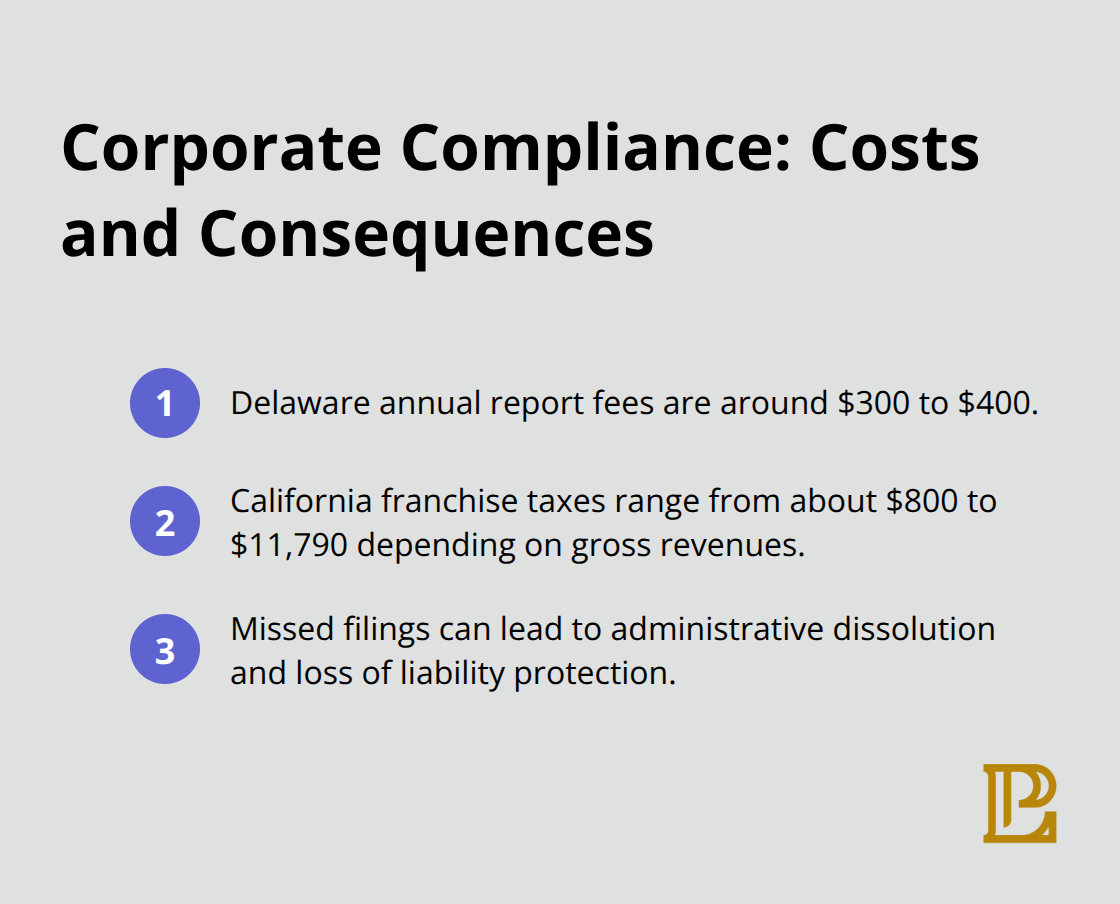
Corporate law compliance, while less frequent, carries higher stakes when it matters. Delaware corporations file annual reports costing around $300 to $400, while California corporations file annual statements and pay franchise taxes that range from $800 to $11,790 depending on gross revenues. Missed filings result in administrative dissolution, which strips away your liability protection and exposes personal assets to creditors. Small businesses with minimal revenue and no outside investors might need minimal corporate compliance, but the moment you bring in investors or plan to scale, corporate law becomes mission-critical.
Identifying Which Framework Applies to Your Situation
The regulatory landscape reflects this split perfectly. Business law reaches into employment, contracts, data handling, and vendor relationships-areas where violations happen frequently and penalties accumulate quickly. Corporate law addresses governance, ownership structure, and capital formation-areas where violations surface less often but carry catastrophic consequences when they do. Understanding which framework applies to your specific situation helps you allocate resources effectively and avoid costly mistakes. Hermosa Beach business owners benefit from legal counsel that recognizes both areas and ensures compliance across both simultaneously.
Final Thoughts
The distinction between business law vs corporate law determines which legal issues demand your attention first and which ones shape your long-term strategy. Most Hermosa Beach business owners need guidance in both areas, but the timing and urgency differ significantly. If you start a business, your immediate priority is business law: you form your entity, draft contracts with vendors, establish employment policies, and secure necessary licenses. These decisions protect your operations from day-to-day legal risks.
As your company grows, raises capital, or plans an exit, corporate law moves to the forefront. You structure governance, establish shareholder agreements, and form tax-efficient capital strategies that become critical to your success and personal liability protection. Many business owners address these areas sequentially rather than simultaneously, which creates gaps in protection. You might have solid contracts and employment policies but lack proper corporate governance, or you might have a well-structured corporation but inadequate vendor agreements or data privacy safeguards.
At Pierview Law, we help Hermosa Beach business owners navigate both business law and corporate law as integrated parts of your overall legal strategy. Whether you form your first business, raise investment capital, or plan a transition, we provide personalized legal solutions that align with your specific situation and long-term objectives. Our approach adjusts as your business grows and your legal needs evolve.