
Your intellectual property represents years of work and investment. When someone infringes on your patents, trademarks, or copyrights, the financial and reputational damage can be severe.
At Pierview Law, we help Hermosa Beach business owners respond quickly and strategically to protect what’s rightfully theirs. This guide walks you through the steps to take when infringement occurs.
What Counts as IP Infringement
Infringement occurs when someone uses your protected intellectual property without permission. The United States Copyright Office confirms that copyright infringement happens when protected material is reproduced, distributed, or performed without authorization. For trademarks, infringement means using a confusingly similar mark on competing goods or services. Patent infringement takes place when someone manufactures, sells, or uses a patented invention without a license. Trade secrets become misappropriated when confidential business information is obtained or used improperly. The line between legitimate competition and infringement depends entirely on which type of IP is involved and how someone uses it.
Recognizing Infringement in Your Industry
Different industries face different infringement patterns. Technology companies frequently encounter patent violations when competitors copy software functionality or hardware designs. Retail and consumer brands deal with counterfeit products and knockoff logos that confuse customers about the source. Manufacturing businesses protect proprietary processes and designs from being copied by rivals. In Hermosa Beach and across Los Angeles County, restaurants protect unique menu concepts and service marks, real estate firms defend proprietary marketing systems, and service providers guard training materials and operational methods. Infringement does not require an exact copy-a confusingly similar logo, a product that performs the same patented function, or unauthorized use of your trade secrets all constitute violations. Damages compound quickly because infringement typically continues until someone takes action.
How Enforcement Changes by IP Type
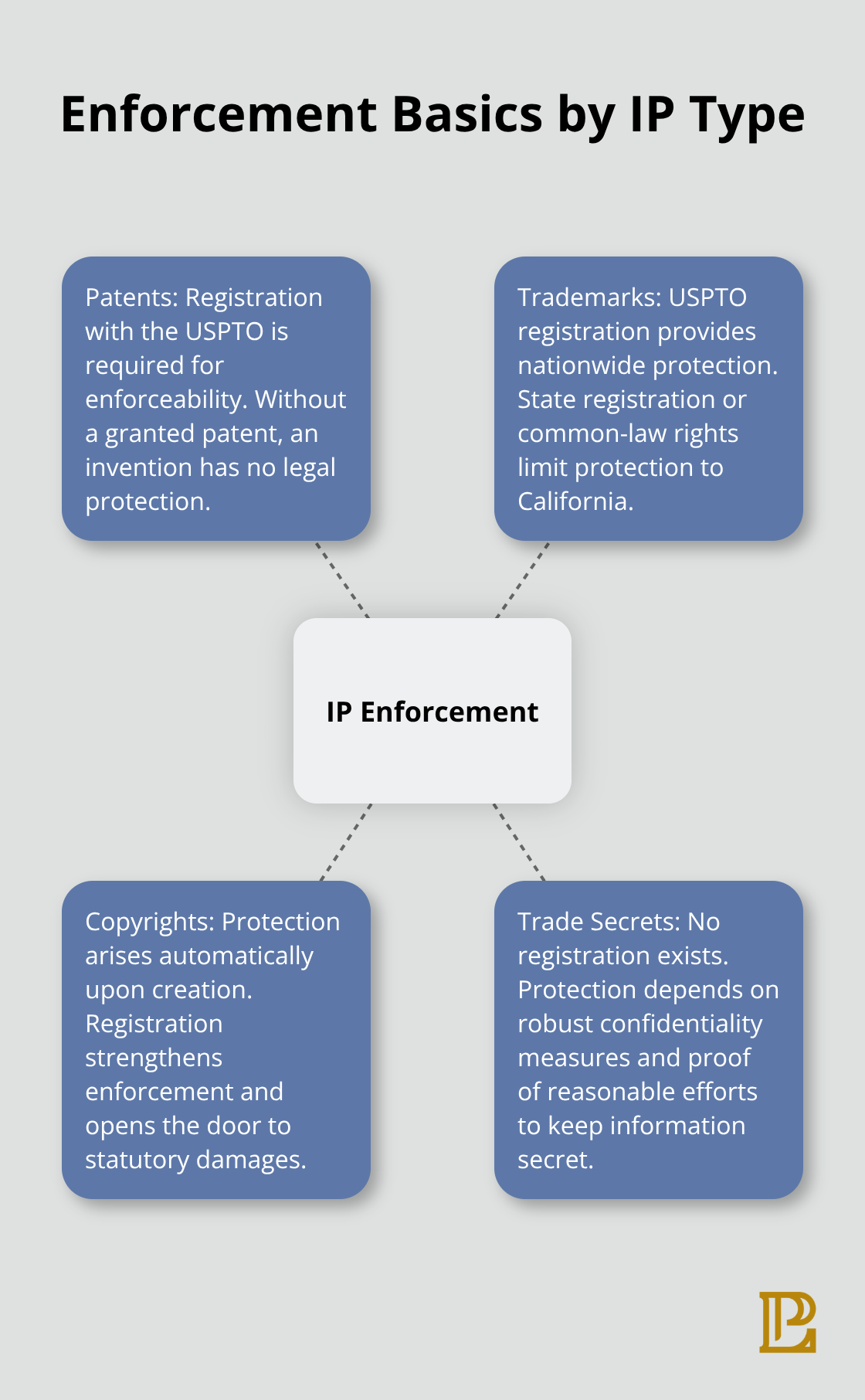
Patents require registration with the United States Patent and Trademark Office to be enforceable, meaning an unregistered invention receives no legal protection. Trademarks registered with the USPTO provide nationwide protection, while state registration or common-law use protects your mark only within California. Copyrights arise automatically upon creation, but registration with the United States Copyright Office strengthens your enforcement position and allows you to recover statutory damages. Trade secrets require no registration but depend on your internal security measures, confidentiality agreements, and documented efforts to keep information confidential.
When infringement occurs, federal courts handle patents, copyrights, and federally registered trademarks. California courts address trade secrets under the California Uniform Trade Secrets Act and unfair competition claims under the California Unfair Competition Act, which protect against deceptive business practices beyond federal protections. The jurisdiction and legal standards shift dramatically based on which IP category applies-this distinction immediately determines your enforcement strategy and available remedies.
Taking the Right First Steps
Identifying the correct IP category immediately shapes everything that follows. You must establish which type of protection applies to your asset before you can assess the strength of your claim or calculate potential damages. An unregistered patent receives no protection, while a registered trademark opens doors to statutory damages and attorney’s fees. The specific category you identify will guide whether you file in federal court, pursue state remedies, or explore alternative enforcement options. Understanding these distinctions now prevents costly missteps later and positions you to respond with confidence when infringement occurs.
What to Do the Moment You Spot Infringement
Collect Evidence Immediately
The first hours after discovering infringement determine whether you stop the violation quickly or watch it spread unchecked. Start collecting concrete evidence right away. Take screenshots of infringing websites, social media posts, or product listings with timestamps and URLs. Photograph physical counterfeit products, packaging, and labels. Gather emails, contracts, and registration certificates that prove you own the IP in question. Document the date you first noticed the infringement and how you became aware of it.
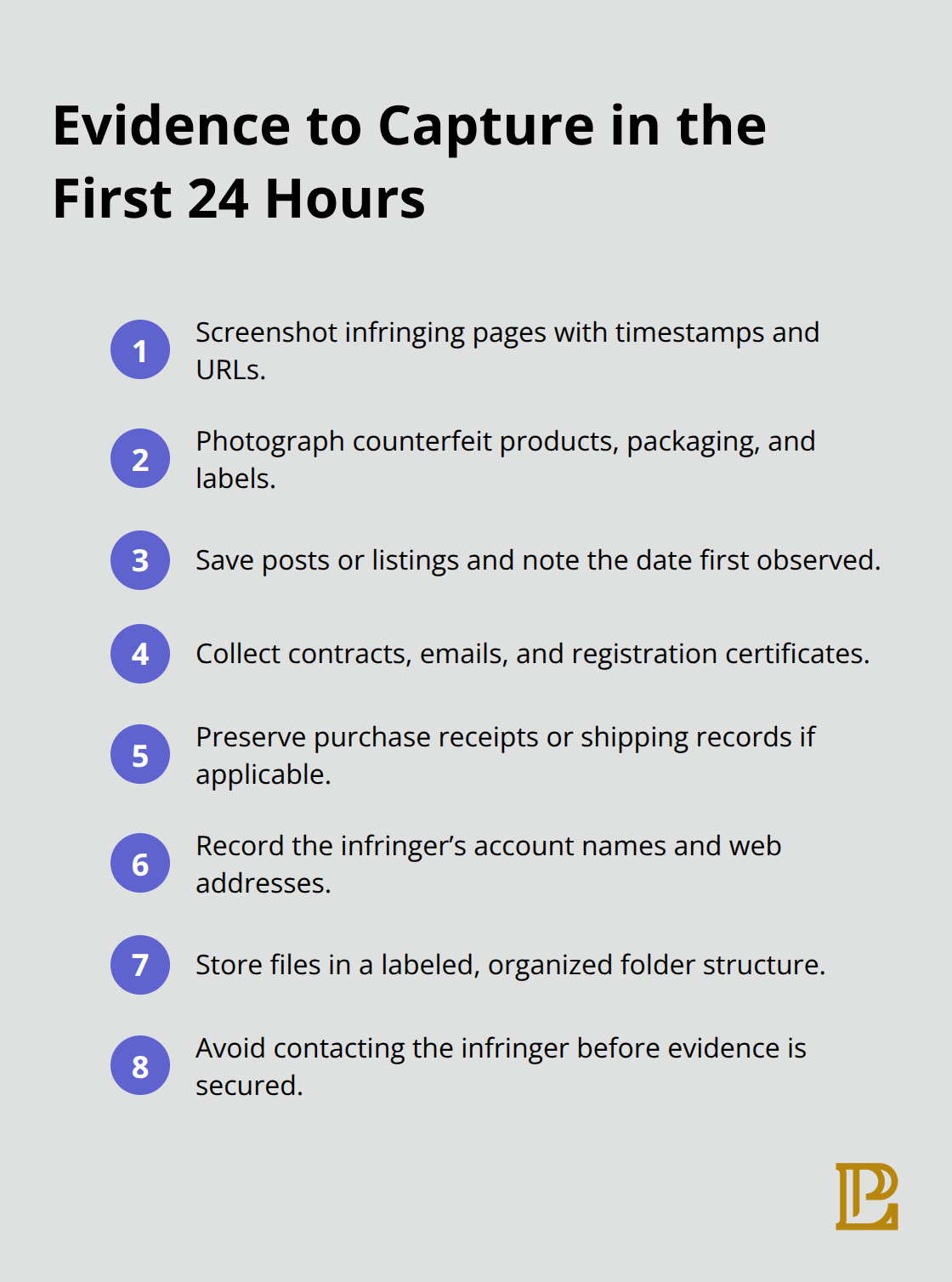
This evidence forms the foundation of every enforcement path you might pursue later, whether that leads to a cease-and-desist letter, settlement negotiations, or litigation. Without solid documentation, you cannot credibly demonstrate infringement to a court or convince an infringer to stop voluntarily. Store all evidence in one organized location with clear labels and dates so you can access it quickly when your attorney needs it.
Send a Cease-and-Desist Letter
Once your evidence is secure, a cease-and-desist letter often stops infringement before litigation becomes necessary. A well-drafted letter identifies the specific IP rights you own, describes exactly how the infringer violates those rights, and demands they stop immediately. The letter should reference registration numbers for patents, trademarks, or copyrights to establish your ownership clearly. Set a firm deadline (typically 10 to 30 days) for the infringer to respond or cease their conduct.
Many businesses comply when they realize you have documented ownership and understand the legal consequences of continuing. The cease-and-desist also creates a paper trail proving you made reasonable efforts to resolve the dispute before filing suit, which strengthens your position if litigation follows. However, aggressive or poorly written letters can backfire by prompting the infringer to file a declaratory judgment action against you, so the tone and legal accuracy matter significantly.
Evaluate Your Next Move
If the infringer ignores your letter or responds dismissively, you then know litigation is your only option and can proceed with confidence that you attempted resolution first. At this stage, you face a critical decision: whether the cost and time of a lawsuit justify the potential recovery. Some infringement cases settle quickly once both parties understand the strength of your evidence and the risks of trial. Others require full litigation to reach resolution.
The path forward depends on factors including the infringer’s location, the type of IP involved, and the financial stakes (whether the infringement causes significant revenue loss or brand damage). Federal courts handle patents, copyrights, and federally registered trademarks, while California courts address trade secrets and unfair competition claims. Understanding which court has jurisdiction and what remedies apply to your specific situation shapes whether you pursue aggressive enforcement or explore licensing or settlement options that might resolve the matter faster.
When Litigation Becomes Necessary
Filing Your Infringement Lawsuit in the Correct Court
Filing an infringement lawsuit transforms your cease-and-desist letter into enforceable legal action. Federal courts handle patents, copyrights, and federally registered trademarks, while California courts address trade secrets and unfair competition claims under the California Uniform Trade Secrets Act. The court you choose determines which remedies apply and which laws govern your case. Before you file, verify that your evidence clearly establishes ownership of the IP in question and demonstrates how the defendant’s conduct violates your rights. Weak documentation at this stage costs money and credibility later.
Your complaint must identify the specific IP asset, reference registration numbers where applicable, describe the infringing conduct in detail, and quantify damages or explain why monetary recovery cannot measure your harm. Courts require solid evidence that infringement occurred and continues, not assumptions or circumstantial observations. Once you file, discovery begins immediately, forcing both sides to exchange documents, answer written questions, and produce evidence.
The Discovery Process and Settlement Signals
Insufficient disclosure during discovery undermines your case and signals weakness to the defendant’s counsel, often triggering settlement discussions that favor the infringer. Most IP cases settle before trial because litigation costs escalate rapidly and both parties recognize the financial and reputational risks of a public verdict. Settlement negotiations and mediation offer faster resolution than trial and preserve business relationships when the infringer is a supplier, customer, or partner.
Settlements should require the defendant to stop all infringing conduct immediately, cease manufacturing or selling infringing products, and destroy existing inventory or materials. Financial compensation should cover your lost revenue, the infringer’s profits from the violation, and your attorney’s fees if the IP category allows recovery. California courts award attorney’s fees in trade secret misappropriation cases, which strengthens your leverage during negotiations.
Obtaining Temporary Relief Through Injunctions
Temporary restraining orders and preliminary injunctions halt ongoing infringement while litigation proceeds, but courts require you to prove likelihood of success, irreparable harm that money cannot remedy, that the balance of harms favors you, and that the public interest supports stopping the infringement. Your evidence must be solid because judges deny injunctive relief when documentation is weak or when the defendant can show they will comply voluntarily. These orders prevent the defendant from profiting further while your case moves through the courts.
Trial Outcomes and Available Remedies
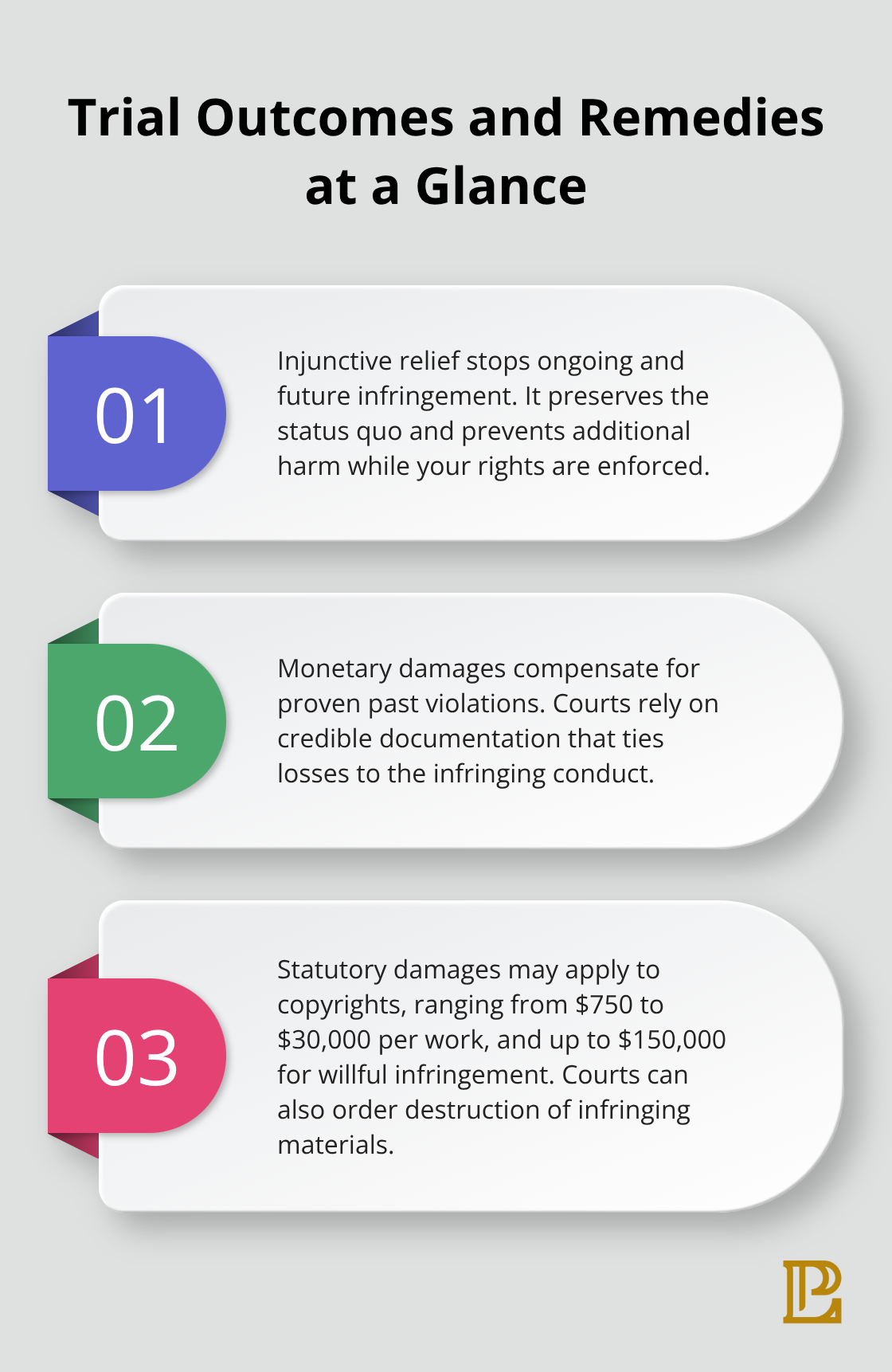
If litigation reaches trial, outcomes include injunctive relief preventing future infringement, monetary damages for past violations, statutory damages for copyright infringement ranging from $750 to $30,000 per work infringed (or up to $150,000 for willful infringement according to the United States Copyright Office), and court orders to destroy infringing materials. The specific remedies available depend on which IP category applies and whether you registered your rights before infringement occurred. Acting quickly through litigation or settlement prevents the defendant from profiting further and signals to competitors that you defend your IP aggressively.
Final Thoughts
Intellectual property infringement spreads quickly once it begins, and every day you delay responding costs you revenue, market share, and brand credibility. The moment you identify infringement, your response determines whether you stop the violation in weeks or watch it compound for months. Collecting evidence immediately, sending a cease-and-desist letter, and evaluating your legal options positions you to act decisively rather than react defensively.
Most infringement cases settle before trial when both parties understand the strength of your documentation and the financial risks of continued litigation. Your intellectual property distinguishes your business from competitors and represents genuine value that deserves protection. Whether you own patents, trademarks, copyrights, or trade secrets, the enforcement path depends on identifying the correct IP category and gathering solid evidence of how someone violated your rights.
At Pierview Law, we help Hermosa Beach business owners respond to intellectual property infringement with speed and precision. Our civil litigation team prepares pleadings, manages discovery, and represents you at trial or through alternative resolution forums. Contact Pierview Law to discuss your infringement situation and learn how we protect what you’ve built.