
California cross-border transactions involve layers of state and federal rules that trip up many business owners. Getting compliance wrong can cost you thousands in penalties and delays.
At Pierview Law, we help Hermosa Beach business owners handle these deals correctly from the start. This guide walks you through the regulations, tax obligations, and documentation you need to succeed.
What Rules Actually Apply to Your Multi-State Deal
Federal and State Law Layers in Cross-Border Transactions
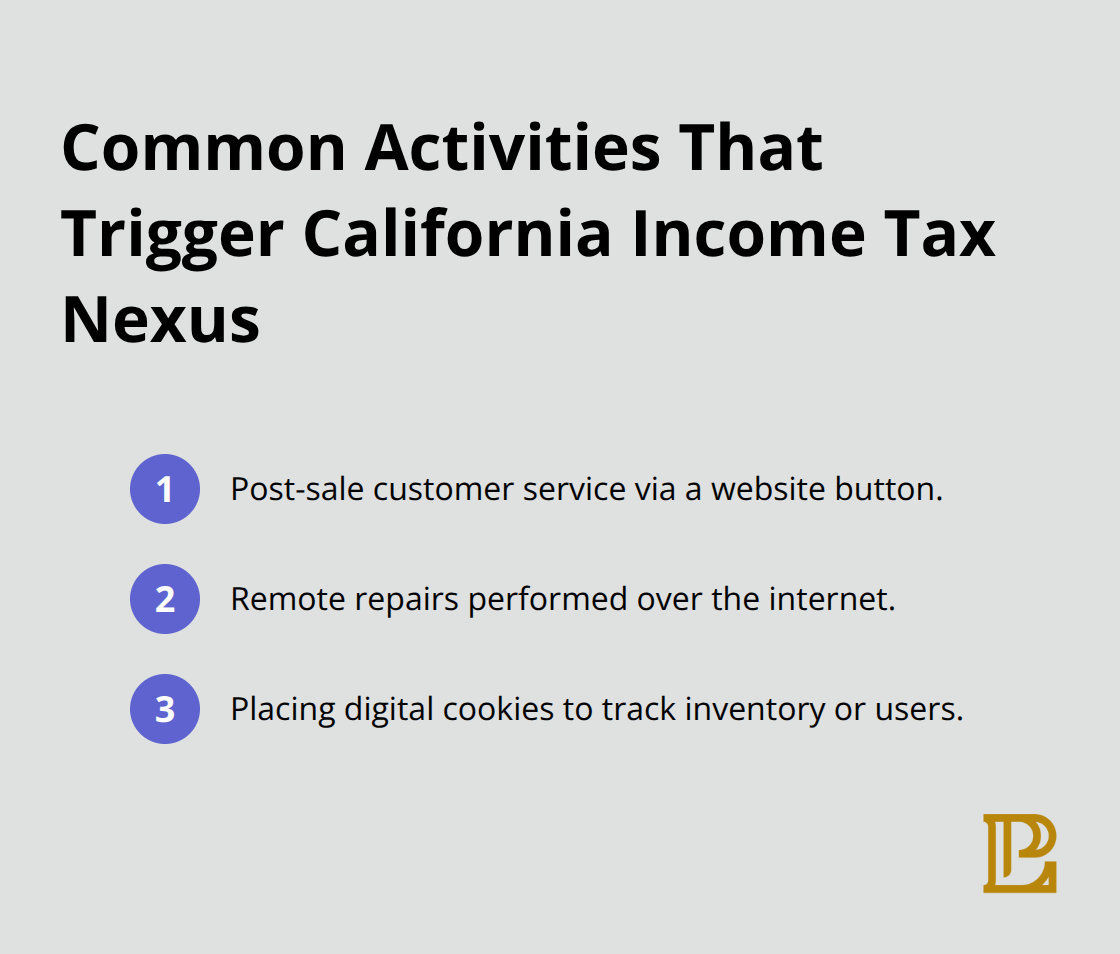
Hermosa Beach business owners often assume that handling a cross-border transaction means following California law plus the law of one other state. That assumption costs money. The reality is messier. Your deal touches federal law, state nexus thresholds, licensing requirements that vary wildly by jurisdiction, and tax rules that shift based on the nature of your business activity. If you sell tangible goods across state lines, Public Law 86-272 may protect you from California income tax-but only if your in-state activity stays limited to solicitation. The moment you add post-sale customer service through a website button, remote repairs over the internet, or even place digital cookies on customer devices to track inventory, you trigger California income tax nexus. The California Franchise Tax Board issued Technical Advice Memorandum 2022-01 asserting exactly this position, signaling how aggressively the state now interprets what counts as doing business in California.
Nexus Thresholds and Annual Changes
For 2025, California’s nexus thresholds sit at $757,070 in sales, $75,707 in property, or $75,707 in payroll-but these numbers climb annually. Missing even one threshold by a few thousand dollars flips your compliance status overnight. Federal standards layer on top of state rules. If you operate across multiple states, you owe apportionment calculations under state rules, file different entity forms in each jurisdiction, and comply with varying licensing boards. A business licensed to operate in Arizona does not automatically gain the right to operate in Nevada or Oregon-each state maintains separate professional licensing requirements, bonding rules, and registration deadlines. Many owners discover this only after they start operations and face penalties for unlicensed activity.
State-Specific Deed Forms and Transfer Taxes
The most expensive mistakes happen when owners treat multi-state deals as simple document exchanges. State-specific regulations hide in plain sight. Some states require specific deed forms-California uses a Grant Deed, Arizona uses a Beneficiary or Warranty Deed, Nevada uses a Grant or Bargain and Sale Deed-and submitting the wrong form causes recording failures or title problems that surface months later during a sale or refinance. Other states impose transfer taxes or conveyance taxes that California does not charge, shifting deal economics unexpectedly. Washington has a real estate excise tax; Hawaii imposes a conveyance tax; Oregon applies its estate tax rules to certain transfers. Without advance planning, you absorb these costs without negotiating who pays.
Jurisdiction, Venue, and Dispute Resolution
Jurisdiction and venue clauses matter more than most realize. If your contract specifies California courts as the forum for disputes but the other party is incorporated in Texas and the underlying transaction involves Nevada real estate, you create a jurisdictional nightmare that costs tens of thousands to litigate. Structuring your agreement to account for where parties operate, where assets sit, and which state’s courts can actually enforce a judgment prevents costly disputes later.
Entity Ownership and Multi-State Tax Obligations
The worst pitfall is operating without understanding whether your business structure itself triggers multi-state tax obligations. If you own a partnership, LLC taxed as a partnership, or an S corporation doing business in California, your distributive share of that entity’s California property, payroll, and sales count toward your personal nexus thresholds. Many owners miss this because they focus only on direct business activity and ignore their ownership stake in other entities. This gap in understanding creates unexpected tax filings and exposure that could have been prevented with proper structuring from the start. Once you understand which rules apply to your cross-border M&A transaction type and confirm your licensing status in each jurisdiction, the next step involves mapping out the tax implications and financial structure that will protect your deal.
Tax Obligations in Cross-Border Deals
How California Taxes Your Multi-State Income
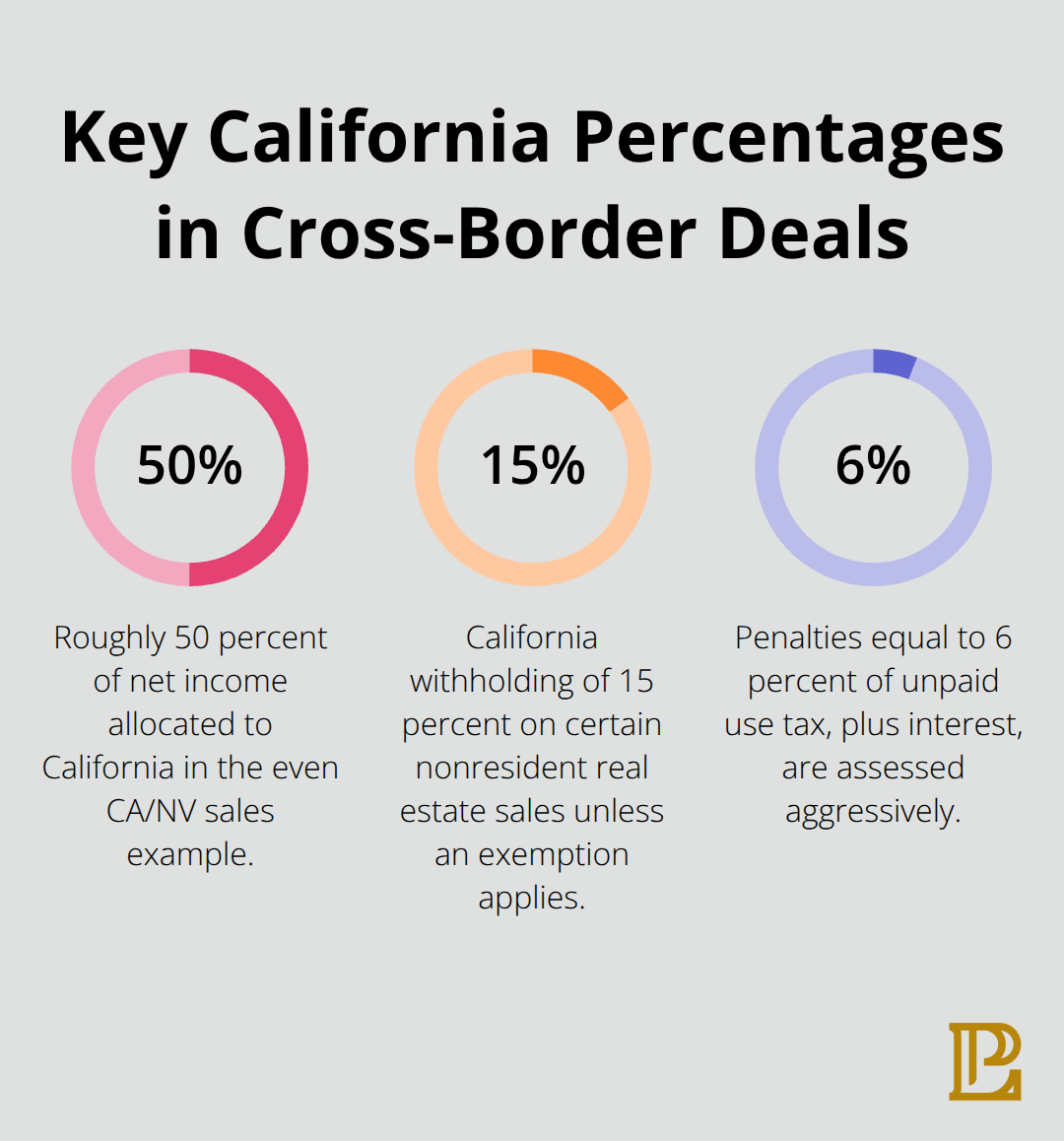
California taxes your income based on where you conduct business, not just where you incorporate. If you have sales, property, or payroll in California that exceed 2025 thresholds of $757,070, $75,707, and $75,707 respectively, you owe California franchise tax on your net income. The state’s Franchise Tax Board applies apportionment formulas that allocate your total income based on the percentage of your sales, property, and payroll located in California. For a business with $5 million in total sales split evenly across California and Nevada, roughly 50 percent of your net income gets allocated to California taxation. This matters because California’s top marginal rate reaches 13.3 percent while Nevada imposes zero state income tax. A poorly structured deal leaves thousands on the table annually.
Entity Ownership and Hidden Nexus Exposure
The real damage occurs when you fail to recognize that your ownership interest in partnerships, LLCs, or S corporations conducting business in California counts toward your personal nexus thresholds. If you own 25 percent of an LLC generating $3 million in California sales, that LLC’s sales activity pushes your combined threshold exposure upward, potentially triggering a California filing obligation you did not anticipate. Many Hermosa Beach business owners discover this only when the Franchise Tax Board issues a residency inquiry or audit notice.
Sales Tax, Use Tax, and Remote Seller Obligations
Sales tax and use tax create a second layer of compliance that catches owners off guard. If you ship products into California or sell digitally to California customers, you owe sales tax on those transactions regardless of where you incorporate. The threshold for collecting California sales tax now applies to remote sellers with more than $600,000 in annual sales or 200 transactions into the state, following the Wayfair standard. Use tax applies when you purchase tangible goods out of state for use in California without paying sales tax at purchase. A business that buys equipment in Nevada for use at a California office owes California use tax on that equipment. The state audits this aggressively, and penalties run six percent of unpaid tax plus interest.
Structuring Ownership to Minimize Tax Exposure
To minimize tax exposure on cross-border deals, structure ownership to separate high-tax-rate income from low-tax-rate jurisdictions. A California business owner with rental property in Nevada should consider holding that property through a Nevada LLC rather than direct ownership, preserving Nevada’s zero income tax treatment while maintaining liability protection. Transfer pricing between related entities across state lines requires documentation showing the pricing reflects arm’s-length economics. If your California corporation charges its Nevada subsidiary an inflated management fee to shift profits out of state, the Franchise Tax Board will push back and reallocate income. The safer approach involves pricing intercompany transactions at rates you could defend to an auditor, supported by comparable market data.
Real Estate Transfers and Multi-State Tax Consequences
Real estate transfers between states trigger different tax consequences depending on structure and timing. A sale of appreciated California real estate by a nonresident triggers California’s fifteen percent withholding on the sale proceeds unless the seller qualifies for an exemption. Placing property into a revocable living trust before sale does not avoid withholding, but structuring the transaction through a properly formed entity can reduce exposure. Each state also maintains different rules on depreciation recapture, stepped-up basis treatment, and entity-level taxation that shift deal economics substantially. Once you map your tax obligations across jurisdictions and structure your entities accordingly, the documentation you prepare for the transaction itself becomes the next critical layer-contracts and agreements must account for the multi-state legal landscape you now understand.
Multi-State Contracts and Documentation
Contracts written for single-state transactions collapse under the weight of multi-state complexity. Most business owners use templates downloaded from the internet or copied from past deals, then assume those agreements work everywhere. They do not. A contract that works perfectly in California may be unenforceable in Nevada or Arizona because it violates public policy, contains venue provisions that courts in those states refuse to honor, or uses legal language that conflicts with how those jurisdictions interpret commercial agreements. The cost of discovering this problem during a dispute runs into six figures.
Selecting Governing Law and Venue
Your agreement must account for which state’s law governs the transaction, which courts have authority to hear disputes, how disputes get resolved before litigation starts, and what happens if one party refuses to cooperate. California courts will enforce a contract that says Nevada law applies and disputes go to Nevada courts, but that means you travel to Nevada to litigate, hire Nevada counsel, and follow Nevada procedural rules. The alternative is drafting a choice-of-law clause that selects California law and a venue clause that keeps disputes in Los Angeles County Superior Court, but only if all parties accept that arrangement.
Selecting governing law is not about choosing your home state. It is about choosing the jurisdiction with the clearest, most predictable legal framework for your specific transaction type. If you are selling a business with substantial intellectual property, California has robust statutes and case law addressing IP assignment, non-compete enforceability, and trade secret protection. If you are buying commercial real estate in Arizona, Arizona law may provide clearer guidance on title defects and remedies than California law would. Pick the state law that gives your transaction the most certainty and protects your interests most directly. Then draft your venue clause to match.
Do not create mismatches where your contract says California law applies but disputes go to Texas courts. Texas courts may refuse to apply California law to a dispute they have no connection to, or they may apply their own law instead, leaving you with an unenforceable judgment. The goal is internal consistency that courts in the selected jurisdiction will actually enforce. Many out-of-state counterparties resist California jurisdiction because they view it as expensive and inconvenient. Negotiate this upfront, when both sides want the deal to close. Fighting about jurisdiction after a dispute arises costs everything.
Building Dispute Resolution Into Your Contract
Litigation over multi-state transactions destroys deal economics faster than almost any other problem. A $500,000 dispute costs $100,000 to litigate to judgment in a single state. Litigating the same dispute across multiple states because parties disagree about jurisdiction can double or triple legal fees. Build a dispute resolution pathway into your contract that requires mediation or arbitration before anyone files a lawsuit.
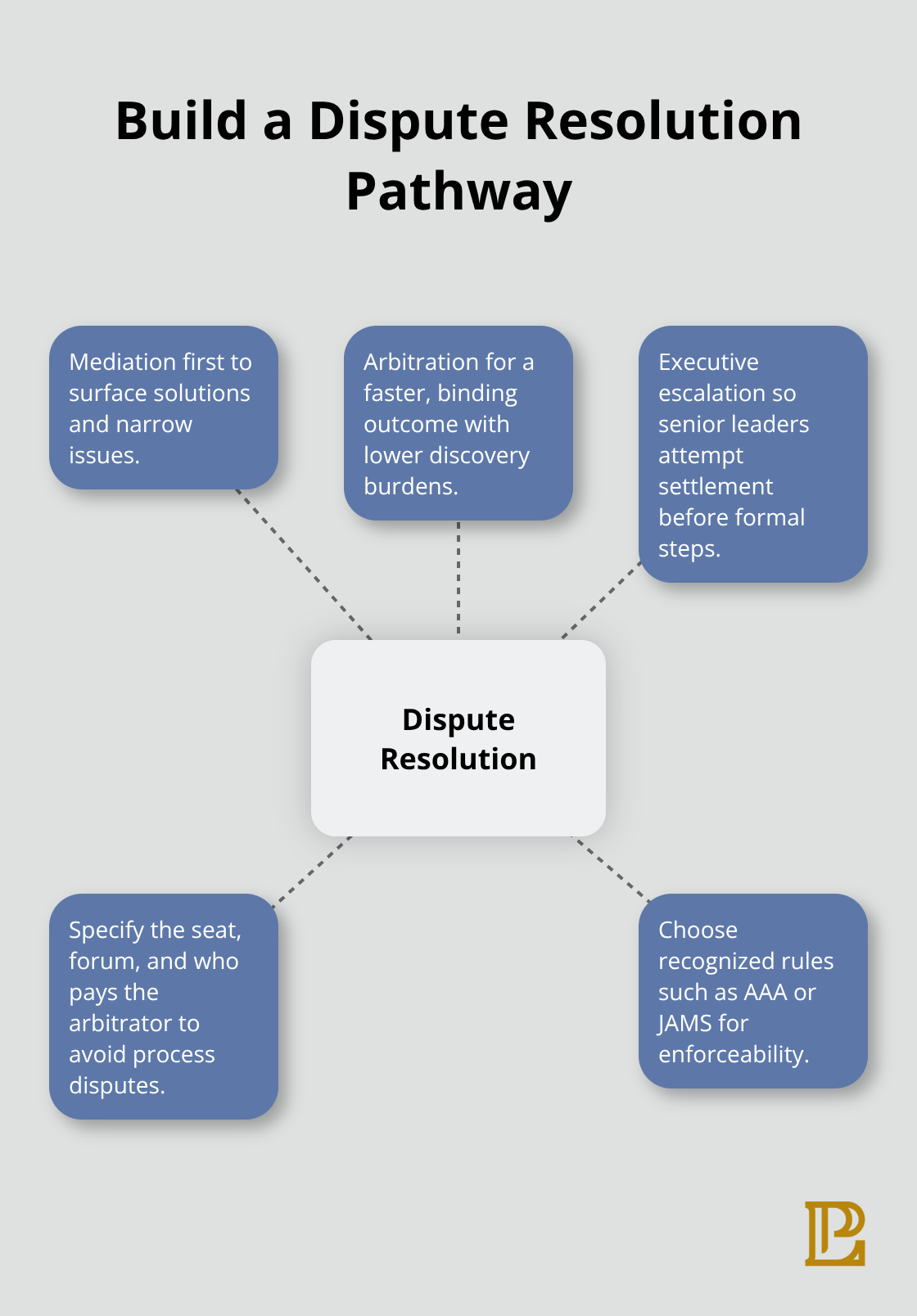
Mediation forces both parties to explain their position to a neutral third party and often surfaces creative solutions neither side considered. Arbitration gets you a binding decision faster than court litigation, with less discovery burden and lower costs. If your contract involves real estate or asset transfers, include an escalation clause that requires senior executives from both companies to meet and attempt resolution before lower-level disputes trigger formal processes. Many disputes settle at this stage because senior leaders have authority to make business decisions that junior employees cannot.
Specify in your contract whether arbitration happens in California or the other state involved, who pays the arbitrator, and which arbitration rules apply. The American Arbitration Association and JAMS both maintain established rules that courts recognize. Leaving these details vague creates new disputes about the dispute resolution process itself.
Handling Real Estate Disputes Across State Lines
Consider whether your transaction involves property in multiple states. If you are buying real estate in California and Nevada simultaneously as part of one deal, your dispute resolution clause should account for the possibility that real estate disputes in each state might need to go to that state’s courts because courts generally refuse to hear disputes about property located outside their jurisdiction. A single arbitration clause works for contract disputes but may not work for title disputes or specific performance claims related to real estate. Draft accordingly to address both contract-level conflicts and property-specific issues that arise when assets sit in different jurisdictions.
Final Thoughts
California cross-border transactions succeed when you handle compliance systematically from day one. The rules follow predictable patterns once you understand which thresholds apply to your business, which tax obligations follow your income across state lines, and how to structure contracts that courts in multiple jurisdictions will actually enforce. Missing any of these elements costs thousands in penalties, unexpected tax bills, or unenforceable agreements that leave you without recourse when problems surface.
Do not assume that handling one state’s requirements means you have handled them all. California’s nexus thresholds change annually and trigger new filing obligations without warning. Your entity structure determines whether you owe taxes in multiple states simultaneously, and your contract language determines whether you can enforce your rights if disputes arise. The cost of reviewing your transaction structure, confirming your licensing status in each jurisdiction, and drafting compliant contracts is a fraction of what you will spend fixing problems after the deal closes.
We at Pierview Law help Hermosa Beach business owners navigate California cross-border transactions with confidence. Our team reviews your entity structure, handles multi-state contract drafting, and protects your interests across state lines through proper structuring and documentation. Contact us to discuss your transaction and move forward with the guidance you need.