
Acquisition integration planning determines whether your business combination succeeds or stumbles. Most companies underestimate the complexity of merging two organizations with different systems, cultures, and workflows.
At Pierview Law, we’ve seen acquisitions fail because teams weren’t aligned and technology systems couldn’t communicate. This guide walks you through the practical steps to avoid those pitfalls and build a stronger combined organization.
What Goes Wrong When Acquisitions Fail to Integrate
Culture clashes, broken systems, and departing talent destroy acquisitions faster than poor financial planning. Deloitte research shows that up to 90% of mergers and acquisitions fail, with integration challenges-not deal structure-driving most of those failures. The root cause typically falls into one of three categories: teams operating under conflicting values, technology systems that cannot exchange data, or key employees walking out the door.

These aren’t theoretical risks. They’re what happens when integration planning happens too late or not at all.
Culture and Values Create Decision Paralysis
Your two organizations likely have different ways of making decisions, rewarding performance, and defining success. One company might prioritize speed while the other demands consensus. One might reward individual achievement while the other emphasizes teamwork. These differences sound soft until your finance team and operations team deadlock on budget allocation, or your sales team ignores the compliance standards the acquired company fought to maintain. The AT&T acquisition of Time Warner illustrates this danger-cultural misalignment contributed significantly to the deal’s failure and eventual unwinding.
The solution isn’t forcing everyone into one culture overnight. Instead, identify the specific decision-making norms and leadership styles that matter most for your combined business within the first 30 days. If the acquired company’s team moves faster on customer decisions while your team emphasizes risk mitigation, decide now which approach you’ll use going forward. Document this decision and communicate it to both organizations. Vague promises to respect both cultures accomplish nothing.
Technology Systems That Don’t Talk to Each Other
Incompatible systems create operational chaos and hidden costs. If one company runs payroll on one platform and the other uses a different system, you cannot generate accurate consolidated financial statements. If your CRM doesn’t connect to the accounting system, invoicing breaks and revenue recognition becomes a guessing game.
The integration timeline should include a detailed IT and operational audit completed within the first 60 days that maps every critical system-ERP, HRIS, CRM, accounting, project management-and identifies which ones must be unified immediately versus which ones can run in parallel. Prioritize the systems that touch customer operations and financial reporting. Everything else is secondary. Plan for data migration to require 4-6 weeks longer than your vendors promise. Budget for temporary manual workarounds during the transition. Most companies discover system incompatibilities during integration that should have been identified during due diligence, costing an average of 15-20% more in integration expenses than budgeted.
Talent Loss Happens Faster Than You Expect
Key employees leave when they feel uncertain about their future in the combined organization. Announce your retention strategy for critical roles within two weeks of close. Identify the 20-30 people whose departure would damage operations or customer relationships, and communicate their role and compensation in the combined organization before rumors start.
If you cannot retain someone, tell them directly rather than letting them guess. Transparent, honest communication about job eliminations is less damaging than silence followed by layoff announcements. Offer severance packages that reflect the person’s tenure and role, not just legal minimums. A departing director who trained five team members takes institutional knowledge that takes months to rebuild. The next section walks you through the strategic planning steps that prevent these three failures from derailing your acquisition.
Building Your Integration Timeline and Governance
Map Every Critical Milestone in Your First 100 Days
The first 100 days after closing determine whether your acquisition succeeds or derails. This period is not about perfection-it’s about establishing the operational and decision-making structures that keep both organizations functioning while you integrate systems and align teams. Create a single document that maps every critical milestone, owner, and deadline for the next 100 days. This timeline identifies which decisions must happen in week one, which systems need auditing by day 60, and which talent conversations require completion by day 30.

Without this timeline, integration becomes reactive firefighting instead of intentional strategy.
The Hermosa Strand and Pier acquisition, which sold for $33.5 million, required successful integration across retail and short-term rental components through a single property management and leasing platform with clear ownership of each data stream. That same principle applies to your combined organization-one person accountable for the overall integration rhythm prevents teams from working in isolation.
Assign Clear Ownership and Decision Authority
Appoint one person as the integration lead with authority to make decisions and resolve conflicts across departments. This person reports directly to the CEO and owns the master integration schedule.
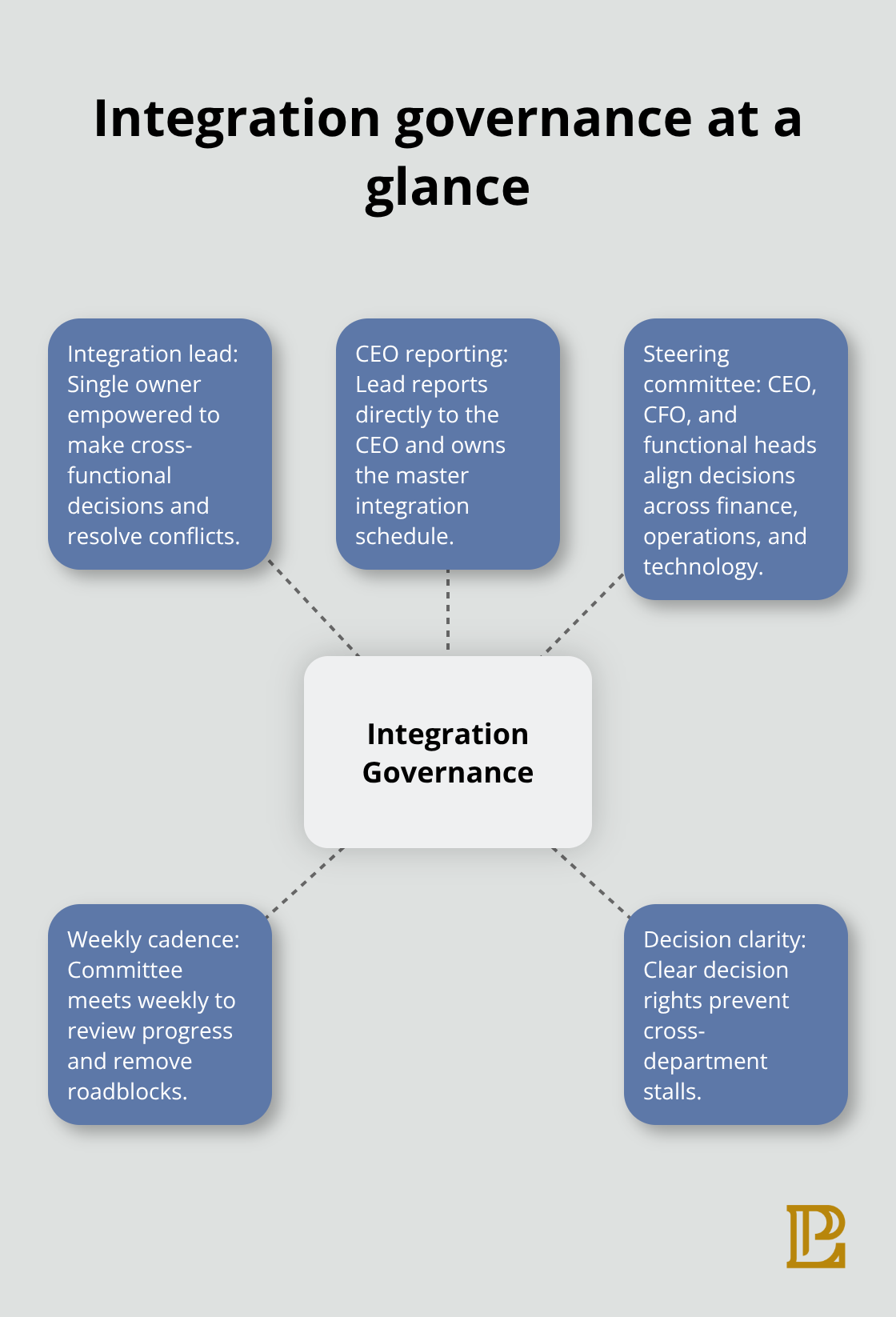
Your governance structure must clarify who decides what during integration. Create a steering committee with the CEO, CFO, and the heads of your three most critical functions-typically finance, operations, and technology. This committee meets weekly to review integration progress, remove roadblocks, and make decisions that affect multiple departments.
Below the steering committee, establish working groups for each major functional area: finance and accounting, technology and systems, sales and marketing, HR and talent, and operations. Each working group leader delivers integration milestones in their area and escalates conflicts to the steering committee. The working group leader also owns communication to their functional teams about integration changes and timelines.
Create Real-Time Visibility Into Integration Progress
Establish clear communication channels that prevent information from getting lost between departments. Weekly emails from integration leads are insufficient-create a shared dashboard that shows real-time progress against the 100-day plan, with red, yellow, and green status indicators for each major workstream. Every employee should know which integration initiatives affect their role and when those changes take effect. Vague communication about integration creates anxiety and rumor. Specific, frequent updates about what’s changing and when reduce uncertainty and help people adapt faster.
Address Employee Concerns Head-On in Week One
Within the first two weeks, hold all-hands meetings in both organizations to explain the integration strategy, introduce the integration leadership team, and outline the first 30 days of actions. Answer the question everyone is asking: What does this acquisition mean for my job? If you don’t address that directly, departing talent will make their own assumptions and start looking elsewhere. Transparent communication about roles, compensation, and job security prevents the talent exodus that derails most acquisitions. The next section walks you through the specific operational and technology decisions that must happen during these critical first 100 days.
How to Audit Systems and Align Operations After Close
Your combined organization cannot function on spreadsheets and manual handoffs. Within 60 days of closing, you need a complete map of every system that touches customer operations, financial reporting, or employee management. Start by listing every software platform currently in use across both organizations-ERP systems, accounting software, CRM platforms, HRIS systems, project management tools, and industry-specific applications. Then identify which systems are business-critical, meaning their failure disrupts customer service or financial reporting within hours. These systems get priority in your integration plan. Secondary systems can run in parallel longer, but they still need consolidation within 180 days. Many acquirers discover during integration that the target company uses outdated systems with limited integration capabilities-information that should have emerged during due diligence but often doesn’t because IT teams aren’t involved early enough in the acquisition process.
Map Your Current Technology Landscape
The audit must answer three specific questions: Which systems can integrate through APIs or standard connectors? Which systems require data migration and manual configuration? Which systems are so incompatible that replacement costs less than integration? Assign one person from your IT department and one from the target company’s IT team to complete this audit within 30 days. They should document the current data flows between systems, identify where manual workarounds exist today, and flag systems that will break when you consolidate operations. Plan for data migration to take 40-50% longer than your software vendors estimate. Budget for temporary manual processes during cutover-even well-planned migrations create a 2-4 week period where some transactions process outside your integrated systems. One commercial real estate transaction required consolidating three separate property management platforms into a unified system that tracked leases, renovations, rent rolls, and tenant communications across multiple property types. That consolidation took eight weeks instead of the planned five weeks, but the decision to prioritize it prevented ongoing operational confusion and data silos.
Standardize Processes Before System Implementation
Process standardization must happen before system implementation. If you implement the target company’s accounting software without first deciding whether both organizations will use the same chart of accounts, cost allocation methodology, and month-end close procedures, you’ll spend months rebuilding the system after cutover. Create a process standardization document for each major function-finance, operations, sales, HR-that specifies how you’ll handle routine decisions going forward. Will you use the acquirer’s approval workflows or the target’s? Will you maintain separate cost centers or consolidate them? Will you keep both company customer databases separate or merge them immediately? Document these decisions in writing and get sign-off from both the CFO and the target company’s finance leader. Then use these standardized processes as the blueprint for system configuration. The integration lead should own a master checklist that tracks process standardization completion for each function, with red status until the standardization document receives final approval.
Deploy Integration Tools for Real-Time Visibility
Your integration team needs one central system where all stakeholders can see current status, outstanding tasks, and upcoming milestones. Project management tools like Asana, Monday.com, or Smartsheet allow you to track integration workstreams in real-time, assign owners to specific tasks, and flag delays before they cascade into other areas. Do not use email threads or shared drives to manage integration-those approaches guarantee that critical information gets lost and duplicate work happens. Set up your integration dashboard to show progress by functional area, with weekly updates from each working group leader. Color-code status by severity: green means on track, yellow means at risk but recoverable, red means delayed and affecting other workstreams. The steering committee reviews this dashboard weekly and removes roadblocks immediately. Integration leads should have access to underlying task lists so they can drill down from high-level status to specific blockers. This transparency prevents surprises and keeps momentum moving through the critical first 100 days.
Final Thoughts
Acquisition integration planning succeeds when you treat it as a business operation, not an afterthought. The companies that emerge stronger from acquisitions establish clear ownership and decision authority from day one, audit systems and processes before attempting to merge them, and communicate transparently with employees about what’s changing and why. These practices prevent the culture clashes, system failures, and talent departures that derail most acquisitions.
Once your teams operate under shared decision-making norms, your systems exchange data reliably, and your key employees understand their role in the combined organization, you unlock the financial and operational benefits that justified the acquisition in the first place. Companies that integrate successfully report 15-25% faster revenue growth in the combined entity, lower customer churn, and higher employee retention. The Hermosa Strand and Pier acquisition achieved 88% occupancy post-integration by aligning retail leasing with short-term rental management through a unified property management platform.
If you’re navigating an acquisition in Hermosa Beach or Los Angeles County, Pierview Law provides the business law guidance you need to structure the deal and plan the integration. We handle entity formation, contract drafting, and the legal complexities that acquisitions create. Contact us to move forward with confidence.